
In the Age of AI, the Younger Students Asked | WE:CONNECT Scholar Networking Day
After Volun-Career, I mentored at WE:CONNECT, the Seoul Future Foundation's scholar networking day, on what new developers and PMs need in the age of AI.
Part 2 / 2
One post-it note on the insight board said this.
"Isn't Claude stronger for coding? GPT Codex is for office work."
We spent the whole evening talking about what new developers should prepare for in the age of AI, and someone summed it up as a comparison of tools. It isn't wrong. But what I wanted to say at that table was that whichever tool you use, the one who chooses the answer and takes responsibility for it is, in the end, a person.
Part 1: The Scholarship Student Who Became a Mentor | Seoul Future Foundation's Volun-Career
📍 Teamplace Hongdae (팀플레이스 홍대) · 12 World Cup-buk-ro 4-gil, Mapo-gu, Seoul, basement 1 (about a 5-minute walk from Hongik University Station, exit 1)
Friday evening, basement 1 in Hongdae
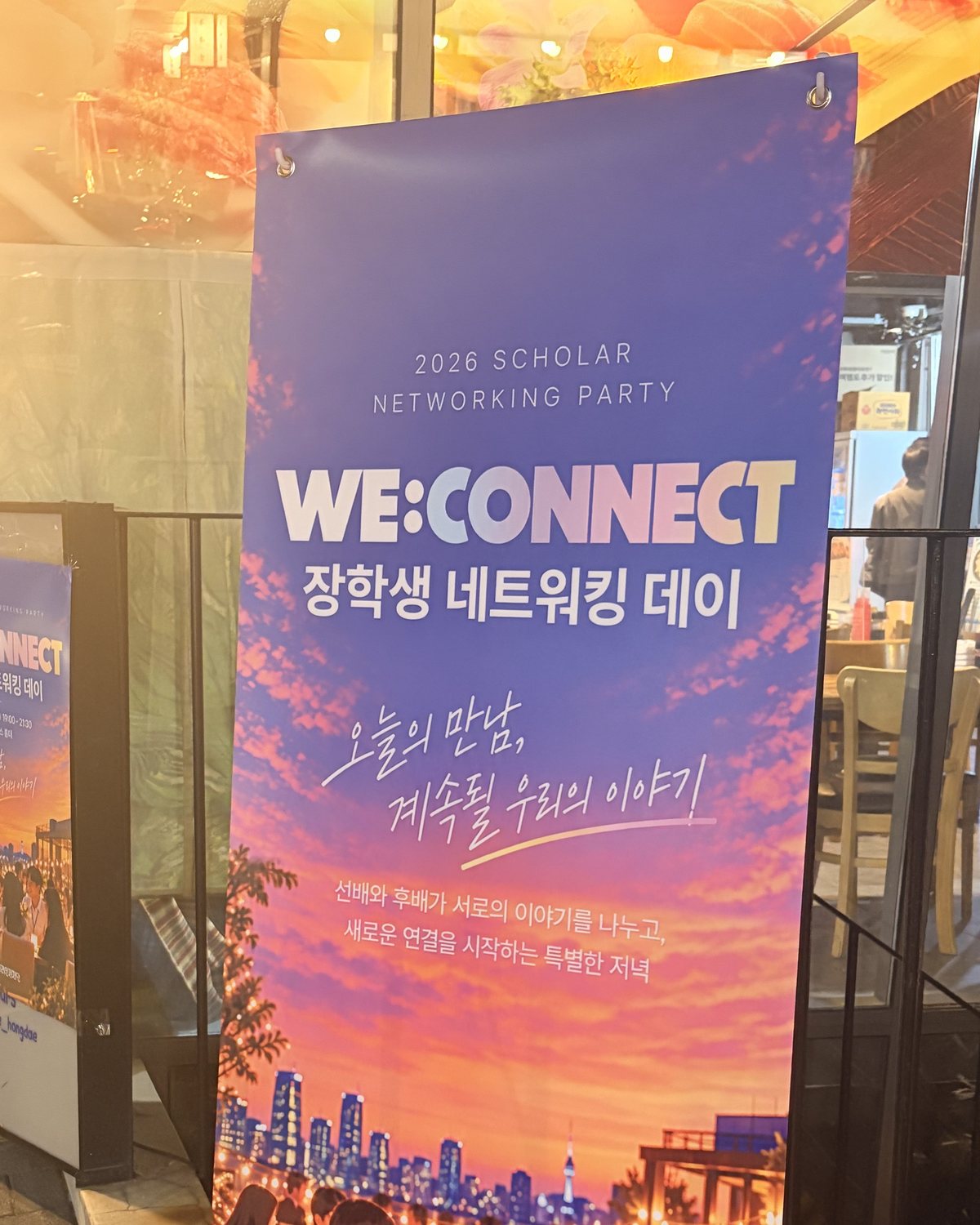
At 19:00 on Friday 6 November, the WE:CONNECT Scholar Networking Day was held at Teamplace Hongdae, near Hongik University Station. The host was the Seoul Future Foundation. It's where I received a scholarship at university, and in September it invited me to be a mentor in its alumni mentoring programme, Volun-Career.
As the name says, this was networking where alumni and current scholarship students met. Alumni working in many different fields and younger students thinking about their careers sat at separate tables and shared experiences and concerns.
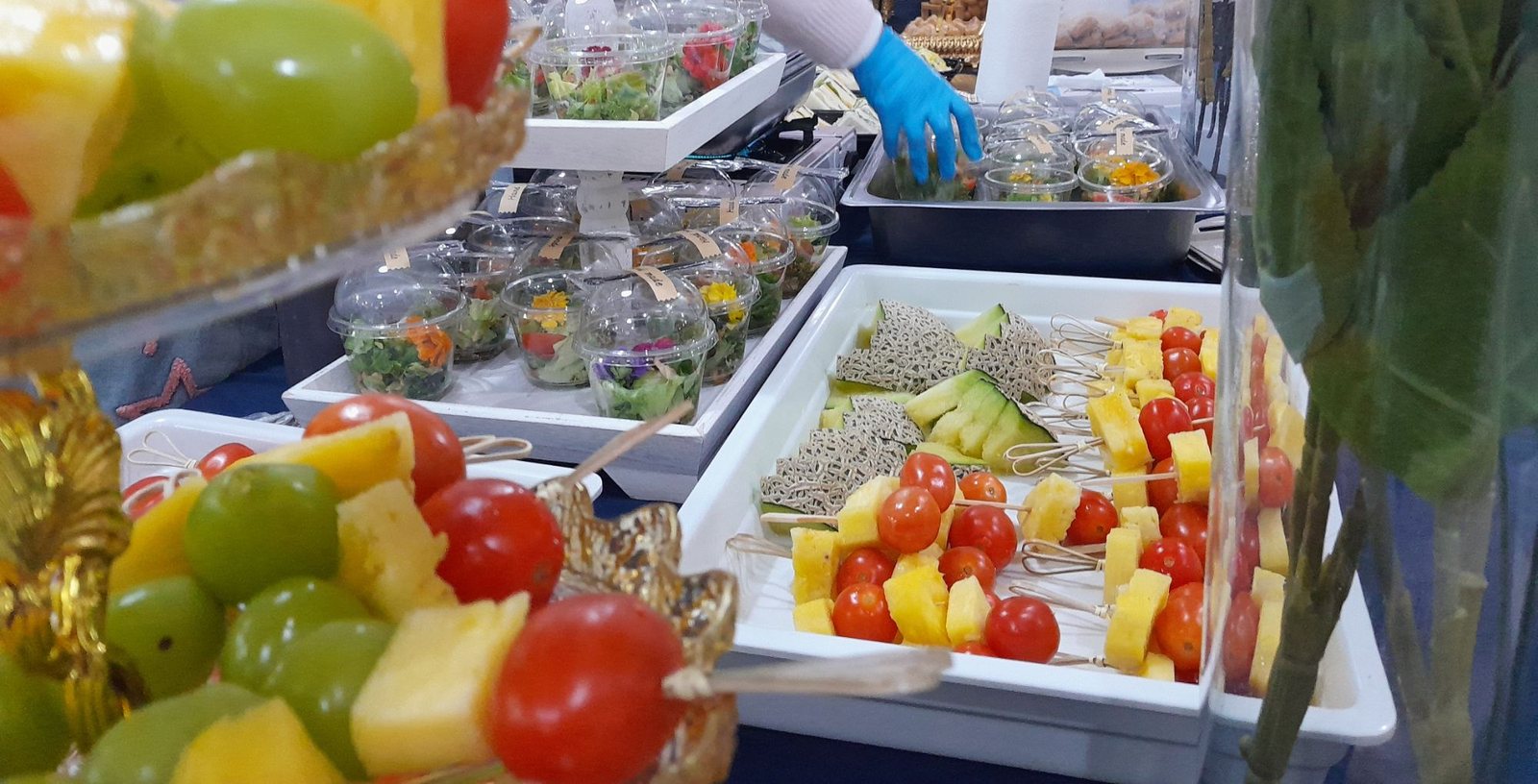
The event began with dinner.
One sentence in a time capsule
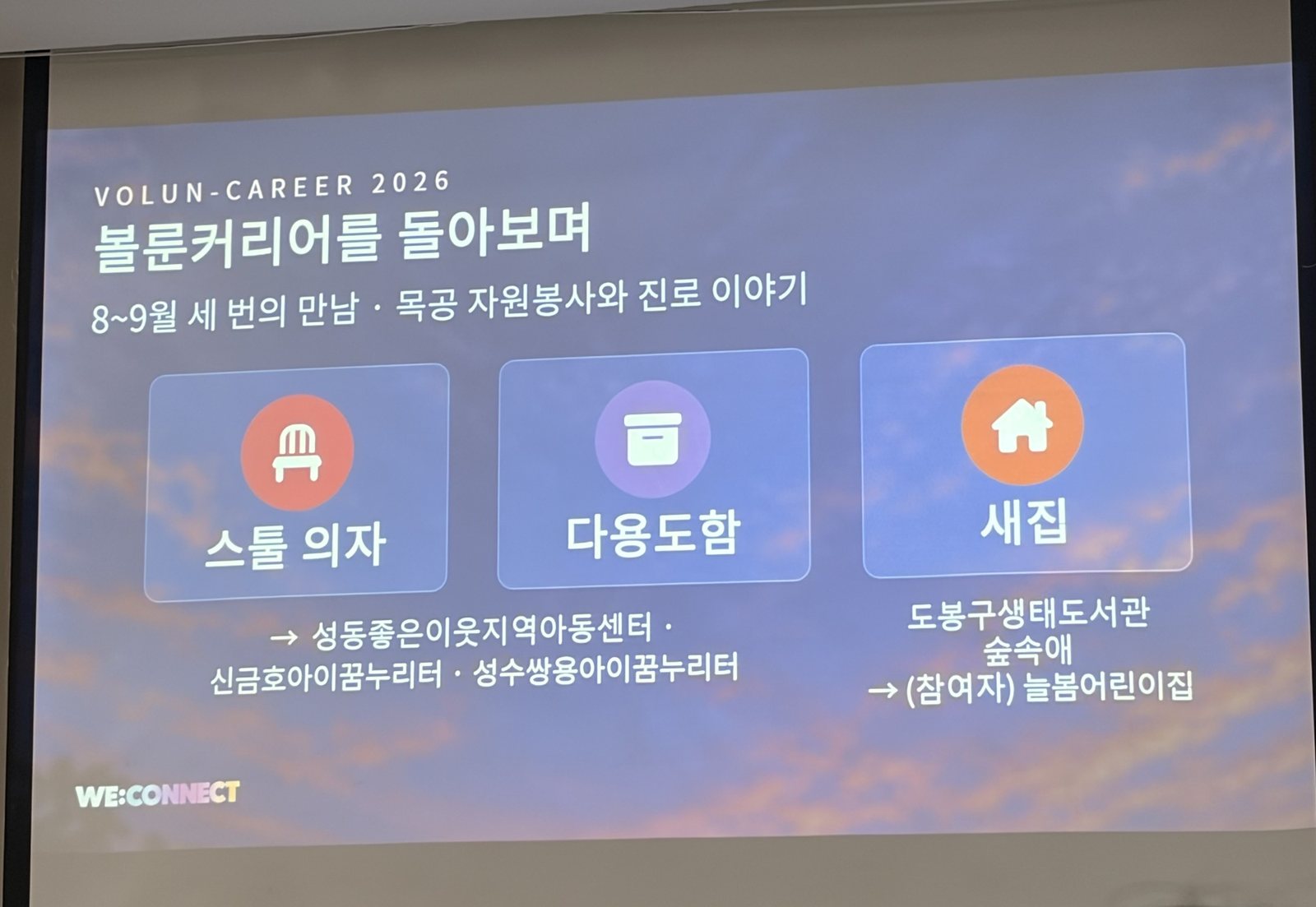
Before the main programme, "Looking back on Volun-Career" came up on the screen. It was a slide showing where the things we made over three Saturdays in August and September had gone.
- Stools · storage boxes: Seongdong Good Neighbours Community Children's Center (성동좋은이웃지역아동센터), Singeumho Aikkum Nuriteo (신금호아이꿈누리터), Seongsu Ssangyong Aikkum Nuriteo (성수쌍용아이꿈누리터)
- Birdhouses: the Dobong-gu Ecological Library "Supsokae" (도봉구생태도서관 숲속애), and, through a participant, Neulbom Daycare (늘봄어린이집)
In part 1 I wrote that you build a birdhouse for a bird that hasn't arrived yet. I still don't know about the bird, but now there's an address.
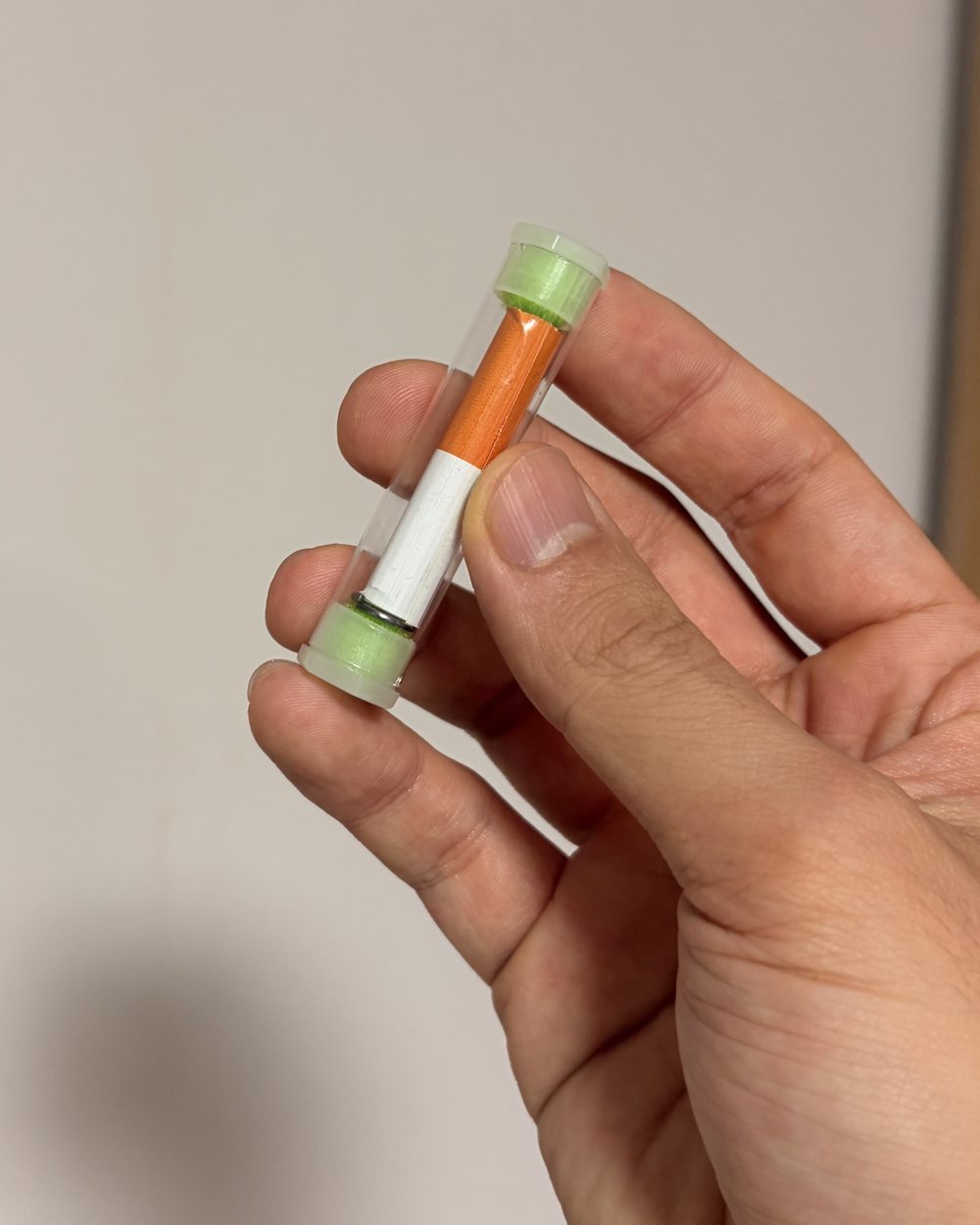
Next came "Opening again the sentence we left back then". During Volun-Career each of us had written a message and put it in a small time capsule; now, in November, we opened them again. Alumni mentors had written advice they wanted to pass on to the younger students, and the student mentees had written a sentence they wanted to remember and "a career question for myself in November". The capsules were handed back to the people who wrote them, who opened and read them, and then shared what they had thought then and what they think now.
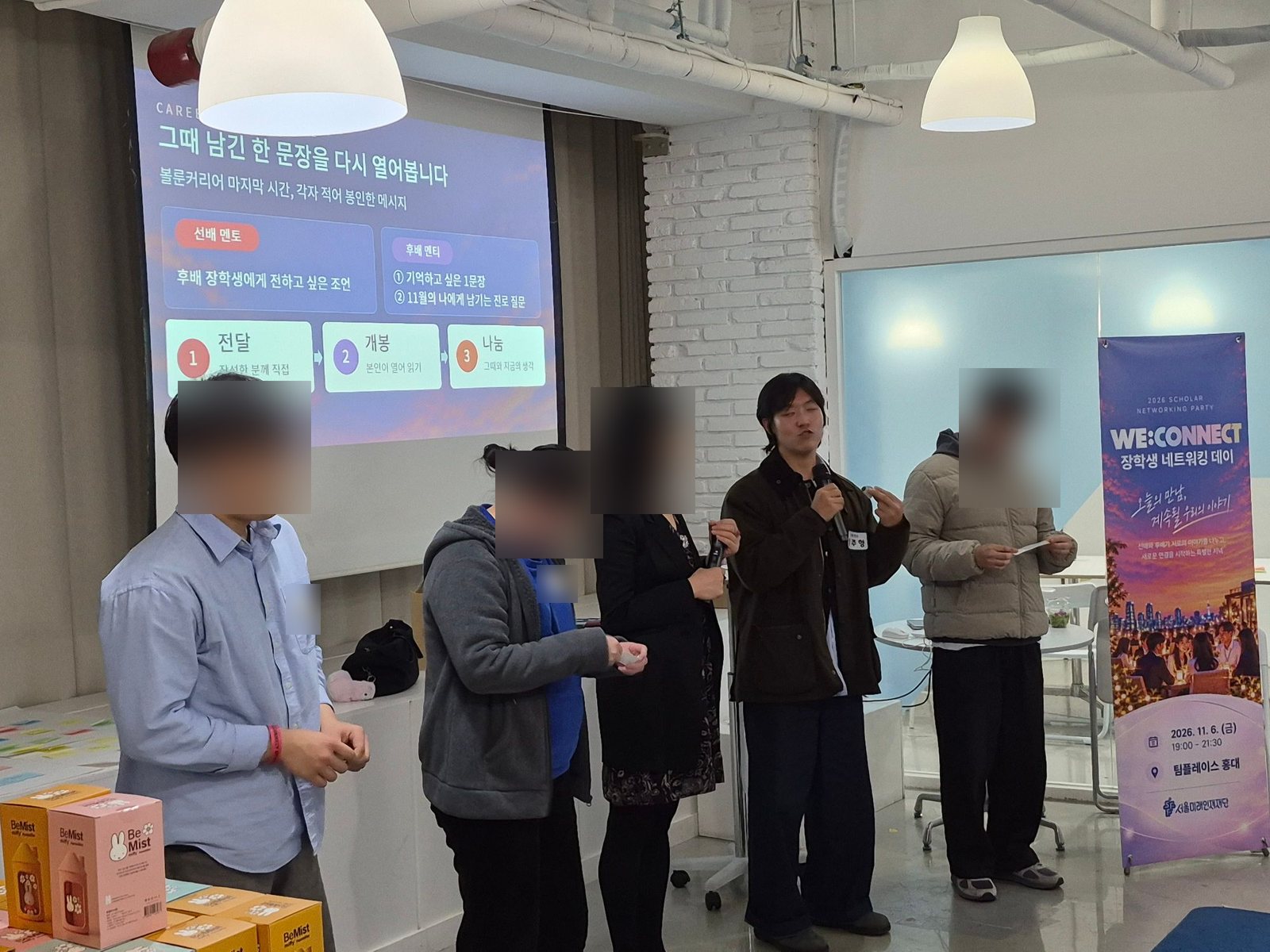
I went up too, took the microphone and read my note. I had written two things. One was well done for getting through university. The other was for the students I'd done Volun-Career with: let's build a SaaS together.
We had put a wooden birdhouse together, so the next thing we put together should be a service. And that line led straight into the first piece of advice I gave at table 1 that evening.
Table 1: IT, development and data
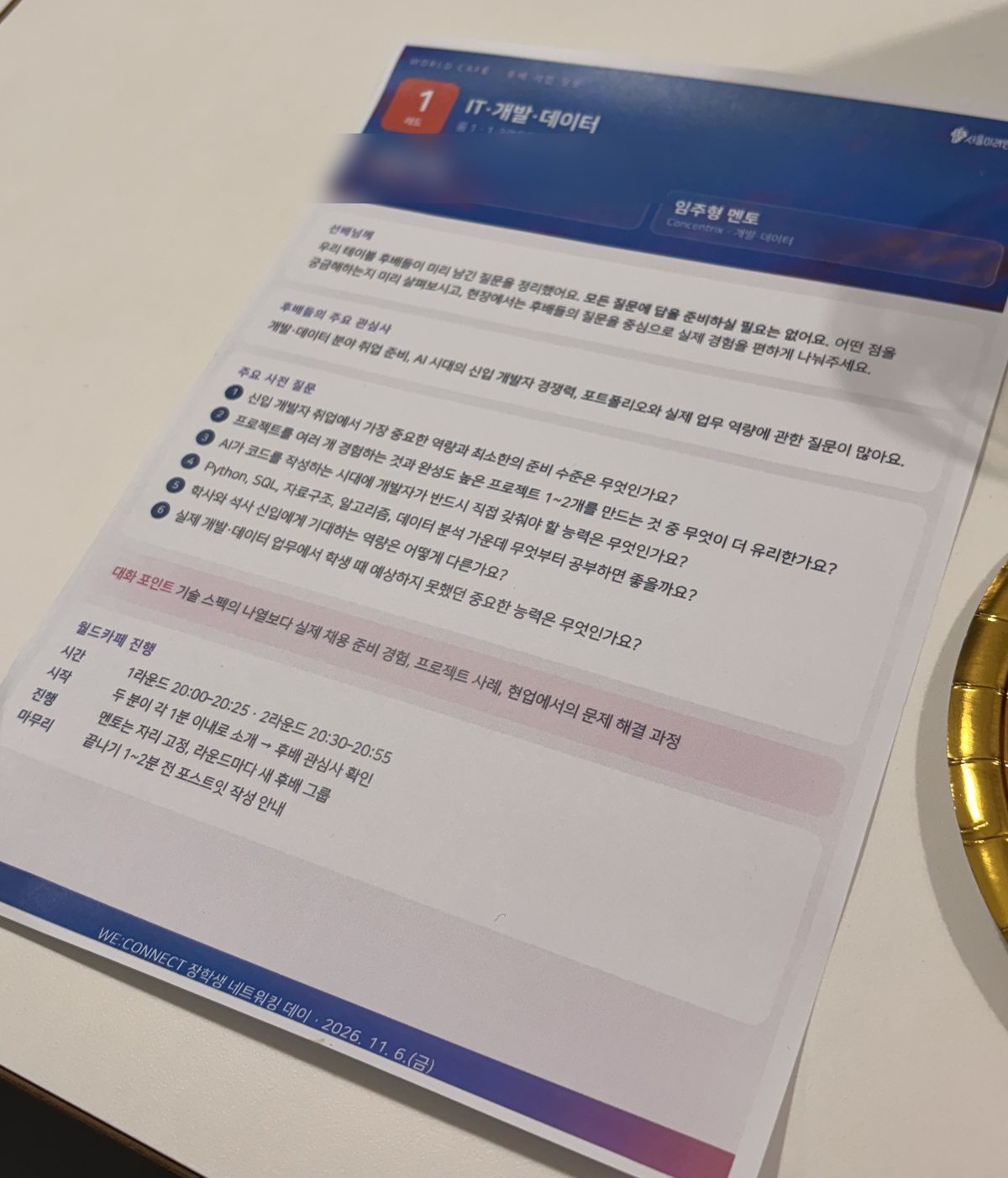
The main programme used the World Café format. Mentors stay put at their tables, and the students move between tables each round. Round 1 was 20:00–20:25, round 2 20:30–20:55. So I never had to get up. Every 25 minutes, new questions came to me on their own.
My seat was table 1: IT, development and data. On the table were the questions the students had sent in advance. Their interests came down to three: preparing for jobs in development and data, how new developers can stay competitive in the age of AI, and portfolios versus the skills real work needs.
A few of the advance questions were these.
- Which is better: doing lots of projects, or building one or two well-finished ones?
- When AI writes code, what abilities must a developer still have themselves?
- In real development and data work, what important ability didn't you expect when you were a student?
At university I also wondered which skills to prepare and which experiences would help in real work. So rather than how to land a job, I focused on what to prepare to stay competitive even when the environment changes.
It used to be that knowing a particular programming language or holding a technical certificate showed a fair amount of ability. Now, with generative AI, writing code, building a website or putting together a simple service has become much easier. I don't think AI will replace every developer's role. But as the barrier to entry for repetitive, standardised work has dropped, new developers and junior PMs have to prove their worth in a different way from before.
So I suggested three things.
One product rather than one certificate
What you've built yourself may come to matter more than what you've studied.
This is what I stressed most. It doesn't mean certificates or study are meaningless. But if you're spending the same time, I wanted to recommend the experience of turning your own idea into a real service.
It doesn't need to be grand. A small website that fixes something that bothered you in daily life, or a tool that automates some work, is enough. What matters is less the size of the result than the thinking and decisions inside it. You should be able to explain what problem you found, why this feature was needed, which technology you chose and what you learned while building it.
This goes double for students preparing to become PMs. If you go through the whole process of making a product yourself, from planning to development, testing and release, it helps a great deal when you talk with developers on real projects and need to understand technical decisions.
It's fine to build it with AI. But you need to understand and be able to explain what the AI made for you.
When AI produces the answer, people verify it
The second was critical thinking and the ability to verify.
AI gives answers remarkably fast, but they aren't always correct. Plausible code can have bugs, and an explanation that looks logical can hide a wrong premise. So from now on, the ability to judge whether an answer is right, and whether it suits the actual problem, will matter more than the ability to find an answer quickly.
A developer should be able to review the structure, security and performance of code the AI wrote. A PM should be able to judge whether a solution the AI proposes fits the real business requirements and user experience.
In the end, you need the fundamentals even to use AI well. However good the tools get, the final judgement and responsibility rest with people.
Languages and books: slightly unexpected advice
The last was learning languages and reading. At a development table, that may have sounded a little unexpected.
Working on projects in a global environment, what I've found is that being able to get my ideas across clearly and understand other points of view matters as much as technical skill. English and other foreign languages are less a qualification for working abroad than a tool that gives you access to wider information and opportunities.
Books are the same. I suggested reading across fields, not only technical books but also the humanities, philosophy, economics and psychology, to widen how you see the world. AI can summarise huge amounts of information quickly, but I believe the ability to decide which questions to ask and which problems matter is, in the end, built by thinking for yourself.
What the post-it notes held
A minute or two before the end, there was a step where everyone wrote one thing they'd discovered that day on a post-it note and stuck it on the insight board.
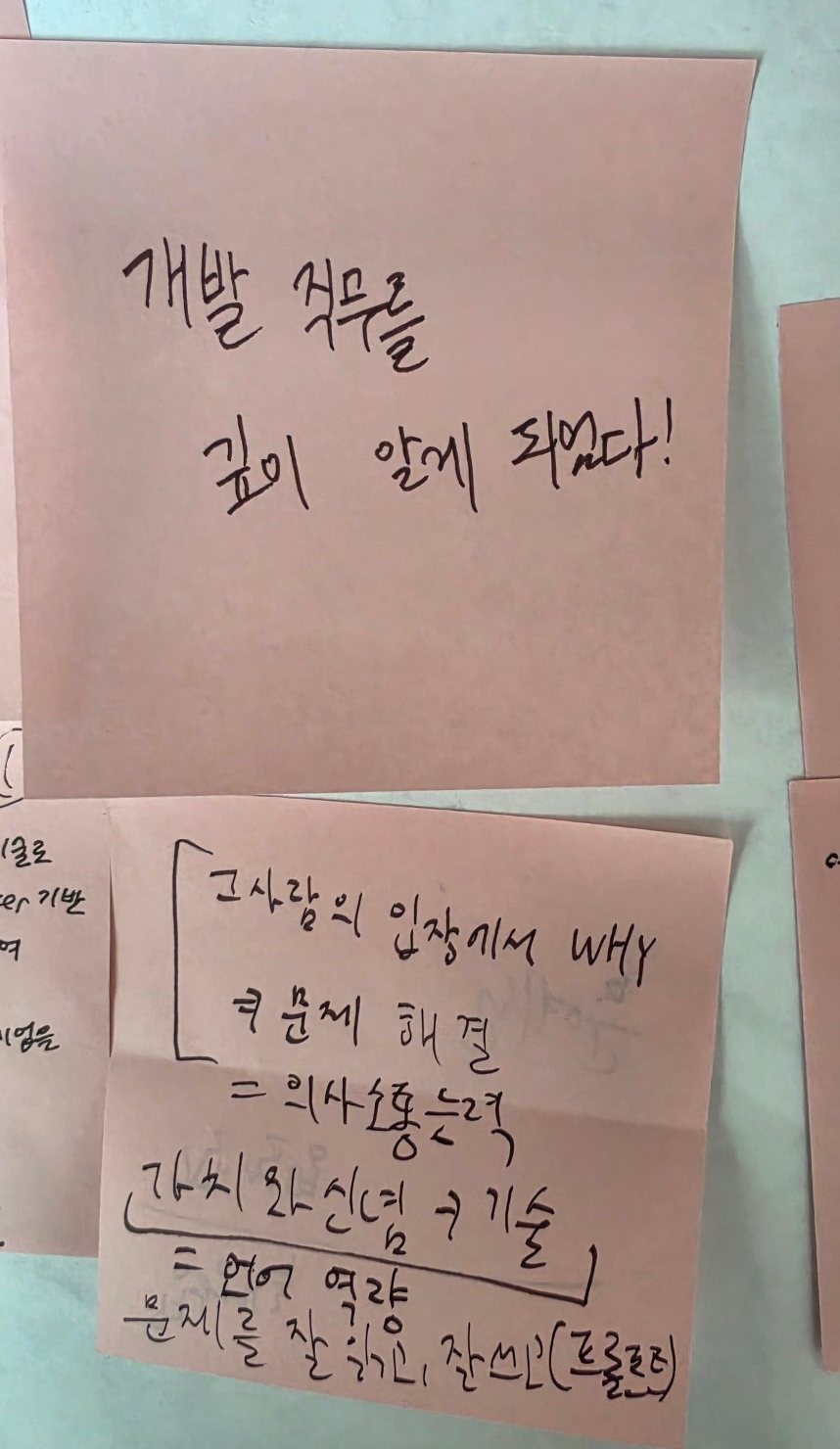
These were some of the sentences on the board.
- I got to know development jobs in depth!
- It's not just about being good at development; language skills matter too! (metacognition)
- When studying now, it's important to recognise the task and handle it well, and to solve problems accurately.
Questions were left there too. CS knowledge and coding tests are still part of hiring in the age of AI, so what level is needed? What is the minimum development ability you still need, even with AI? Where exactly do people in the industry use AI?
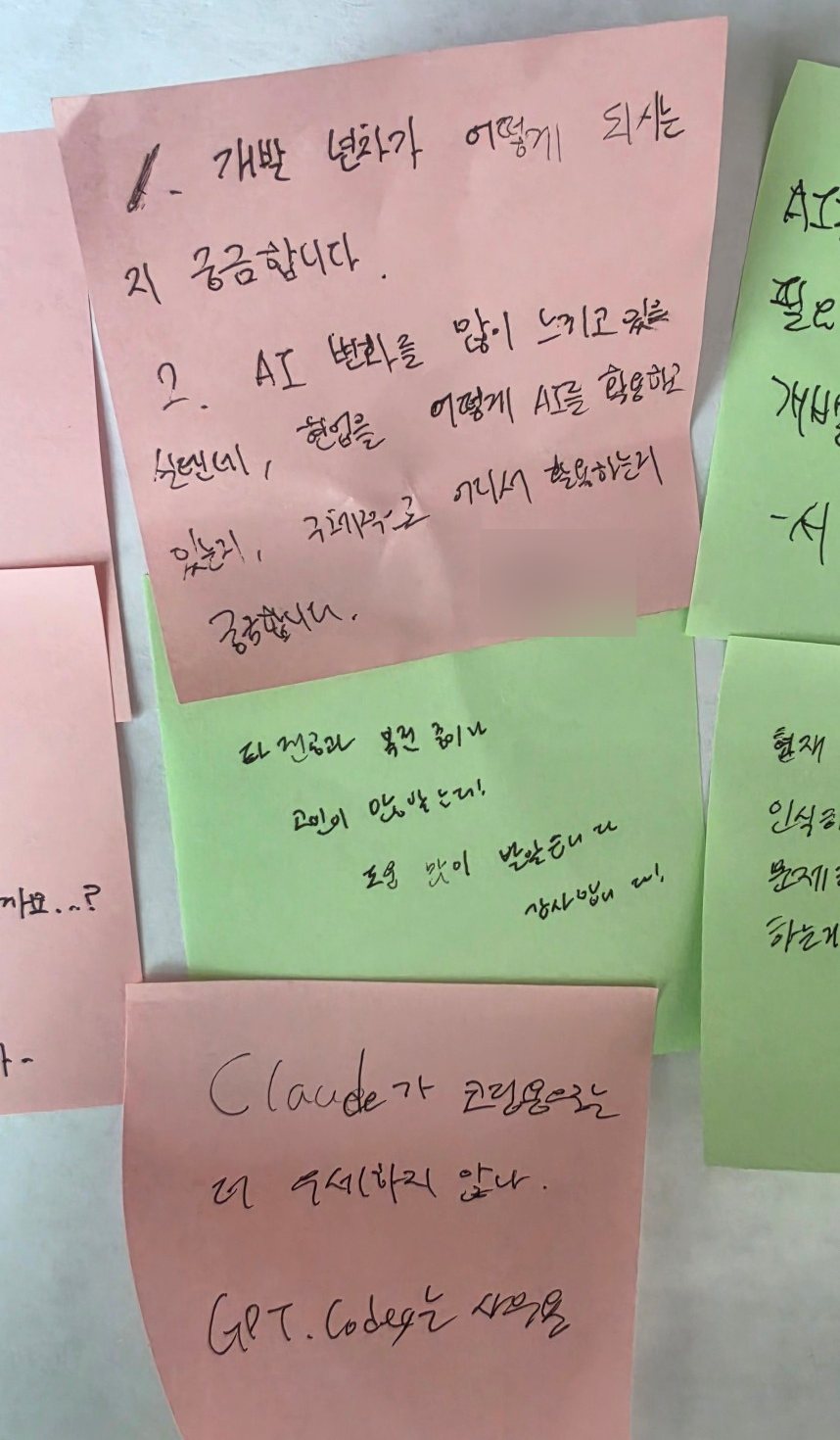
And below them was the post-it I quoted at the start. The last line of a conversation about careers in the age of AI was a model comparison. Still, that question too comes down to "which answer do you trust?"
I went as a senior and came back having learned
Giving someone advice ends up being a chance to look back on your own experience and thinking. Listening to the younger students' serious concerns, I remembered when I first got interested in development and IT and was thinking about my own career. What I went through isn't the right answer, but I was grateful that it could be a small reference for someone finding their own direction.
The evening didn't end with sharing experience with younger students. True to the word networking, I also had a long talk with a developer working in the industry. Sharing the experience we'd built in different environments, how we see technology and what we think about our careers ahead, I gained a new perspective too.
When it comes to learning, there seems to be no line between senior and junior. To one person you're a senior sharing experience; in front of another, you become a student learning something new. We walk different paths, but maybe we grow most at the moments those paths meet.
The more technology advances, the more it comes back to people
On the way home I found myself thinking: why do we learn, and what are we trying to grow for?
For a long time, people have developed technology to know more, work faster and live more efficiently. Now we live in a time when we share even intellectual work with machines. Even so, asking what is worth doing, and giving meaning to that choice, is still up to people.
Socrates tried to understand himself and the world through constant questioning. Now, when AI produces countless answers, is exactly when we need the ability to ask deeper questions. Beyond what we can build, why we should build it; beyond how to succeed, what kind of person to be.
Looking back, the things I recommended to the younger students, building a product, foreign languages and reading, all pointed the same way: becoming someone who thinks for themselves, understands the world and finds their own answers.
And that path isn't one you walk alone. I grew up on other people's advice and encouragement, and now I share a little of my experience with younger students. One day the students I met that evening will pass their own stories on to someone else. That's how knowledge becomes experience, and experience becomes wisdom that connects people. Growth may be less about reaching higher than others and more about the path you've walked becoming a small signpost for someone.
Technology changes the times, but people change each other's lives.
I want to keep learning new things without hesitation, but I hope people are always at the place that learning leads to. Before being a good senior, I want to live as someone who keeps asking, learning and growing all my life. The most important product we have to build may well be our own lives.
My thanks to the Seoul Future Foundation for arranging an evening of good meetings and learning.
Jayden's verdict
Two months ago I built a birdhouse and sent it off; this time I came home with a house-shaped humidifier. A Friday when I went to take questions and came back carrying some of my own.
- Event: Seoul Future Foundation WE:CONNECT Scholar Networking Day (Friday 6 November 2026, 19:00–21:30)
- Venue: Teamplace Hongdae, 12 World Cup-buk-ro 4-gil, Mapo-gu, Seoul, basement 1
- My seat: World Café table 1, IT, development and data (alumni mentor)
- Three pieces of advice: one product rather than a certificate, the ability to verify AI's answers, and languages and books
- If there's a younger student or colleague around you thinking about their career in the age of AI, I hope you'll pass on even one of the three.
Connected reading
Posts tied to this one by series, direct links, topic hub or tags.
Series · From Scholar to Mentor · Part 2 of 2
All 2 parts →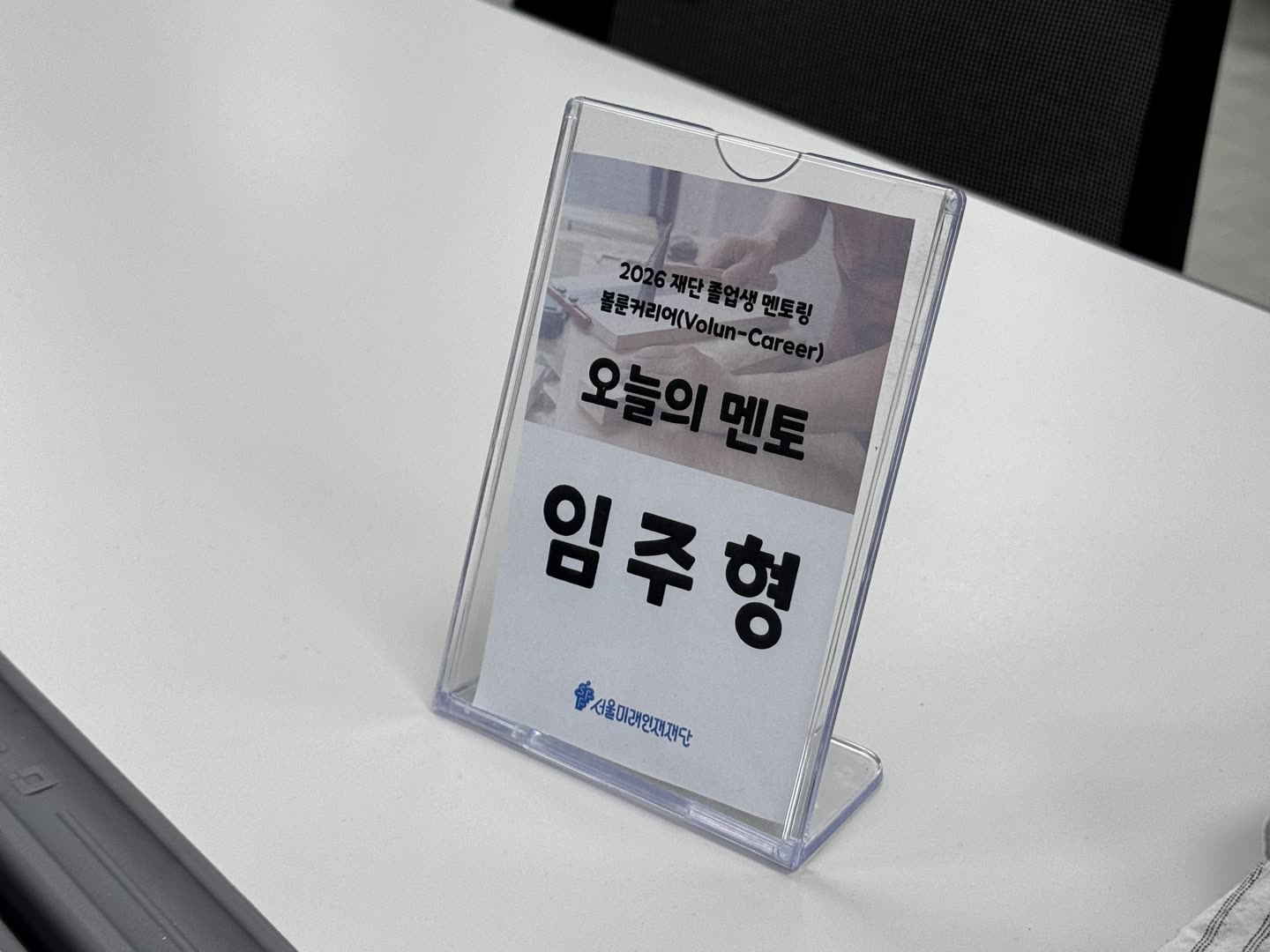
Topic hub · Seoul Days & Running
All 10 posts →

Ask DailySay
Continue Reading

The North Face Kalix Light Down Jacket, Steel Gray XL: Missed Twice Trying to Save 3,000 Won
I missed the sold-out Kalix Light Down Jacket in Steel Gray XL twice over 3,000 won in points, then got it: light duck down, finger holes, hood, XL fit.
Notes worth keeping.
Occasional updates about project management, AI, products, travel, and the things I’m building.
No spam — occasional notes only. See our Privacy.