PMP Pass Review Part 1: 7-Week Preparation and Journey from 60s in Study Hall to PASS
A summary of the 7-week study process for passing the PMP exam on July 3, 2026, using online lectures, PMI Study Hall, error logs, GPT, and NotebookLM.
Hello. On Friday, July 3, 2026, I took the PMP exam and finally received a PASS.
While preparing for the exam, I read pass reviews on Korean PMP communities and posts on Reddit r/PMP almost every day. I received a lot of help by looking up whether people with similar Study Hall scores passed, how difficult the actual exam was, and what to prepare on the day of the exam.
Having always read other people's pass reviews, writing one myself feels strange but really great. I hope this post will be a small reference for those who are anxious about their current scores or have not grabbed a study direction.
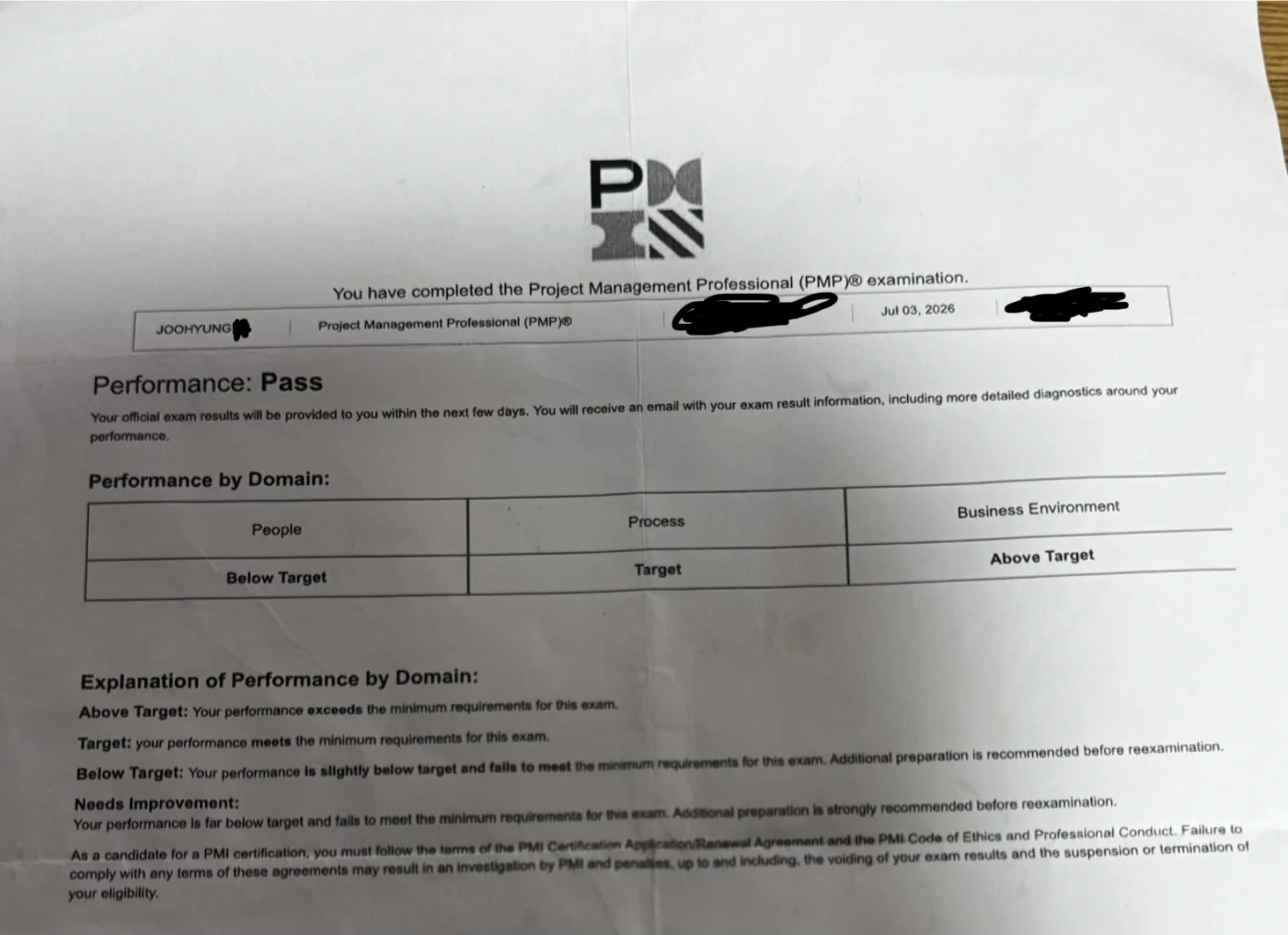
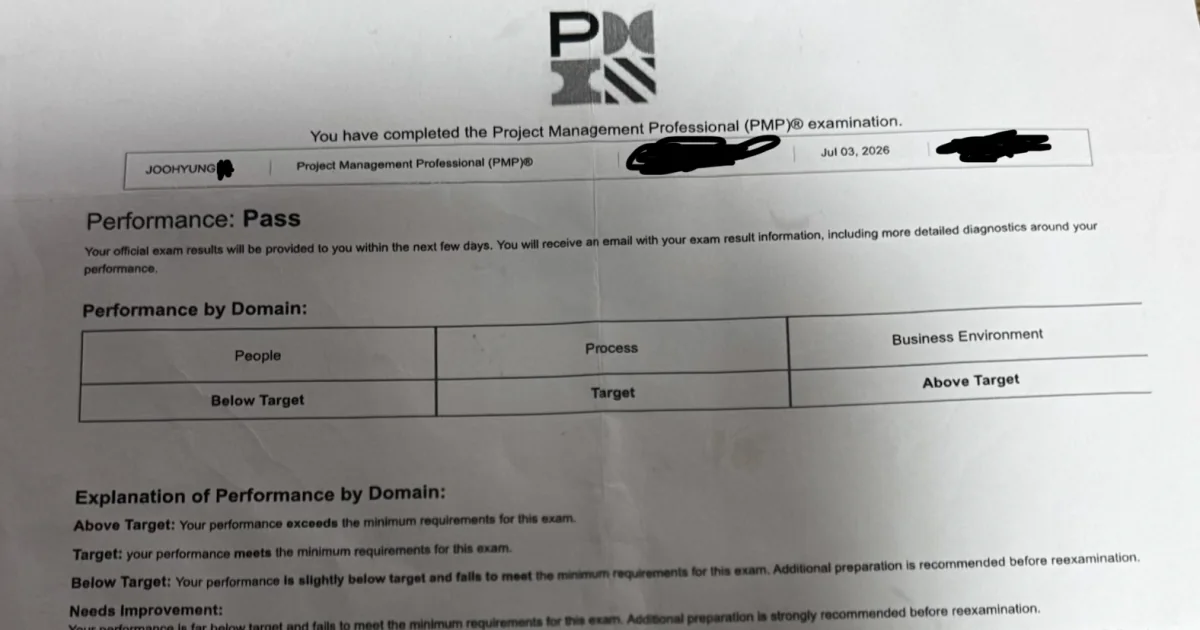
Result sheet received at the Pearson VUE center immediately after the exam. The overall result was PASS, and domain results were People Below Target, Process Target, and Business Environment Above Target.
What is the PMP Certification?
PMP (Project Management Professional) is a project management professional certification run by PMI (Project Management Institute). It is not limited to a specific industry or a single methodology, but evaluates whether you can manage people, processes, and business priorities while leading projects.
It is far from an exam that simply checks how much you have memorized the PMBOKPMBOKProject Management Body of Knowledge: A collection of processes, best practices, terminologies, and guidelines compiled by the PMI.Read More → content. Most of the actual questions present situations likely to occur in a project and ask the project manager to judge what to do first or what action to take next in that situation.
Therefore, while understanding terminology and processes is important, it was more critical to learn the order of looking at questions and the attitude expected of a project manager by PMI.
Eligibility requirements include project leading experience based on education level and project management education requirements. These criteria can also change, so checking your conditions directly on the PMI Official Eligibility Requirements is the most accurate.
Summary of My PMP Preparation Results
| Item | Details |
|---|---|
| Exam Date | Friday, July 3, 2026 |
| Preparation Period | About 7 weeks |
| Exam Venue | Pearson VUE Test Center |
| Main Study Materials | Online Lectures, PMI Study Hall, Error Logs |
| Study Hall Full Mock 1 | 66% |
| Study Hall Full Mock 2 | 65% |
| Study Hall Overall Average | About 62% |
| Auxiliary Tools | GPT, NotebookLM |
| Final Result | PASS |
Looking only at the result sheet, the preparation process seems to have gone as planned, but in reality, I felt anxious every time I checked my Study Hall scores. The more high-score pass reviews I read, the more I wondered, "Is it okay to schedule the exam with this score?"
In retrospect, what was more important than the score itself was identifying what kind of mindset caused me to make repeated mistakes.
Why Did I Take the Existing Exam in 7 Weeks?
Initially, considering when the PMP exam would change, I started studying with PMBOKPMBOKProject Management Body of Knowledge: A collection of processes, best practices, terminologies, and guidelines compiled by the PMI.Read More → 8th edition-based textbooks. I planned to prepare slowly based on the new exam.
However, once I started studying, I finished the online lectures faster than expected, and there was still room to schedule an exam before the revision. Since the core principles I had already studied connected to the existing exam, I decided to focus and take it according to the current exam rather than extending the preparation period.
What was important in this choice was not the fact that I looked at the latest book, but re-aligning the Exam Content Outline and question types of the exam I would take. If you are preparing for PMP, it is better to check the official test standards applied to your exam date first rather than just looking at the edition of the textbook.
How I Studied for 7 Weeks
My study process was largely divided into four stages.
Stage 1: Understanding the Overall Structure through Online Lectures
I did not try to memorize all details of the PMBOKPMBOKProject Management Body of Knowledge: A collection of processes, best practices, terminologies, and guidelines compiled by the PMI.Read More → from the beginning. While listening to online lectures, I grasped the big flow first: how Predictive, Agile, and Hybrid approaches differ, and what role the project manager should play in each situation.
On weekdays, I listened to lectures even a little after work. On days when I had energy, I listened to several lectures in a row; on hard days, I finished even a short section. On weekends, I reviewed what I had listened to on weekdays or solved questions.
I am not the type of person who focuses and studies for a long time after work. So rather than perfectly keeping a daily study volume, I focused on reducing the number of days I completely stopped studying.
Stage 2: Learning the Actual Judgment Method with Study Hall
The resource I used the most after listening to basic lectures was PMI Study Hall. Solving questions immediately revealed whether I didn't know a concept, misread a question, or chose Escalation too quickly.
At first, I only looked at the number of correct answers. If the score was low, I thought my study was insufficient, and looking up reviews of people with high scores made me more anxious. But as I solved questions repeatedly, I learned that even with the same score, the information contained within it was different.
- Questions missed because I didn't know the concept itself
- Questions where I missed the intent of keywords like
FIRST,NEXT, orBEST - Questions where I arbitrarily assumed situations not in the problem
- Questions where I immediately escalated to the Sponsor or upper management
- Questions where I tried to replace people before talking to the team
- Questions where I implemented before analyzing the impact of a change
Classifying the reasons for making mistakes like this turned scores from a simple evaluation into data telling me the next study direction.
Stage 3: Experiencing About 4 Hours with Full Mock Exams
My Study Hall Full Mock 1 was 66%, Full Mock 2 was 65%, and the overall average was about 62%. To be honest, it was not a reassuring score.
Still, I did not place the main purpose of the Full Mock solely on predicting the pass probability. I checked whether I could maintain concentration for a long time, in which section my speed slowed down, and whether I could immerse myself in questions again after breaks.
The PMP exam tests not only knowledge but also stamina and time management. Going to the test center after only solving short question sets makes you experience the actual exam fatigue for the first time. I recommend timing yourself and solving a Full Mock from start to finish at least once before the exam.
Stage 4: Focusing on Error Logs rather than New Questions
When the exam drew near, I did not add many new questions. I tried to answer the following questions while reviewing the questions I had already missed:
"Why did I choose this option?"
"Why is this answer more appropriate than other options from the PMI perspective?"
If I memorized the correct sentence, I made a mistake again when the words changed slightly in a similar situation. On the other hand, if I could explain my judgment process, I could apply the same principle to new questions.
PMP Mindset that Helped in the Exam
I did not accept the PMP Mindset as a memorization formula that applies unconditionally. This is because there are exceptions requiring immediate action, such as ethics, laws, safety, and urgent risks. However, in typical conflict or change situations, the following order helped my judgment:
- Understand the situation and find the cause before acting.
- Talk to the team first for issues that can be resolved within the team.
- Do not immediately escalate or hand over to the Sponsor.
- Try coaching, collaboration, and conflict resolution before replacing people.
- Find the Root Cause rather than the symptoms of a problem.
- Process change requests according to formal procedures after analyzing the impact.
- The project manager supports the team and removes obstacles rather than controlling them.
In actual questions, several options seemed plausible. At this time, the answer that "understands the situation and helps the team solve it" was often more appropriate than the answer that "takes the strongest action right now."
Were Online Lectures Enough?
Personally, I was satisfied with the online lectures. They were enough to grasp the big flow and Mindset needed for the exam.
At first, I wondered if I should take expensive offline classes. But in my case, the combination of learning the basic structure through online lectures, solving Study Hall questions, and analyzing error logs worked well.
I felt that the time solving questions, making mistakes, and reorganizing judgment processes after listening to lectures was more critical than which lectures I chose. The fact that I completed a lecture alone did not allow me to choose options in exam situations.
How I Utilized GPT and NotebookLM
I also utilized GPT and NotebookLM a lot in the PMP preparation process. Rather than using AI as a tool that chooses correct answers for me, I used it as a review partner to explain and compare the contents I understood.
GPT Usage
- Comparing the difference between two confusing concepts in a table
- Explaining my thought process for my chosen answer and being questioned about missing premises
- Classifying error causes into concept deficiency, question interpretation, or Mindset errors
- Having complex concepts re-explained with real-world project examples
- Creating short review questions based on the organized contents
For example, instead of asking for the correct answer, I asked like this:
I judged that I should immediately report to the Sponsor in this situation.
Find the assumptions hidden in my judgment,
and let me know the action I should check first from the PMI perspective in the form of a question.
Do not tell me the correct answer immediately so that I can judge again.
NotebookLM Usage
I gathered the error logs and review materials I organized in NotebookLM and used it to find repeating themes within the materials.
- Summarizing only frequently missed Mindsets
- Reviewing Agile and Predictive situations separately
- Comparing confusing topics like change management and conflict management
- Creating a short review list to check right before the exam
If various materials are mixed, it becomes difficult to check what criteria were used to answer. Therefore, I focused on official materials with clear sources and notes I reviewed directly.
What I Learned from Study Hall 60% Scores
My scores were Full Mock 66%, 65%, and an overall average of about 62%. Looking only at these scores, you might want to delay the exam. I felt the same way.
However, as a result, the following three things were more important than the score:
- Is the number of questions missed for the same reason decreasing?
- Can I explain the judgment process without memorizing the answer?
- Can I maintain concentration during the actual exam time?
Of course, my score cannot be a passing standard for everyone. Study Hall scores and actual exam results vary by individual. However, I want to say that you do not need to deny the entire preparation just because of the single number of 60% mid-to-high.
The error was not a verdict that "I am not ready," but a question that made a possibility to get it right one more time before the actual exam.
Closing Part 1
The biggest change during the 7 weeks was the order of looking at questions, rather than the amount of memorized knowledge. I gradually became familiar with checking the situation before acting immediately, talking before changing people, and analyzing the impact before making changes.
In the next post, I recorded my experience from the moment I entered the Pearson VUE test center, having my mentality shaken by spending 80 minutes on the first 60 questions, the 10-minute break, snacks and stretching, to time management in the final session.
Continue Reading: PMP Pass Review Part 2: Time Management on Exam Day and Final Tips for Passing
Revision History
Initial PMP pass review covering the 7-week study plan.
- •Documented Study Hall journey and AI study methods
Knowledge Relationships
- ReferencesWhy Every PM Should Learn AI Automation
Referenced By
These articles mention this article
Idea Evolution
Ask DailySay
Related Posts


Continue Reading
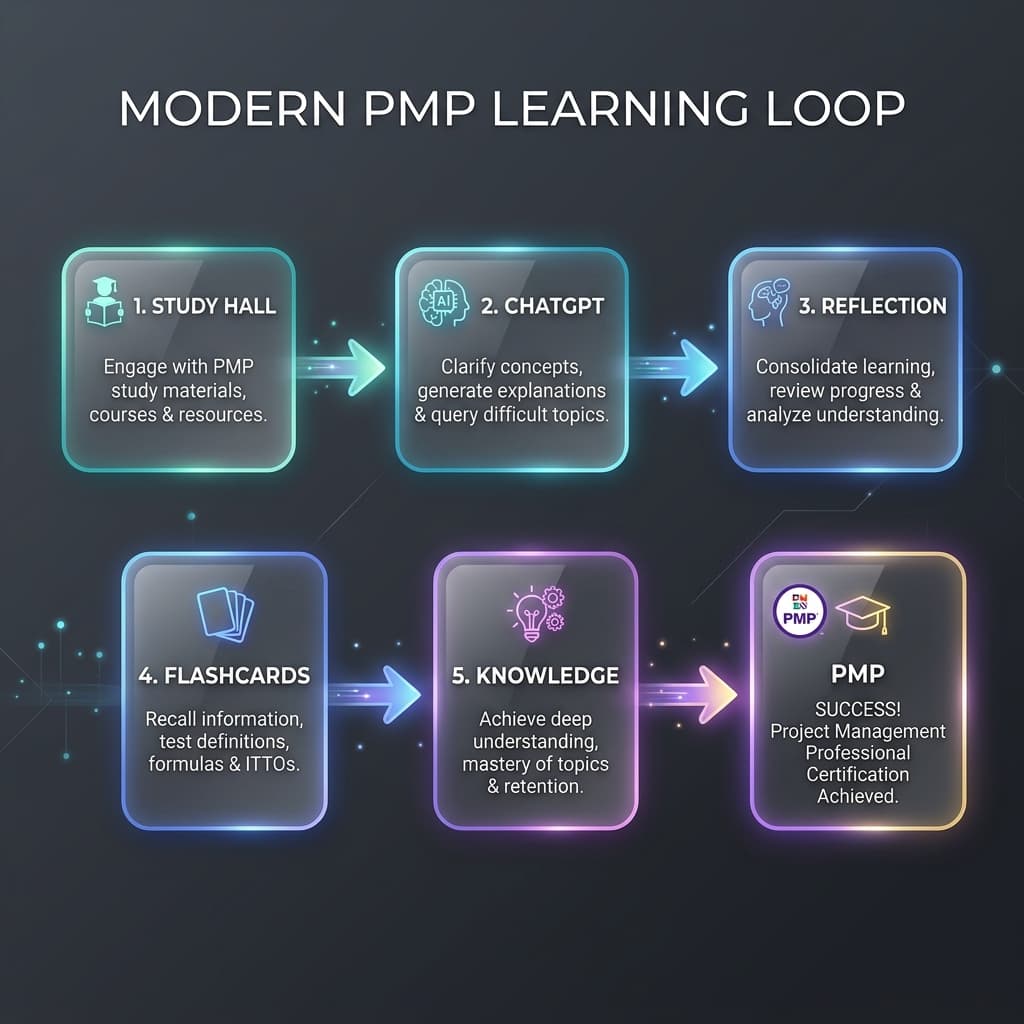
AI Didn't Help Me Pass PMP. It Changed How I Learn
How I shifted from using AI as an answer machine to a cognitive partner, building a robust learning feedback loop for the PMP exam and future knowledge systems.
Notes worth keeping.
Occasional updates about project management, AI, products, travel, and the things I’m building.
No spam — occasional notes only. See our Privacy.