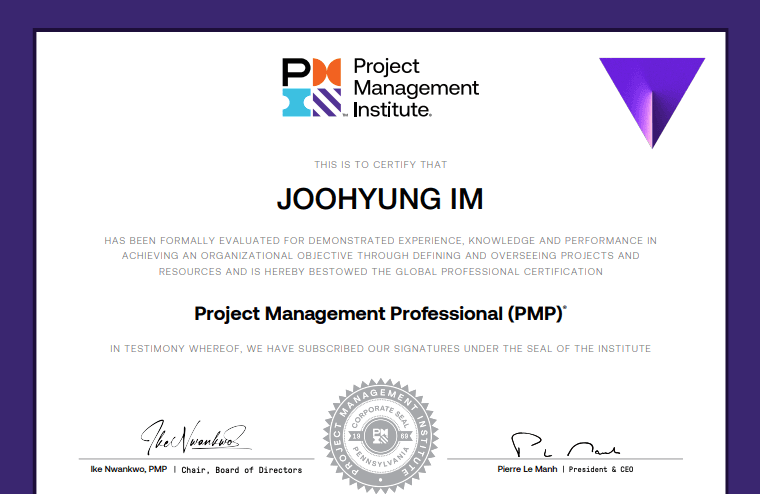
PMP Pass Review Part 2: Time Management on Exam Day and Final Tips for Passing
Sharing the actual experience of taking the PMP exam at the Pearson VUE center, managing the first 60 questions, taking 10-minute breaks, reviewing error logs right before the exam, and what to prepare.
In Part 1, I summarized what kind of certification the PMP is, and how I utilized online lectures, PMI Study Hall, error logs, GPT, and NotebookLM for about 7 weeks.
In Part 2, I will share the experience from the moment I entered the test center to receiving the PASS result sheet in chronological order. Although it was hard to realize when studying, after taking the exam in person, I felt that stamina, time management, and managing breaks are just as important as knowledge.
Exam Day at a Glance
| Item | My Experience |
|---|---|
| Exam Venue | Pearson VUE Test Center |
| Exam Structure At the Time | 180 questions, 230 minutes |
| Session Structure | 3 sessions of 60 questions each |
| Break Times | Two 10-minute breaks between sessions |
| First 60 Questions Time Spent | About 80 minutes |
| Snacks Prepared | Chocolate bars, walnuts, almonds |
| Final Result | PASS |
Looking only at the exam structure, it is easy to think, "I just need to solve 60 questions three times." However, reading and judging similar situational questions continuously for about 4 hours was far more tiring than I expected.
Arriving at the Pearson VUE Center
I took the exam at a Pearson VUE center. I had solved Full Mocks during my studies and thought I was prepared to some extent, but entering the test center felt completely different.
From the moment I verified my identity, organized my personal items, and sat down at the exam desk, tension began to rise. When the first question appeared on the screen, I ended up reading sentences longer than usual and kept doubting even simple options.
Center guidelines and check-in rules may vary, so it is best to check the arrival time, identification cards, and storage rules in the reservation email in advance. In particular, I double-checked whether my English name and ID information matched the reservation details exactly.
The Actual Exam Felt More Difficult Than Expected
Personally, the actual exam felt more difficult than I expected. Although I had seen many questions of similar formats in Study Hall, the tension in the test center made small differences between options feel much larger.
Every time I solved a question, thoughts like the following repeated:
- Both options sound correct, so what should I do first?
- In this situation, is analysis first or action first?
- Is it time to escalate now?
- Is this an Agile situation or a Predictive situation?
- Does the question ask for
FIRSTorNEXT?
Questions that required choosing one of two options consumed far more energy than questions where I had no idea of the answer. Trying to gain perfect certainty on every single question made time disappear quickly.
Spent 80 Minutes on the First 60 Questions
It took about 80 minutes to solve the first session of 60 questions. When I came out for the first break, I thought, "If I go at this speed, won't I run out of time later?"
The reason it took so long in the first section was simple:
- I read questions repeatedly out of nervousness.
- I re-reviewed answers I had clearly chosen.
- I couldn't move on from difficult questions immediately.
- I focused on the current single question rather than the overall time.
During the first break, I tried not to think about the score or the difficult questions. I drank water, ate a little of the chocolate bar and nuts, and stretched my neck and shoulders. Moving completely away from the screen and questions, even briefly, was helpful.
When I went back in, I changed my strategy:
Don't reread questions you clearly know. Don't let one difficult question take away the time to solve easy questions later.
After that, I first checked whether the question required FIRST, NEXT, or BEST, eliminated options that were clearly incorrect, and made my decision. Thanks to this, I had some time left in the final session.
Time Management Method That Worked for Me
If I were to prepare for the exam again, I would not divide the time per question perfectly equally. Instead, I would check the remaining time in units of 60 questions and reduce the moments of staying on one question for too long.
1. Check the Action Demanded by the Question First
Before reading the situation description, looking at what the project manager should do first, next, or how in the last sentence made the focus of the question slightly clearer.
2. Finish Clear Questions at Once
If you choose a clear answer but read it again just out of anxiety, time accumulates. I tried to distinguish between questions that actually needed review and those I doubted simply due to nervousness.
3. Spend Limited Time on Difficult Questions
If two options kept remaining, I made a decision after checking the core words of the question and the PMP Mindset again. Finishing the entire exam was more important than obtaining perfect confidence on one question.
4. Look at the Remaining Time Before the Session Ends
Looking at the clock for every question can break your concentration. Instead, checking the remaining time at regular intervals and before the end of a session worked better for me.
Check the 10-Minute Breaks Yourself
If you take the exam at a Pearson VUE center, I recommend checking the break times yourself. 10 minutes passes much faster than you think.
Going to the restroom, eating snacks, and passing through identification and security checks to enter again takes up time quickly. I slightly exceeded 10 minutes during the first break.
It is safe to check the clock in front of the center door or at the guided location before moving. You may not be allowed to use your mobile phone, so it is safer not to assume you can check the time with your phone. Be sure to follow the exact procedures of the center.
What I Actually Did During Breaks
- Drank water.
- Ate a little chocolate bar and nuts.
- Stretched my neck, shoulders, and waist.
- Didn't recall past questions.
- Checked only the remaining time and the next session strategy.
Reviewing questions during breaks only increases anxiety about sessions you have already submitted. For me, clearing my head and moving my body was much more effective.
Study That Helped Most Right Before the Exam
The most helpful thing right before the exam was not reading the book from start to finish again. It was looking at the questions I had missed and explaining why I missed them in my own words.
In particular, starting two days before the exam, I repeated the following two things rather than adding new contents:
1. Existing Error Logs
I looked at the mistakes I repeated rather than the correct answers.
- I didn't read the question to the end.
- I didn't distinguish between
FIRSTandNEXT. - I escalated before talking to the team.
- I chose a solution before finding the cause.
- I executed before analyzing the impact of a change.
- I confused Agile and Predictive situations.
2. PMP Mindset
Right before the exam, I briefly reviewed the basic order of judgment rather than the vast list of processes.
Understand situation → Check cause → Collaborate with team → Analyze impact → Act according to procedures
Of course, this is not a formula that applies to all questions identically. However, it served as a reference to keep me from hastily choosing strong actions in tense situations.
Items Good to Pack for the Test Center
Under the premise of checking center regulations first, the following preparations were personally helpful:
- A valid ID card matching reservation details
- Snacks that can be eaten quickly, like chocolate bars
- Nuts like walnuts or almonds
- Water
- Comfortable clothes that can be adjusted to temperature
- A memo of the test center location and arrival time
Rather than eating a lot of snacks, it was good to replenish sugar and energy slightly during breaks without feeling burdened. Lightly stretching my neck, shoulders, and waist was also helpful in restoring concentration for the next session.
Be Sure to Experience a 4-Hour Mock Exam
Getting good scores on short question sets and continuing judgments for about 4 hours were different experiences.
Solving a Full Mock to the end allows you to check things other than knowledge:
- In which session does concentration drop the most?
- Am I solving the first 60 questions too slowly?
- How long does it take to concentrate again after breaks?
- How much water and snacks should I eat to feel comfortable?
- Are my neck and waist okay when sitting for a long time?
I recommend putting your mobile phone away, timing yourself, and using only the designated break times to solve it as similarly to the actual exam as possible. You can reduce at least one element you experience for the first time on the exam day.
If Your Study Hall Score is in the 60s
If your Study Hall score is in the 60% mid-to-high range, you might feel anxious comparing it with the high scores of passing reviews. My Full Mock scores were also 66% and 65%, and the overall average was about 62%.
I passed the actual exam with those scores, but I don't want to state this as a standard that "60% means unconditional passing." Individual experiences with solved questions, error analysis levels, and exam day conditions differ.
Instead, I hope you check the following questions:
- Can you explain the reason you made a mistake in your own words?
- Do you avoid repeating the same mistake in similar situations?
- Can you finish a Full Mock within the actual time limit?
- Can you apply the PMI judgment order without memorizing answers?
The answers to these questions showed my readiness state better than the single score number.
AI Was a Review Partner, Not an Answer Sheet
GPT and NotebookLM were helpful for organizing error logs, reviewing PMP Mindset, and comparing confusing concepts. Especially right before the exam, they were useful for turning scattered contents into short questions and summaries.
However, I do not recommend entering PMP questions directly and checking errors based only on the options selected by the AI. The AI can misinterpret subtle differences between choices and may confidently present incorrect answers with plausible explanations.
Even when using AI, you must do the following processes yourself:
- Write down why you chose that answer first.
- Verify official explanations and sources.
- Ask the AI about gaps in your thought process rather than the correct answer.
- If descriptions differ, verify again based on official materials.
- In the end, leave a one-line principle in your own words.
When I Received the Result Sheet
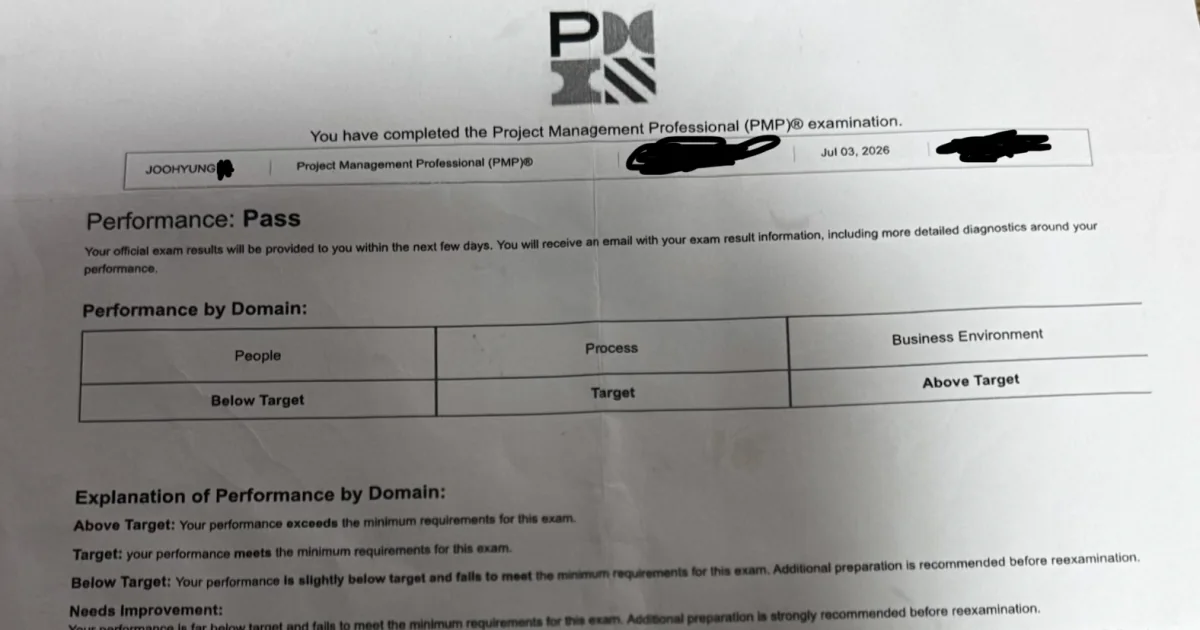
When the exam ended and I verified the PASS result, the first emotion I felt was relief. Although I shook every time I saw low scores and difficult questions during preparation, in the end, those error logs became the resources that made me think once more in the exam room.
My domain results were People Below Target, Process Target, and Business Environment Above Target. Although one domain was Below Target, the overall result was PASS. However, this is only my personal result, and it does not mean that the PMI passing criteria can be simply calculated using domain grades.
Final Words
Instead of thinking "Why did I miss this?" when an error occurs, it would be good to accept it as "This is a question that increased the probability of getting it right in the actual exam." There are definitely questions that are a relief to get wrong before the exam.
The important thing was not the score itself, but finding out in what way I make incorrect judgments through error analysis.
If you are preparing for the exam, try spending time turning already studied contents into your own judgment criteria rather than continuously adding new materials. And try sitting for about 4 hours before the exam. You can solve questions much more stably when knowledge, stamina, and time management are prepared together.
Cheering for everyone preparing now. Good luck! 💪🍀
Read from Beginning: PMP Pass Review Part 1: 7-Week Preparation and Journey from 60s in Study Hall to PASS
Revision History
Exam-day companion to Part 1: time management and prep tips.
- •Added Pearson VUE day-of tactics
Knowledge Relationships
Referenced By
These articles mention this article
Idea Evolution
Ask DailySay
Related Posts

Continue Reading
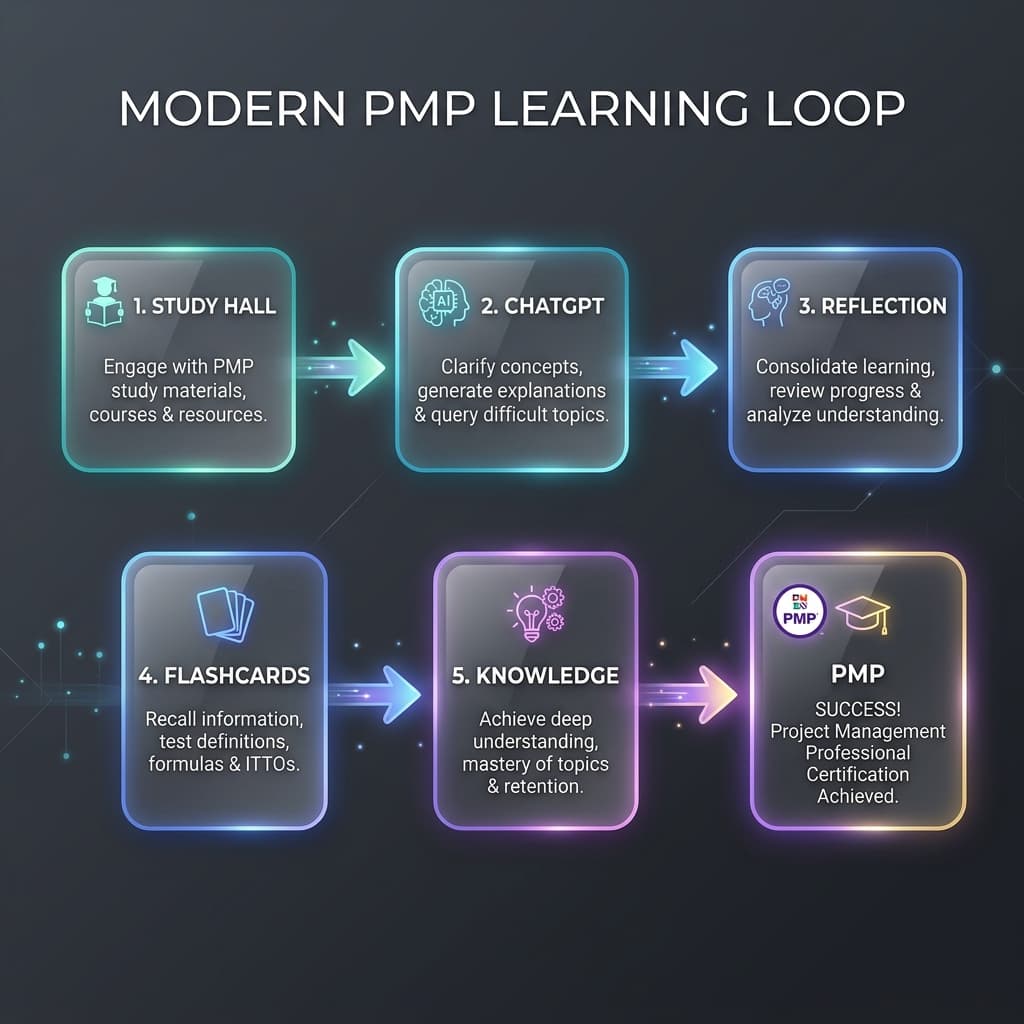
AI Didn't Help Me Pass PMP. It Changed How I Learn
How I shifted from using AI as an answer machine to a cognitive partner, building a robust learning feedback loop for the PMP exam and future knowledge systems.
Notes worth keeping.
Occasional updates about project management, AI, products, travel, and the things I’m building.
No spam — occasional notes only. See our Privacy.