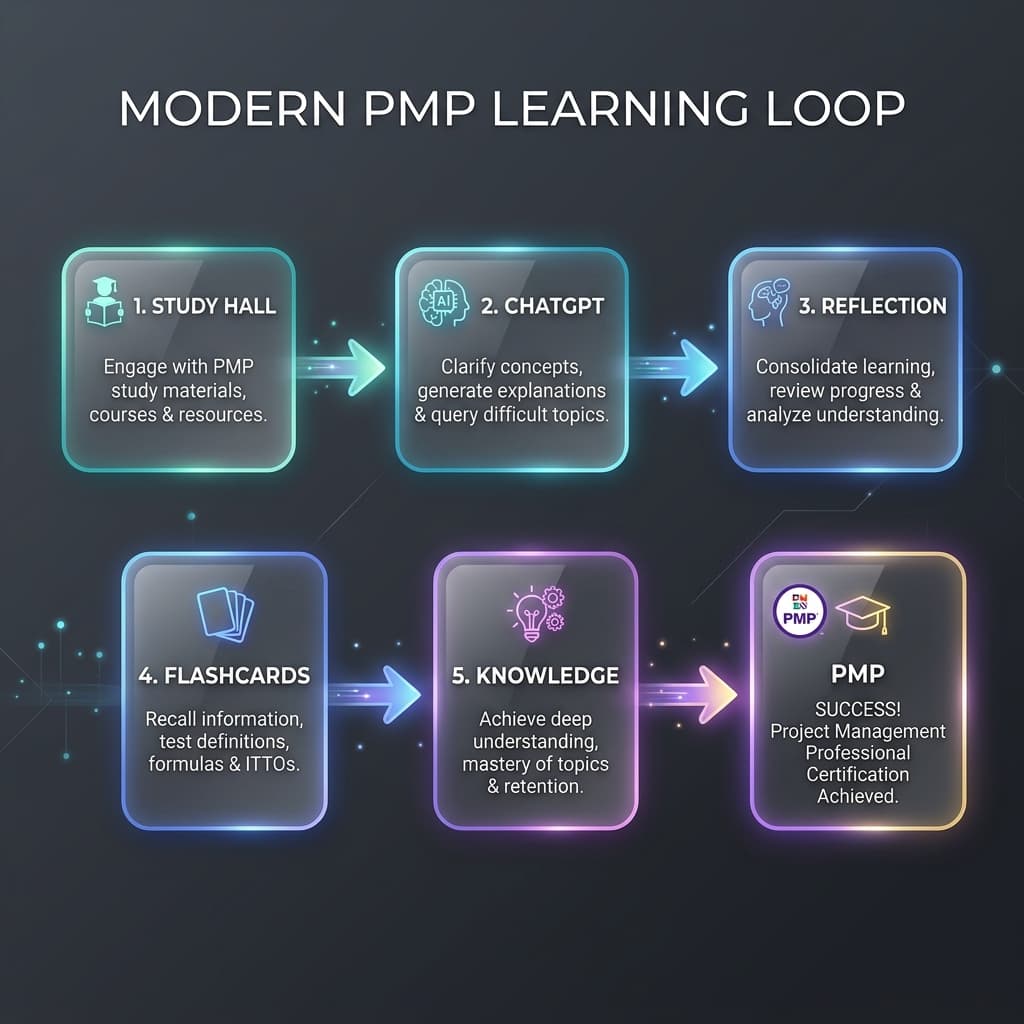
AI Didn't Help Me Pass PMP. It Changed How I Learn
How I shifted from using AI as an answer machine to a cognitive partner, building a robust learning feedback loop for the PMP exam and future knowledge systems.
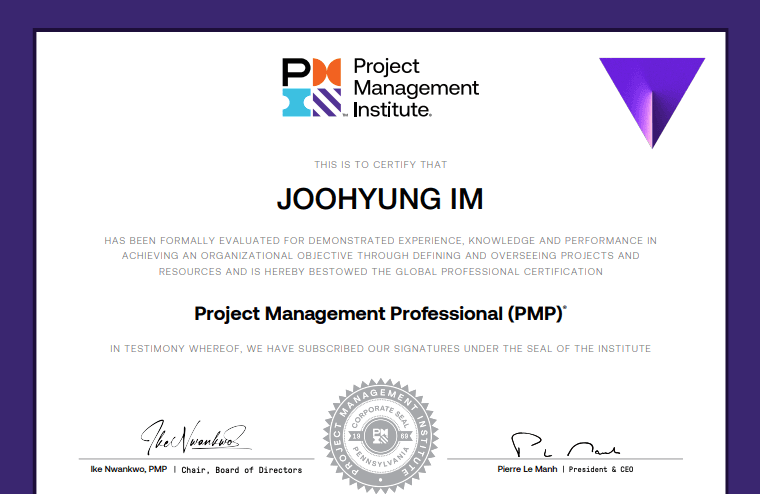
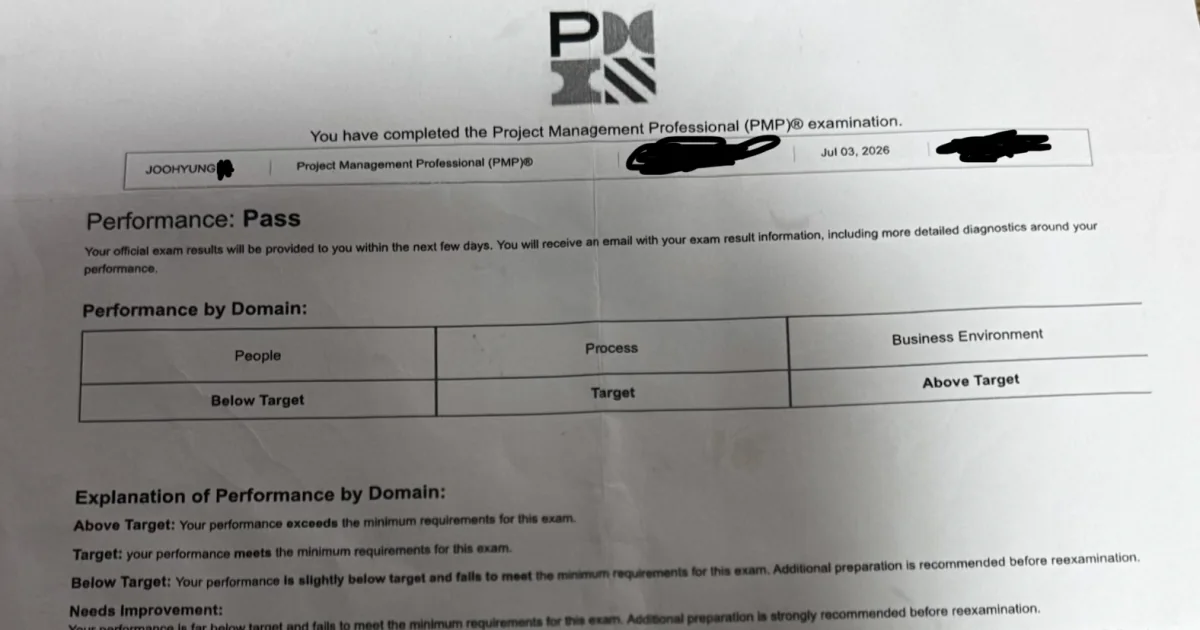
When people found out that I passed the PMP (Project Management Professional) exam, one question came up repeatedly:
"What promptsPrompt EngineeringThe practice of structuring, refining, and optimizing textual inputs to instruct generative AI models to produce desired outputs.Read More → did you use?"
At first, I smiled because I knew they were asking the wrong question. It wasn't a specific set of promptsPrompt EngineeringThe practice of structuring, refining, and optimizing textual inputs to instruct generative AI models to produce desired outputs.Read More → that made the difference. The workflow was.
That realization completely changed the way I study—not just for the PMP, but for everything I want to learn going forward. This post serves as a personal guide for my future self, outlining a structured learning system that I can deploy whenever I face new, complex domains.
Most People Use AI as Google
I almost made the same mistake. The standard approach goes like this:
- Ask a question when stuck.
- Read the answer.
- Move on, feeling productive.
While this feels efficient, very little actually stays in your long-term memory. When you get answers too easily, your brain stops putting in the effort to retain them.
Eventually, I realized that AI becomes far more valuable when it doesn't give you the answers immediately, but instead challenges you to ask better questions. I needed a thinking partner, not a search engine.
My Learning Feedback Loop
Instead of treating AI as a search engine, I built a feedback loop to convert mistakes into reusable knowledge assets.
[Question & Practice]
         ↓
    [Own Attempt]
         ↓
   [Wrong Answer]
         ↓
  [AI Dissection]
         ↓
    [Reflection]
         ↓
  [Personal Notes]
         ↓
   [Flashcards]
         ↓
   [Re-attempt]
It is not about the volume of questions solved; it is about how effectively every incorrect answer triggers a corrective loop in the system.
5 Principles of Using AI as a Cognitive Partner
Here are the five operational rules I established for my learning workflow, which I must follow in future studies:
1. Dissect Every Incorrect Option
Most people ask, "Why is A correct?" True learning, however, lies in understanding the incorrect options. I frequently asked the AI:
"I know A is the correct answer in this scenario. But explain exactly why B, C, and D are incorrect. What assumptions or conditions make them wrong?"
Understanding why something is incorrect often teaches you more than simply knowing the correct answer. This single habit dramatically improved my understanding of PMI's specific mindset and logic.
2. Compare Boundaries of Mental Models
Whenever I struggled to differentiate between Predictive, Agile, and Hybrid approaches, I resisted asking, "Which one is correct here?" Instead, I prompted:
"I have Predictive, Agile, and Hybrid models. In this specific situation, what are the exact failure modes of each approach? Where do they break down?"
By focusing on where models fail, I gained a clear, boundary-defined understanding of when to apply each model.
3. Force AI to Challenge My Logic
To prevent confirmation bias, I deliberately asked the AI to play the devil's advocate. This forced active metacognition:
Roleplay setup:
"Pretend you are a highly critical, skeptical PMP instructor.
Find the logical flaws in the conclusion I just drew, challenge my reasoning,
and try to convince me why I am wrong."
Defending my thoughts and refining my arguments against the AI's critiques forced me to organize my knowledge and solidified my understanding.
4. Build Structured Assets from Mistakes
Every incorrect answer had to be converted into a reusable asset:
- A flashcard (using spaced repetition like Anki) for core concept reviews.
- A personal note detailing why I fell for the distractor choice.
- A one-sentence summary explaining the concept to a complete beginner.
By systematically converting mistakes into assets, my weakest areas gradually transformed into my strongest domains.
5. Aggregate Error Patterns
The biggest advantage of AI wasn't that it knew the facts; it was its ability to detect patterns across my data.
I periodically fed my error logs and notes to the AI and asked:
- What recurring logical fallacies do you notice in my thinking?
- What concepts am I consistently misunderstanding?
- Where am I exhibiting overconfidence or bias?
Instead of studying the entire curriculum blindly, this analysis allowed me to surgically target the exact concepts that needed improvement.
Looking Back
Passing the PMP exam wasn't the most valuable outcome. Learning how to build a scalable learning system was.
After sharing my PMP journey on LinkedIn, the post reached over 21,000 impressions. Yet, almost all follow-up conversations focused on the "shortcuts"—specifically, the promptsPrompt EngineeringThe practice of structuring, refining, and optimizing textual inputs to instruct generative AI models to produce desired outputs.Read More →.
It reminded me of an important truth: people often search for short-term shortcuts. But sustainable growth comes from improving the underlying systems, not collecting better promptsPrompt EngineeringThe practice of structuring, refining, and optimizing textual inputs to instruct generative AI models to produce desired outputs.Read More →.
PromptsPrompt EngineeringThe practice of structuring, refining, and optimizing textual inputs to instruct generative AI models to produce desired outputs.Read More → and models will change, but the core human feedback loop of mistake, reflection, and adjustment remains constant.
Key Takeaways for My Future Self
- AI is a thinking partner, not a knowledge vending machine.
- Prioritize decomposing incorrect paths over memorizing correct answers.
- Convert every error into a structured, reusable learning asset.
- Motivation fluctuates; a robust feedback loop is what guarantees improvement.
- The quality of your growth is determined by the quality of your questions. The most important question I ever asked was: "Why am I wrong?"
This system will shape how I approach project management, language learning, building products, and writing for years to come. Whenever I need to master a new skill, this feedback loop is the first thing I will run.
Revision History
Initial publication of PMP learning workflow and system reflections.
- •Structured the post to emphasize the cognitive workflow and system-building for future reference
Ask DailySay
Related Posts

Continue Reading

How I Build Products Alone with AI: From Idea to Launch
A practical process for using AI across research, planning, development, testing, and launch while keeping product judgment and responsibility human.
Notes worth keeping.
Occasional updates about project management, AI, products, travel, and the things I’m building.
No spam — occasional notes only. See our Privacy.