Why Gamification Matters at Work: What Homo Ludens Teaches About Play and Work
Huizinga argued in Homo Ludens that culture arises in and as play. What play's features mean for work and onboarding, and gamification beyond points and badges.
Part 3 / 3
In part 1, I wrote about why onboarding matters in projects. In part 2, I argued that onboarding should be an experience, not a document. The question for this last post: why turn that experience into a game, of all things?
To answer it, we need to talk about play before we talk about work.
Homo Ludens: man the player
The Dutch historian Johan Huizinga (1872–1945) published Homo Ludens in Dutch in 1938. The English edition, which came out in 1949, carries the subtitle A Study of the Play-Element in Culture. Homo ludens is Latin for "man the player," or the playing human.
The book's central claim fits in one line:
Civilization arises and unfolds in and as play.
— Johan Huizinga, Homo Ludens
Huizinga isn't saying that play later turned into culture. He's saying culture emerged in the form of play from the very beginning, and never fully left it. That's why he treated play not as one branch of culture but as something that comes before it. Early in the book he notes that play is older than culture, since animals never waited for humans to teach them how to play. From there, he goes looking for the play-element in law, war, poetry, philosophy and art.
Play, as Huizinga saw it
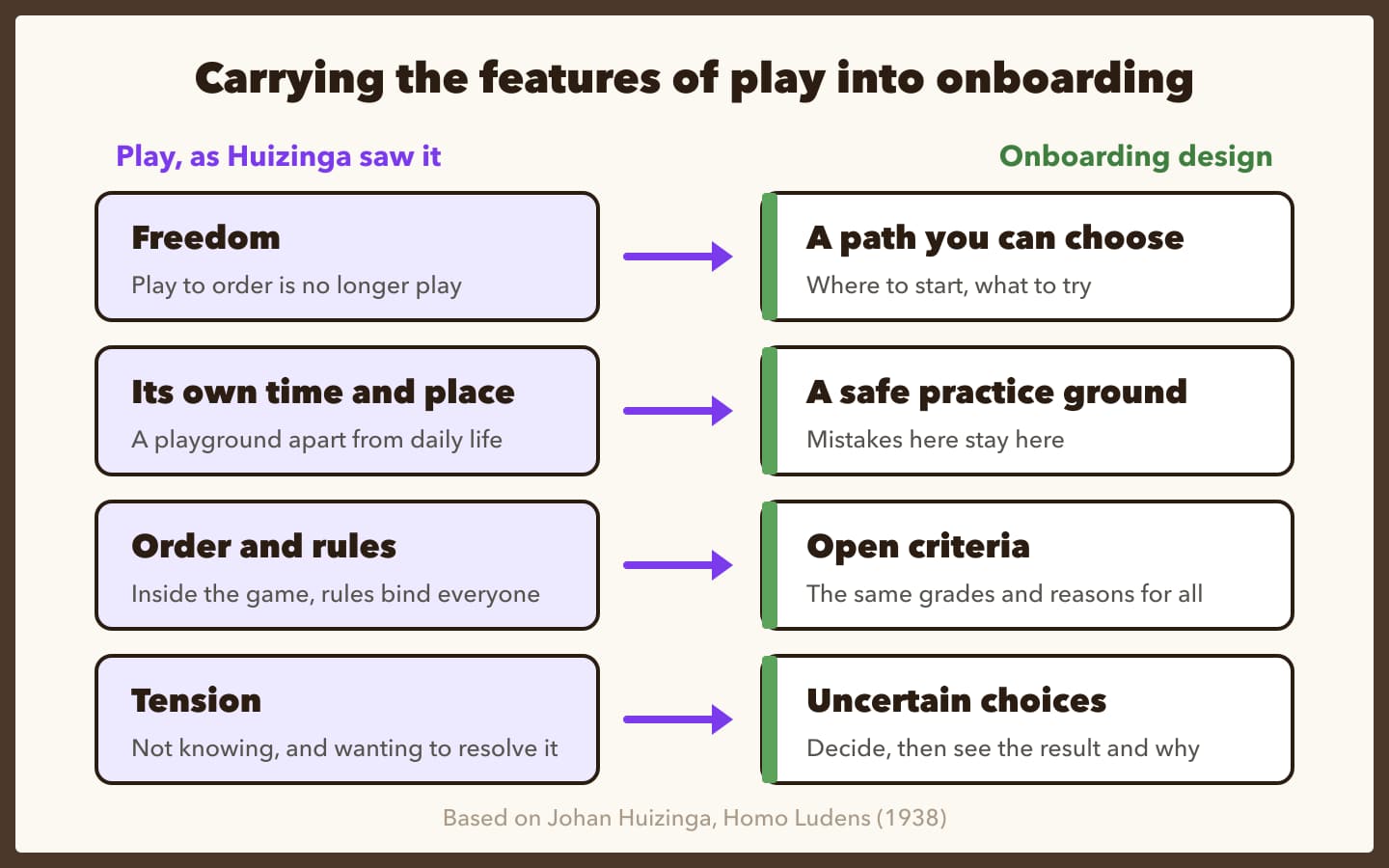
In the first chapter, Huizinga sets out the formal features of play. Four of them matter most for this post:
- Freedom: play is voluntary. In the English translation's words, "play to order is no longer play"; at best it's a forced imitation.
- A separate time and place: play happens apart from ordinary life, for a set stretch of time. Huizinga grouped the arena, the card table, the stage and the court of justice together as playgrounds, and the magic circle is on that same list. Decades later, Katie Salen and Eric Zimmerman popularized the term in Rules of Play (2003) as shorthand for the special space you step into when a game begins.
- Order and rules: Huizinga wrote that play creates order, and is order. The rules inside a game bind everyone, and whoever breaks them spoils the game itself.
- Tension: the uncertainty of an outcome not yet decided, and the urge to resolve it through your own effort. Huizinga thought this tension plays a particularly important part in play.
There's one more. Huizinga also said play is connected with no material interest. I'll come back to that fifth feature later.
Laying play over onboarding
Put those four features next to the conditions of good onboarding from part 2 and they overlap more than you might expect:
| Feature of play | Carried into onboarding |
|---|---|
| Freedom | Room to choose what to explore first and which options to try |
| A separate time and place | A practice ground that doesn't touch the real project. Mistakes made here stay here |
| Order and rules | The criteria for a good decision are visible and apply to everyone equally |
| Tension | You make a choice without knowing the outcome, then see the result and the reasoning right away |
I want to underline the second row. In part 2, one condition of good onboarding was a safe place to be wrong. In Huizinga's terms, that's exactly the playground set apart from ordinary life. Because everyday rules are suspended there for a while, you can try the choices you'd hesitate to make on a real project, and fail at them.
Good gamification and shallow gamification
Gamification is usually defined as the use of game design elements in non-game contexts, a definition proposed by Sebastian Deterding and colleagues in 2011. The trouble is how broad that is. The same game element can produce completely different results depending on how you use it.
| Shallow gamification | Gamification done well | |
|---|---|---|
| Core | Points, badges and leaderboards stuck on top of existing content | Making the call at work becomes the core action of the game |
| Rewards | Given for logging in, clicking and getting to the end | Given for good decisions, together with the reasoning |
| Failure | You lose points or drop down the leaderboard | A chance to learn why and try again |
| Participation | Pushed with leaderboards and reminders | You open the next quest because you're curious |
By Huizinga's standards, shallow gamification isn't play. Leave a dull document as it is and bolt points onto it, and people tend to learn how to collect points before they learn the content. Pressure people into joining through a leaderboard, and the freedom is gone. It borrows the look of play while stripping out what makes play work.
In gamification done well, rewards follow judgment. Levels and badges aren't the goal. They're a record that says, "I can now make calls like these."
Work isn't play, and yet
There's something I should be honest about. Huizinga said play has no material interest. Work does. We're paid for it, and it has real consequences. You can't turn work into play wholesale, and I don't think you should. You can't treat a real production incident like a game.
But the time when you're learning the work is different. Onboarding is time set aside to practice judgment, a step removed from real consequences. It's the most natural place for Huizinga's separate playground to exist. For the stretch when someone is first learning how a company works, I think there's every reason to borrow the form of play.
One more thing. Onboarding is usually mandatory, which seems to clash with freedom. Here's how I resolve that tension: what you need to learn can be fixed, while how you walk that path stays your choice. Which mentor to meet first, which option to try, when to retry the ones you missed. Even that much freedom moves onboarding a little closer from something you have to do to something you want to do.
That's why I built First Run
If, as Huizinga argued, human culture arose in play, then onboarding, the first time someone meets a company's culture, can start in play too. That's why I built First Run. The conditions of play from this post are all in it:
- A separate space: the campus of Make Feelbetter, a fictional IT company. Decisions made there don't affect any real project.
- Order and rules: every answer is graded Excellent, Good, Risky or Poor, with the reasoning and a learning point.
- Tension: you choose what to do first in real work situations and see the outcome right away. There are answer combos, too.
- Freedom: you pick one of five roles to start, and from level 3 you can take on other roles' quests. Missed quests can be retried on the Review Board.
- Rewards as a record: a seven-chapter story from prologue to epilogue, levels, badges, area unlocks and 12 achievements, and at the end a result report with your strengths, areas to work on and recommended review quests.
Still, the center of First Run is judgment, not points. The project context from part 1, onboarding as an experience from part 2, and play from this post: I wanted to bring all three together in one place. Turning onboarding you read into onboarding you decide and experience. That's why I built First Run.
Try it yourself — the demo is free in your browser on desktop or mobile, with no sign-up, in Korean, English, Japanese and Spanish. If you're curious about a version built for your company or project, you can request a custom build on the site. Play First Run →
That's the end of the Onboarding, Played series. Thanks for reading all the way through.
Frequently asked questions
Who wrote Homo Ludens, and when?
The Dutch historian Johan Huizinga published it in Dutch in 1938. The English edition appeared in 1949 as Homo Ludens: A Study of the Play-Element in Culture. Its central claim is that civilization arises and unfolds in and as play.
Is gamification just adding points and badges?
Gamification is usually defined as using game design elements in non-game contexts. Points and badges are game elements, but adding only those tends to leave the content unchanged and turn learning into a race for points. This post suggests making the judgment at the heart of the work the core action, and using rewards as a record of good decisions.
Does First Run count toward PMP PDUs?
No. First Run was designed from the experience of a PMP-certified project manager, but it is not a PMI-affiliated course and does not grant PDUs.
Sources
Connected reading
Posts tied to this one by series, direct links, topic hub or tags.
Series · Onboarding, Played · Part 3 of 3
All 3 parts →
Related project
The project this post is about · An onboarding RPG for new hires and people joining a project. You join Make Feelbetter, a fictional IT company, pick one of five roles (developer, PMO, publisher, planner, designer) and make real work decisions in quests given by mentor NPCs. Free to play in the browser, no sign-up.
Topic hub · Career & Onboarding
All 10 posts →


Idea Evolution
Ask DailySay
Continue Reading
Onboarding Is an Experience, Not a Document: Deciding Sticks Better Than Reading
Plenty of onboarding docs, yet new members still get lost. Why reading doesn't stick, and the four things good onboarding needs instead.
Notes worth keeping.
Occasional updates about project management, AI, products, travel, and the things I’m building.
No spam — occasional notes only. See our Privacy.