PMP Error Log: 6 Steps to Turn Wrong Answers into Judgment Rules (+ Free Word Template)
A PMP error log isn't for copying questions. It's for building judgment rules: log misses and lucky guesses, tag the cause, and write 'If ___, first ___.'
Part 6 / 15
In seven weeks of PMP prep, most of my time didn't go into new questions. It went into the ones I'd already gotten wrong. I walked into the exam with Study Hall mock scores of 66% and 65% and walked out with a PASS, and looking back, my error log did a lot of the heavy lifting.
In three lines — A PMP error log isn't for memorizing answers; it's for building judgment rules like "If ___, first ___." Log every miss and every lucky guess, tag the cause with one of six letters (C·R·M·S·A·T), and review on day 1, day 7 and day 21. I turned my method into a 9-page Word template you can have for free.
A PMP error log fixes judgment, not memory
Most PMP questions don't test what you know. They drop you into a project situation and ask what the project manager should do first, or next.
Here's the catch: most of the options aren't wrong. Reporting up, calling a meeting, updating the plan: at work you'd do all of them at some point. What separates the right answer from the rest is order and priority, not knowledge.
That's why the classic error log, where you copy the question and the answer, doesn't do much for the PMP. As I wrote in Part 1, when I memorized answer sentences, I got the question wrong again as soon as a few words changed. What you want to keep isn't the question. It's a rule: "Next time I'm in a situation like this, what do I do first?"
My Study Hall full mocks came in at 66% and 65%, and my overall average was about 62%. High-score pass stories made me nervous every time I read one. What I trusted more than the score was a different signal: I was missing fewer questions for the same reason. The error log is what let me actually see it.
Six steps from a wrong answer to a judgment rule
The method is the six lines on the first page of the template. Each error card has room for a one-line situation, my answer and the correct one, why the correct one is the best, the trap I fell into, cause tags, a rule for next time, and review boxes.
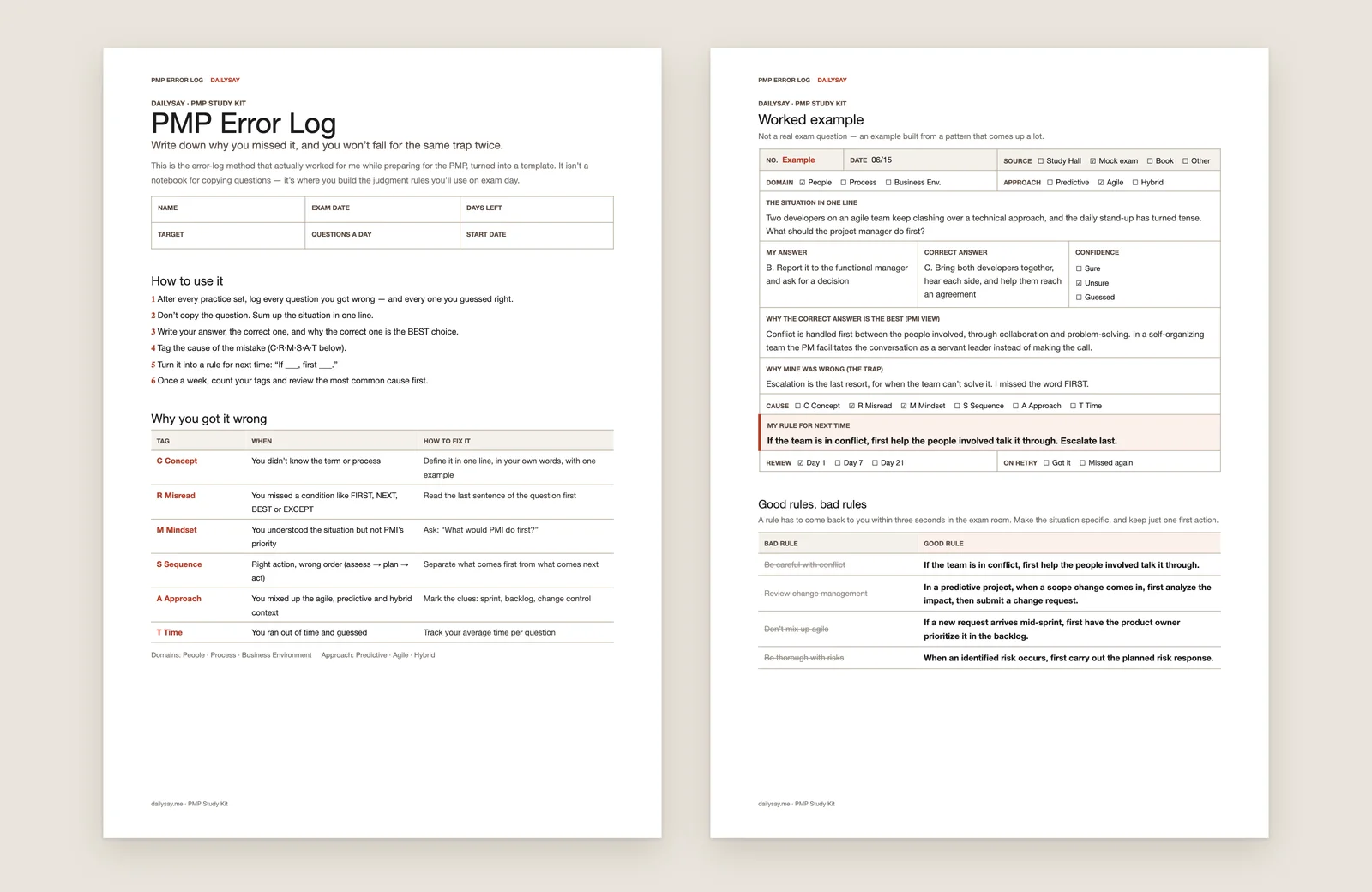
Pages 1 and 2 of the template: how to use it and the cause tags on the left, the worked example and "Good rules, bad rules" on the right.
Step 1: Log every miss, and every lucky guess
If you only log the questions you got wrong, you miss half the picture. If you picked between two options on a hunch and it happened to be right, that's a miss that got lucky. Nothing guarantees the luck shows up again on exam day.
So every card has a confidence box: Sure, Unsure or Guessed. If you got it right but were unsure or guessed, it goes in the log. You don't need to log the ones you knew cold, though. That time is better spent taking another look at your misses.
Step 2: Don't copy the question. Sum up the situation in one line
Copying a whole question takes forever, and you end up memorizing sentences. Instead, boil it down to who, what's happening, and what's being asked.
Two devs on an agile team keep clashing over a technical approach; stand-ups have turned tense. What does the PM do first?
Squeezing it into one line forces you to find the core, so writing the summary is already review. Tick the domain (People, Process, Business Environment) and the approach (predictive, agile, hybrid) as well. After a few weeks, patterns pop out, like "I keep missing People questions set in agile teams."
On the new exam, Business Environment went from 8% to 26% of the questions, so don't skip the domain box. I covered what changed in Part 5: Everything that changed in the 2026 PMP exam.
Step 3: Write your answer, the correct one, and why it's the BEST
Put your answer and the correct answer side by side, then fill in the box that matters most. Not "why is this correct?" but "why is this the best?"
On the PMP, the answer you picked is usually a reasonable thing to do. So you need to be able to explain, in a sentence or two and from PMI's point of view, why this answer comes first and yours doesn't. If you can't, you haven't really got it yet.
Right below that, write why yours was wrong: the trap you fell into. Keep it short, like "escalated too early" or "missed the word FIRST."
Step 4: Tag the cause with C·R·M·S·A·T
Once you sort the causes, your score stops being a report card and becomes a prescription. The template uses six tags.
| Tag | When | How to fix it |
|---|---|---|
| C Concept | You didn't know the term or process | Define it in one line, in your own words, with one example |
| R Misread | You missed a condition like FIRST, NEXT, BEST or EXCEPT | Read the last sentence of the question first |
| M Mindset | You understood the situation but not PMI's priority | Ask: "What would PMI do first?" |
| S Sequence | Right action, wrong order (assess → plan → act) | Separate what comes first from what comes next |
| A Approach | You mixed up the agile, predictive and hybrid context | Mark the clues: sprint, backlog, change control |
| T Time | You ran out of time and guessed | Track your average time per question |
One question can get more than one tag. The worked example below has both M and R.
When I reread the mistake lists in Part 1 and Part 2, almost every item fits one of these six boxes. Handing things straight to the sponsor: M. Not telling FIRST from NEXT: R. Acting before analyzing a change's impact: S. Mixing up predictive and agile situations: A. And spending about 80 minutes on the first 60 questions on exam day was a T warning.
Step 5: Turn it into a rule: "If ___, first ___."
This one line is what the whole log produces. Every other box on the card is raw material for it.
A rule has to come back to you within three seconds in the exam room. Two habits make that happen:
- Make the situation specific: "team members in conflict," not just "conflict."
- Name exactly one first action.
Write every rule in that same "If ___, first ___" shape and both habits take care of themselves.
Step 6: Review on day 1, 7 and 21, and count your tags weekly
A log you never reopen turns into a drawer full of paper. Every card has three review boxes: Day 1, Day 7 and Day 21. The next day, a week later and three weeks later, look only at the situation line, make the call again, then tick "Got it" or "Missed again." Spacing reviews out like this sticks far better than cramming them into one sitting.
Once a week, count the tags you used. The template's weekly review sheet has columns for questions solved, wrong answers, accuracy, a count for each of C·R·M·S·A·T, and "Focus next week." The biggest number is next week's homework. Lots of M? Go back over the mindset. Lots of R? Practice reading the last sentence first. Lots of T? Do timed sets.
As the exam gets close, fill in "Rules I keep breaking — top 3" and "Read the night before: my 10 rules." As I wrote in Part 2, from two days before the exam I went over my error log instead of doing new questions. At that point, what you need isn't the whole stack of cards. It's that short list.
Worked example: a team conflict where "report it" looks right
Here's the worked example from page 2 of the template, box by box. It isn't a real exam question; it's built from a pattern that comes up a lot.
| Box | What's written |
|---|---|
| Source · Domain · Approach | Mock exam · People · Agile |
| The situation in one line | Two developers on an agile team keep clashing over a technical approach, and the daily stand-up has turned tense. What should the project manager do first? |
| My answer | B. Report it to the functional manager and ask for a decision |
| Correct answer | C. Bring both developers together, hear each side, and help them reach an agreement |
| Confidence | Unsure |
| Why the correct answer is the BEST | Conflict is handled first between the people involved, through collaboration and problem-solving. In a self-organizing team the PM facilitates the conversation as a servant leader instead of making the call. |
| Why mine was wrong (the trap) | Escalation is the last resort, for when the team can't solve it. I missed the word FIRST. |
| Cause | M Mindset, R Misread |
| My rule for next time | If the team is in conflict, first help the people involved talk it through. Escalate last. |
| Review | Day 1 done |
B is tempting because at work it looks like the responsible move. Two people are butting heads, so you tell someone above you and get a decision. Fast and safe. But on the PMP, the project manager is the person who helps the team solve its own problems. Pushing something upward that the team could have handled is the wrong answer.
That doesn't mean escalation is always wrong. If talking it through fails, you can take it up a level. That's why the rule ends with "Escalate last." That little tail keeps you from memorizing "escalation is always wrong."
This pattern was on my own mistake list in Part 1. Given that People came back Below Target on my result sheet, I think it stayed homework right to the end.
Good rules, bad rules
First rules tend to come out like New Year's resolutions: "Be careful with conflict." Not wrong, but in the exam room that sentence tells you nothing. Careful about what? And what do you do first?
| Bad rule | Good rule |
|---|---|
| Be careful with conflict | If the team is in conflict, first help the people involved talk it through. |
| Review change management | In a predictive project, when a scope change comes in, first analyze the impact, then submit a change request. |
| Don't mix up agile | If a new request arrives mid-sprint, first have the product owner prioritize it in the backlog. |
| Be thorough with risks | When an identified risk occurs, first carry out the planned risk response. |
Good rules share three things: a specific situation, a single first action, and short enough to recall in three seconds.
The last page of the template lists 12 judgment patterns that come up again and again on the exam, one line each. A few of them:
- When something goes wrong, assess and analyze first. Don't jump straight to reporting or acting.
- In predictive projects, scope, schedule and cost changes go through integrated change control.
- In agile, the product owner prioritizes the backlog.
- Quality comes from prevention, not inspection.
- For a team member's performance problem, talk one-on-one and find the cause first.
It isn't a list to memorize. Put it next to your own rules and check which line each of your rules is a more specific version of. As I said in Part 1, some situations call for immediate action, like ethics, legal, safety and urgent risks.
A separate "error log" chat in ChatGPT
I used ChatGPT on my error log, too. Inside a ChatGPT project called "PMP 시험공부" (PMP exam study), I kept a separate chat named "오답노트 (정리)", which is roughly "error log (cleanup)."
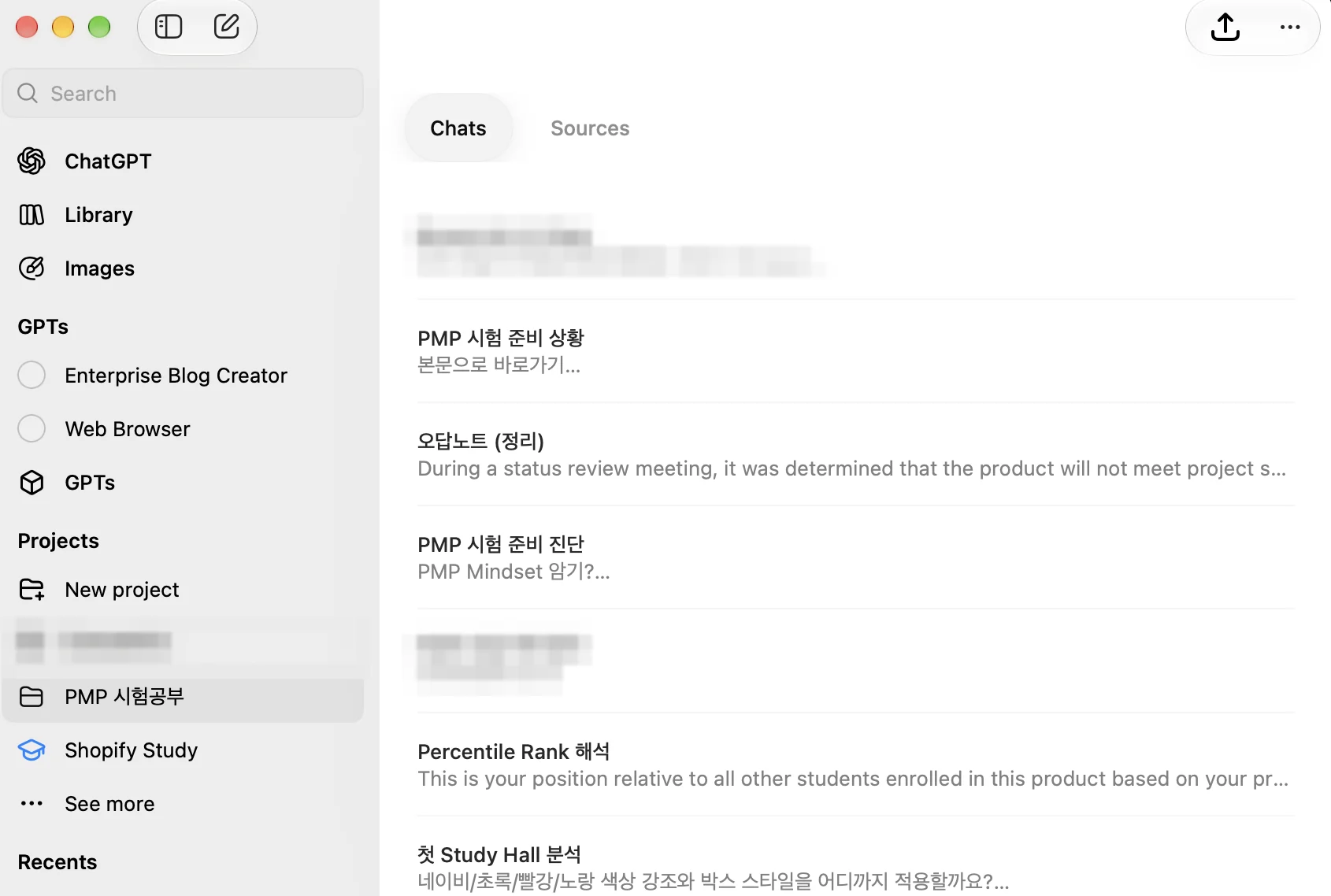
The chat list in my ChatGPT project "PMP 시험공부." Three private items are pixelated.
I had GPT sort my mistakes by cause, and I'd walk it through my reasoning and ask it to point out the assumptions I'd skipped. The final rule, though, I always wrote in my own words. That's the version that comes back to you in the exam room.
What to ask GPT, and how, is in Part 7, with example promptsPrompt EngineeringThe practice of structuring, refining, and optimizing textual inputs to instruct generative AI models to produce desired outputs.Read More →.
The free PMP error log template (Word)
I put everything in this post into a Word file. It's 9 pages:
- Page 1: the six steps and the cause tags (C·R·M·S·A·T)
- Page 2: the worked example, plus good rules vs. bad rules
- Pages 3–7: 10 blank error cards
- Page 8: the weekly review sheet, "Rules I keep breaking — top 3" and "Read the night before: my 10 rules"
- Page 9: 12 one-line PMP mindset rules
It comes in Korean, English, Spanish and Japanese, and you pick the file language when you request it. Leave your email below and agree to the newsletter, and I'll email you the download link.
Free template · Word (.docx)
PMP Error Log Template
The error-log method I used all the way to my pass, as a Word template. Leave your email and I’ll send the download link right away.
- A worked example + six error tags (C·R·M·S·A·T)
- 10 error cards and a weekly review sheet
- 12 one-line PMP mindset rules
Wrapping up
Keeping an error log takes time, no question. But for me, turning one wrong answer into a one-line rule was worth more in the exam room than doing more new questions. The questions never come back. The judgment calls do.
Case-study questions on the new exam go on the same cards. I cover how to prepare for them in Part 9.
Next up: how I checked this error log with GPT and reviewed it with NotebookLM audio on my commute.
Next: GPT for Concepts, NotebookLM Audio for the Commute: My PMP AI Study Routine
Frequently asked questions
When should I start a PMP error log?
From your very first practice set. If you collect cause tags from the start, you see early which kinds of questions you keep missing, and it gets easier to decide what to study in the time you have left.
Should I log questions I got right?
Log the ones you guessed or weren't sure about. A lucky right answer can easily turn into a wrong one on exam day. You don't need to log the ones you knew for certain.
Can I just copy the questions into my error log?
You can, but I wouldn't. It takes a long time and you end up memorizing answer sentences. Summarize the situation in one line and spend the time on why the correct answer is the best and on your rule for next time.
How do I get the PMP error log template?
Enter your email in the template box in this post and agree to the newsletter, and the download link arrives by email. It's a 9-page Word file, available in Korean, English, Spanish and Japanese.
My Study Hall scores are in the 60s. Is an error log enough?
My full mocks were 66% and 65%, my overall average was about 62%, and I passed. That isn't a passing line that works for everyone, though. Alongside your score, check whether you're missing fewer questions for the same reason and whether you can explain your reasoning in your own words.
Sources
GPT for Concepts, NotebookLM Audio for the Commute: My PMP AI Study Routine
Part 7 / 15Revision History
Error-log method in six steps with a free Word template.
- •C·R·M·S·A·T cause tags, worked example and good-vs-bad rules
- •Added the template request box
Knowledge Relationships
- ContinuesEverything That Changed in the 2026 PMP Exam, Plus PMBOK 7th vs 8th Edition
- ContinuesGPT for Concepts, NotebookLM Audio for the Commute: My PMP AI Study Routine
- ExpandsHow to Prepare for PMP Case-Study Questions: Reading and Solving the New 2026 Format
- ExpandsPMP Study on Your Commute: Short, Frequent Sessions (+ My PMP Vocabulary List)
- ExpandsGPT for Concepts, NotebookLM Audio for the Commute: My PMP AI Study Routine
- ExpandsPMP Pass Review Part 1: 7 Weeks of Prep, Study Hall Scores in the 60s, and a PASS
Referenced By
These articles mention this article
- After the PMP: I Started Volunteering on the PMI Korea Chapter's Education Committee
- What Changed at Work After the PMP: Not My Title, but How I Talk
- How to Prepare for PMP Case-Study Questions: Reading and Solving the New 2026 Format
- PMP Study on Your Commute: Short, Frequent Sessions (+ My PMP Vocabulary List)
- GPT for Concepts, NotebookLM Audio for the Commute: My PMP AI Study Routine
- Everything That Changed in the 2026 PMP Exam, Plus PMBOK 7th vs 8th Edition
- PMP Pass Review Part 2: Time Management on Exam Day and Final Tips for Passing
- PMP Pass Review Part 1: 7 Weeks of Prep, Study Hall Scores in the 60s, and a PASS
Idea Evolution
Ask DailySay
Related Posts
GPT for Concepts, NotebookLM Audio for the Commute: My PMP AI Study Routine
After the PMP: I Started Volunteering on the PMI Korea Chapter's Education Committee
Is the PMP Worth It? An Honest Look at Work, Salary and Hiring

The PMP May Matter Most for Non-PMs: When Developers and Designers Think Like PMs
Continue Reading
GPT for Concepts, NotebookLM Audio for the Commute: My PMP AI Study Routine
How I used a ChatGPT project to re-check concepts and a 155-source NotebookLM notebook to make audio reviews for my commute, with prompts and setup steps.
Notes worth keeping.
Occasional updates about project management, AI, products, travel, and the things I’m building.
No spam — occasional notes only. See our Privacy.