Everything That Changed in the 2026 PMP Exam, Plus PMBOK 7th vs 8th Edition
The PMP exam that launched July 9, 2026, compared with the old one: questions, time, breaks, domain weights, eligibility, PMBOK 7 vs 8 and the AI Standard.
Part 5 / 15
Yesterday (September 14), a member email from PMI landed in my inbox. The subject: "Your member access: PMI's AI Standard." Members can now read PMI's standard on AI in project management for free.
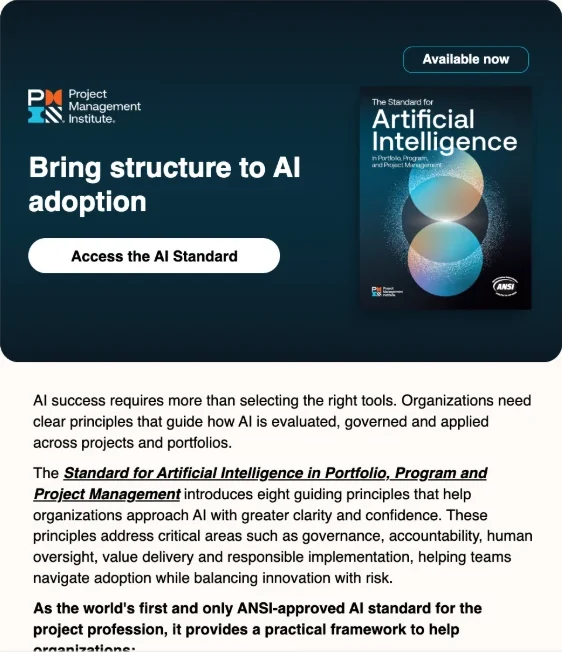
The PMI member email I received on September 14, 2026. It mentions the standard's eight guiding principles and calls it the first and only ANSI-approved AI standard for the project profession.
That email says a lot about where PMI is heading: setting principles for how AI gets used, judging projects by the value they create, and building sustainability in. The PMP exam moved the same way on July 9, 2026.
I passed the old exam on July 3, six days before the switch. So this isn't a review of the new exam. Instead, I've gone through PMI's official documents (the 2026 Exam Content Outline, the Certification Handbook and the PMBOKPMBOKProject Management Body of Knowledge: A collection of processes, best practices, terminologies, and guidelines compiled by the PMI.Read More → Guide page) to lay out what changed and how studying should change with it.
In three lines — Since July 9, 2026, the PMP has 180 questions (170 scored + 10 unscored) in 240 minutes, and it opens with a case-study section. The biggest shift is Business Environment, which more than tripled from 8% to 26% of the exam. The PMBOKPMBOKProject Management Body of Knowledge: A collection of processes, best practices, terminologies, and guidelines compiled by the PMI.Read More → Guide was also reshaped in its 8th edition (6 principles, 7 performance domains), but the exam isn't based on any single book.
Old vs New at a Glance
| Item | Old exam (the one I took) | New exam (from July 9, 2026) |
|---|---|---|
| Questions | 180 (175 scored + 5 pretest) | 180 (170 scored + 10 unscored) |
| Time | 230 minutes | 240 minutes |
| Breaks | Two 10-minute breaks (after Q60 and Q120) | Two 10-minute breaks (after the case-study section, and about halfway through the independent questions) |
| New question types | — | Case/scenario questions, graphic-based questions |
| Domain weights | People 42% · Process 50% · Business Environment 8% | People 33% · Process 41% · Business Environment 26% |
| Tasks | 35 | 26 (People 8 · Process 10 · Business Environment 8) |
| Approach | About 50% predictive · 50% agile/hybrid | About 40% predictive · 60% agile/hybrid |
| Experience window | Last 8 years | Last 10 years |
| Education routes | 60 months (secondary), 36 months (bachelor's), and so on | New 48-month route for associate degrees and similar (EQF level 5) |
| 35 training hours | Live classes from any provider | From Dec 1, 2026, live classes count only from an ATP, a China REP or an accredited higher-education program |
| Identity check | — | Persona check (selfie plus government ID) before payment |
| Exam fee (Korea, PMI member) | $405 (my June receipt) | $405 (PMI store, October 3, 2026) |
The question count is still 180. What changed is the split: scored questions went from 175 to 170, and unscored ones from 5 to 10. Exam time grew by 10 minutes, to 240.
For reference, my Pearson VUE appointment was 270 minutes long: the 230-minute exam plus the tutorial, the agreement and the survey. I go through that booking email in PMP Pass Review Part 2.
The new case/scenario and graphic-based questions appear both at test centers and online. Some other formats, like matching, hotspot and pull-down questions, only appear at test centers.
Six Ways Studying Changes
Here's what the numbers in that table mean for how you study.
1. Business Environment Jumps from 8% to 26%
This is the big one. On the exam I took, Business Environment was a small slice, 8% of the questions. Now it's roughly one question in four.
My result sheet showed Above Target for Business Environment, but back then it carried little weight in the overall result. If you're preparing now, you can't treat it as an afterthought. It even has as many tasks as People: eight.
2. Agile and Hybrid Make Up 60%
The predictive-to-agile/hybrid split moved from roughly 50:50 to 40:60. The more hybrid scenarios there are, the more it matters to tell which part of a project runs predictively and which part runs agile.
One of the repeat mistakes I listed in PMP Pass Review Part 2 was mixing up predictive and agile situations. On the new exam, assume you'll be tested on that distinction more often.
3. Value-Based Delivery Becomes a Task
The Process domain has a new task: "Help ensure value-based delivery." I read it as a signal that hitting the schedule and budget isn't enough; the exam also cares whether the result created value. That lines up with the PMBOKPMBOKProject Management Body of Knowledge: A collection of processes, best practices, terminologies, and guidelines compiled by the PMI.Read More → Guide 8th edition, which defines a project by the value it's meant to create.
4. Sustainability Sits Inside Four Tasks
Sustainability isn't a task of its own. It's written into the enablers (illustrative examples of the work) of four tasks: planning, quality, compliance and risk. Rather than memorizing it as a separate chapter, get used to weighing it whenever you think about planning or risk.
5. AI Lives Inside Scenarios, Not in Its Own Domain
There's no AI domain and no AI task. AI and sustainability were inputs to the job analysis that sets the exam's scope, and on the exam AI shows up as context within scenarios. If you read that the PMP added an AI domain, that's not accurate.
6. Case Studies Come First
The new exam opens with the case-study section: one scenario followed by a series of questions. When the section ends, you get your first break, and once you start that break you can't go back. I cover how to read these scenarios and pace yourself in Part 9: How to Prepare for PMP Case-Study Questions.
Eligibility Changed Too
It's not just the exam. The application rules moved as well.
- Experience window: up from the last 8 years to the last 10. When I applied in June, the 8-year rule still applied.
- New 48-month route: associate degrees and similar EQF level 5 qualifications now need 48 months of experience. Bachelor's degrees still need 36, secondary school 60, and GAC-accredited degrees 24.
- 35 training hours: from December 1, 2026, live classes count only if they come from a PMI Authorized Training Partner (ATP), a China Registered Education Provider (REP) or an accredited higher-education program. Self-paced courses count from any provider, and books or practice exams alone never count. An active CAPM waives the 35 hours.
- Identity check: the application now includes "enhanced verification," and before you pay, Persona checks a selfie against your government-issued ID.
How to write up your experience, and what happens if you're audited, is in Part 4: Writing Up Your PMP Experience and Handling an Audit.
PMBOKPMBOKProject Management Body of Knowledge: A collection of processes, best practices, terminologies, and guidelines compiled by the PMI.Read More → Guide: 7th vs 8th Edition
You can't talk about the PMP without the PMBOKPMBOKProject Management Body of Knowledge: A collection of processes, best practices, terminologies, and guidelines compiled by the PMI.Read More → Guide. The 8th edition came out in November 2025 (the launch was announced on November 13). It runs 408 pages, and PMI says it draws on more than 48,000 data points. PMI members get the PDF for free.
| PMBOKPMBOKProject Management Body of Knowledge: A collection of processes, best practices, terminologies, and guidelines compiled by the PMI.Read More → Guide 7th edition | PMBOKPMBOKProject Management Body of Knowledge: A collection of processes, best practices, terminologies, and guidelines compiled by the PMI.Read More → Guide 8th edition | |
|---|---|---|
| Released | August 1, 2021 | November 2025 (launch announced November 13) |
| Principles | 12: stewardship, team, stakeholders, value, systems thinking, leadership, tailoring, quality, complexity, risk, adaptability and resiliency, change | 6: holistic view, focus on value, embed quality, accountable leadership, integrate sustainability, empowered culture |
| Performance domains | 8: stakeholders, team, development approach and life cycle, planning, project work, delivery, measurement, uncertainty | 7: governance, scope, schedule, finance, stakeholders, resources, risk |
| Processes | Removed from the Guide; moved to PMIstandards+ and a separate Process Groups practice guide (2022, 49 processes) | 40 non-prescriptive processes are back in the book, with the five process groups returning as five Focus Areas (initiating, planning, executing, monitoring and controlling, closing) |
| Tailoring | One of the principles, plus its own section | No longer a principle, but the guidance stays |
| Other content | Models, methods and artifacts section | Tools and techniques section; expanded coverage of AI, PMOs and procurement |
What Stands Out, Having Studied with the 8th Edition
As I wrote in Part 1, I started out planning for the new exam and studied with the PMBOKPMBOKProject Management Body of Knowledge: A collection of processes, best practices, terminologies, and guidelines compiled by the PMI.Read More → Guide 8th edition, then took the old exam because the timing worked. From that seat, three differences stand out.
- The return of processes is a practical change. The 7th edition moved processes out of the book (to PMIstandards+ and a separate guide). The 8th edition brings 40 of them back and groups them into Focus Areas from initiating to closing. For predictive questions, I think that makes it easier to follow "which stage of the work is this?" within a single book.
- The 8th edition's principles echo the new outline's vocabulary. "Focus on value" pairs with the value-based delivery task, and "integrate sustainability" with the sustainability enablers in four tasks. Reading the 8th edition makes the new exam's language feel familiar.
- Governance and finance are now performance domains. I read that as moving in the same direction as Business Environment's bigger share of the exam.
The 8th edition also covers AI in more depth. One of the sources in my NotebookLM notebook is a YouTube video called "ALL the A.I. in the New PMBOKPMBOKProject Management Body of Knowledge: A collection of processes, best practices, terminologies, and guidelines compiled by the PMI.Read More → 8th Edition." Still, as above, AI has no task of its own on the exam.
The Exam Still Isn't Based on One Book
PMI is clear that the PMP exam isn't written from any single text. Its top-10 reference list is the PMBOKPMBOKProject Management Body of Knowledge: A collection of processes, best practices, terminologies, and guidelines compiled by the PMI.Read More → Guide and the Agile Practice Guide plus eight books from other publishers. So "the new exam is based on PMBOKPMBOKProject Management Body of Knowledge: A collection of processes, best practices, terminologies, and guidelines compiled by the PMI.Read More → 8" isn't accurate.
There is a link, though. The 2026 Exam Content Outline uses the PMBOKPMBOKProject Management Body of Knowledge: A collection of processes, best practices, terminologies, and guidelines compiled by the PMI.Read More → Guide 8th edition's definition of a project: "a temporary initiative in a unique context undertaken to create value." That's why I'd treat the 8th edition less as the exam's syllabus and more as the language the exam speaks.
What Is PMI's AI Standard?
Back to yesterday's email. The full name is The Standard for Artificial Intelligence in Portfolio, Program, and Project Management.
| Item | Details |
|---|---|
| Released | June 9, 2026 |
| Length | 275 pages |
| Price | Free for PMI members; $74.95 digital for non-members |
| 8 guiding principles | Strategic value, risk, governance, people, ethics, stakeholders, optimization, data quality |
| 5 performance domains | Stakeholder expectations, scope, architecture, strategy execution, risk |
| Notable | Human-in-the-loop; ties to the EU AI Act and ISO 42001 |
The email introduces it as the world's first and only ANSI-approved AI standard for the project profession.
That doesn't make the AI Standard a new part of the PMP exam. In the new outline, AI has no task of its own and appears as context inside scenarios. But if you're a member and your job involves rolling out AI, it's free and worth a skim.
If You're Starting Now
In Part 1, I wrote that you should check the outline for your exam date before worrying about which textbook edition you have. After the update, that matters even more. Here's the order I'd suggest:
- Read the 2026 ECO PDF yourself. The tasks and enablers in each domain are your study list.
- Check that your course, question bank and practice exams reflect the July 2026 update.
- Spend more time on Business Environment and on agile and hybrid scenarios.
- Practice case-study and graphic-based questions on their own. My approach is in Part 9.
- Log the questions you miss, by reason. My method and a template are in Part 6.
- If you haven't applied yet, check the new experience rules first. They're in Part 4.
Wrapping Up
If I had to sum up the update in one line: the PMP now asks you to see projects through the lens of value and the business context around them. The question count didn't change, but the PM the exam has in mind did.
Part 6 is about the error log, which I called the most useful thing in the days right before my exam in Part 2. I'll show how I kept it and share a Word template.
Next: Part 6: How to Keep a PMP Error Log
Start from the beginning: PMP Pass Review Part 1
Frequently asked questions
How many questions and minutes are on the new 2026 PMP exam?
There are 180 questions (170 scored and 10 unscored), and you get 240 minutes. There are two 10-minute breaks: the first right after the case-study section, the second about halfway through the independent questions that follow. Once you start a break, you cannot return to the previous section.
Is the new PMP exam based on the PMBOKPMBOKProject Management Body of Knowledge: A collection of processes, best practices, terminologies, and guidelines compiled by the PMI.Read More → Guide 8th edition?
No. PMI says the PMP exam is not written from any single text. That said, the 2026 Exam Content Outline uses the 8th edition's definition of a project, and the PMBOKPMBOKProject Management Body of Knowledge: A collection of processes, best practices, terminologies, and guidelines compiled by the PMI.Read More → Guide and the Agile Practice Guide are both on the top-10 reference list, so reading the 8th edition helps.
Is AI a new domain on the PMP exam?
No. There is no AI domain or AI task. AI shows up as context within scenarios. AI and sustainability were inputs to the job analysis that defines the exam's scope.
Did the PMP exam fee go up with the 2026 update?
As of October 3, 2026, the PMI store shows $405 for members and $655 for non-members in Korea, the same member price I paid in June. The US store lists $425 and $675, so prices vary by region.
Did the PMP experience requirements change?
Yes. The experience window grew from the last 8 years to the last 10, and there is a new 48-month route for associate degrees and similar EQF level 5 qualifications. Bachelor's degrees need 36 months, secondary school 60, and GAC-accredited degrees 24. From December 1, 2026, the rules for counting live classes toward the 35 training hours also change.
Sources
PMP Error Log: 6 Steps to Turn Wrong Answers into Judgment Rules (+ Free Word Template)
Part 6 / 15Revision History
The 2026 PMP exam changes compared with the old exam, plus PMBOK 7th vs 8th edition.
- •Old-vs-new exam table and what each change means for studying
- •Eligibility changes, PMBOK 7 vs 8 table and the PMI AI Standard
Knowledge Relationships
Referenced By
These articles mention this article
- After the PMP: I Started Volunteering on the PMI Korea Chapter's Education Committee
- The PMP May Matter Most for Non-PMs: When Developers and Designers Think Like PMs
- What Changed at Work After the PMP: Not My Title, but How I Talk
- PMP vs CAPM vs PMI-ACP: Which One Fits You? (2026 Comparison)
- How to Prepare for PMP Case-Study Questions: Reading and Solving the New 2026 Format
- PMP Study on Your Commute: Short, Frequent Sessions (+ My PMP Vocabulary List)
- PMP Error Log: 6 Steps to Turn Wrong Answers into Judgment Rules (+ Free Word Template)
- Writing Up Your PMP Experience and Handling an Audit: Applied June 1, Approved June 9
- From PMP Application to Pearson VUE Booking: Applied June 1, Booked June 13 (Real Emails)
- PMP Pass Review Part 2: Time Management on Exam Day and Final Tips for Passing
- PMP Pass Review Part 1: 7 Weeks of Prep, Study Hall Scores in the 60s, and a PASS
Idea Evolution
Ask DailySay
Related Posts
PMP Error Log: 6 Steps to Turn Wrong Answers into Judgment Rules (+ Free Word Template)
After the PMP: I Started Volunteering on the PMI Korea Chapter's Education Committee
Is the PMP Worth It? An Honest Look at Work, Salary and Hiring

The PMP May Matter Most for Non-PMs: When Developers and Designers Think Like PMs
Continue Reading
PMP Error Log: 6 Steps to Turn Wrong Answers into Judgment Rules (+ Free Word Template)
A PMP error log isn't for copying questions. It's for building judgment rules: log misses and lucky guesses, tag the cause, and write 'If ___, first ___.'
Notes worth keeping.
Occasional updates about project management, AI, products, travel, and the things I’m building.
No spam — occasional notes only. See our Privacy.