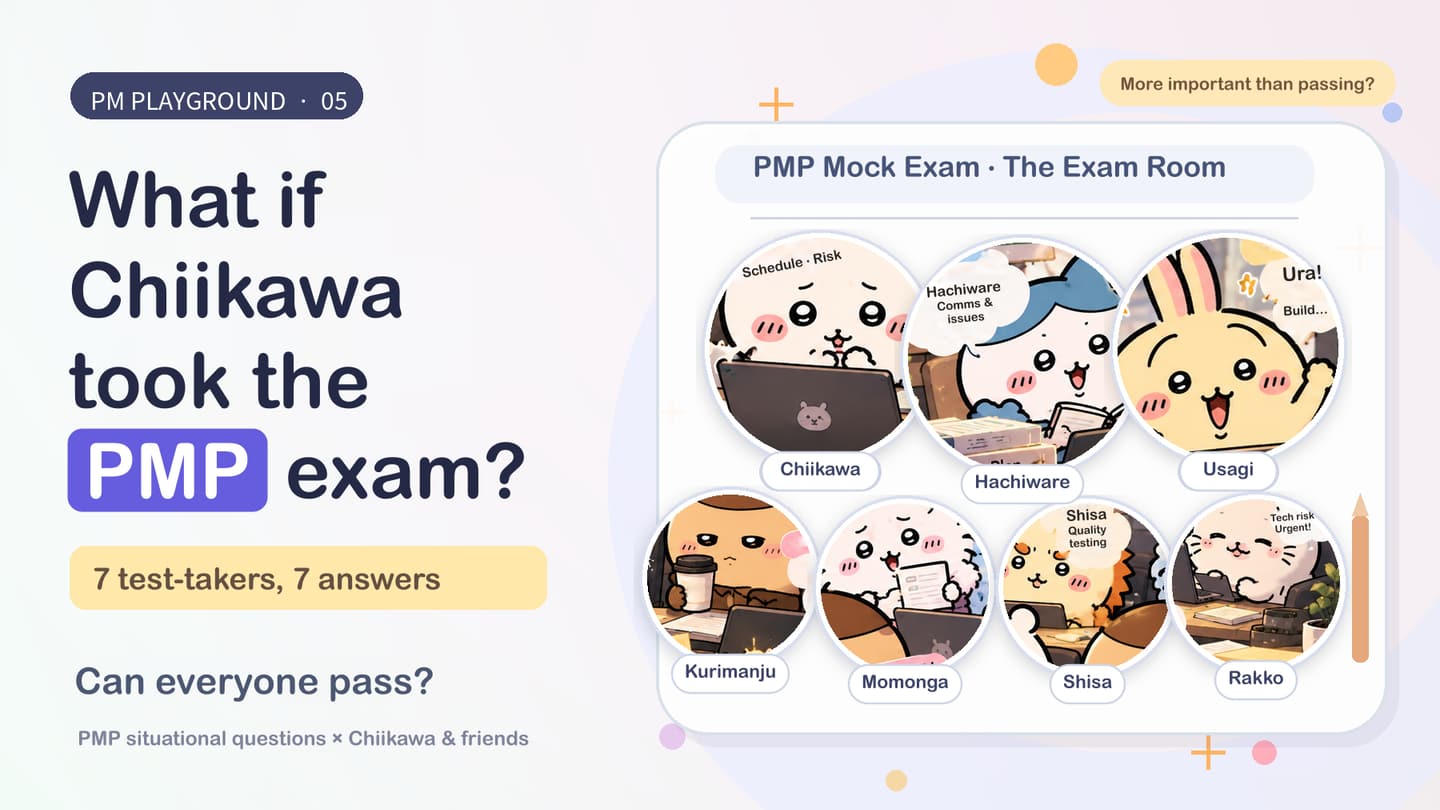
What If Chiikawa Took the PMP Exam? 🐹 | 7 Test-Takers, 7 Answers
Worried Chiikawa, upbeat Hachiware and act-first Usagi sit the PMP exam. Seven study styles and three original situational questions show how PMs make the call.
Part 1 / 1
7 test-takers, 7 answers… Is Usagi even reading the questions?
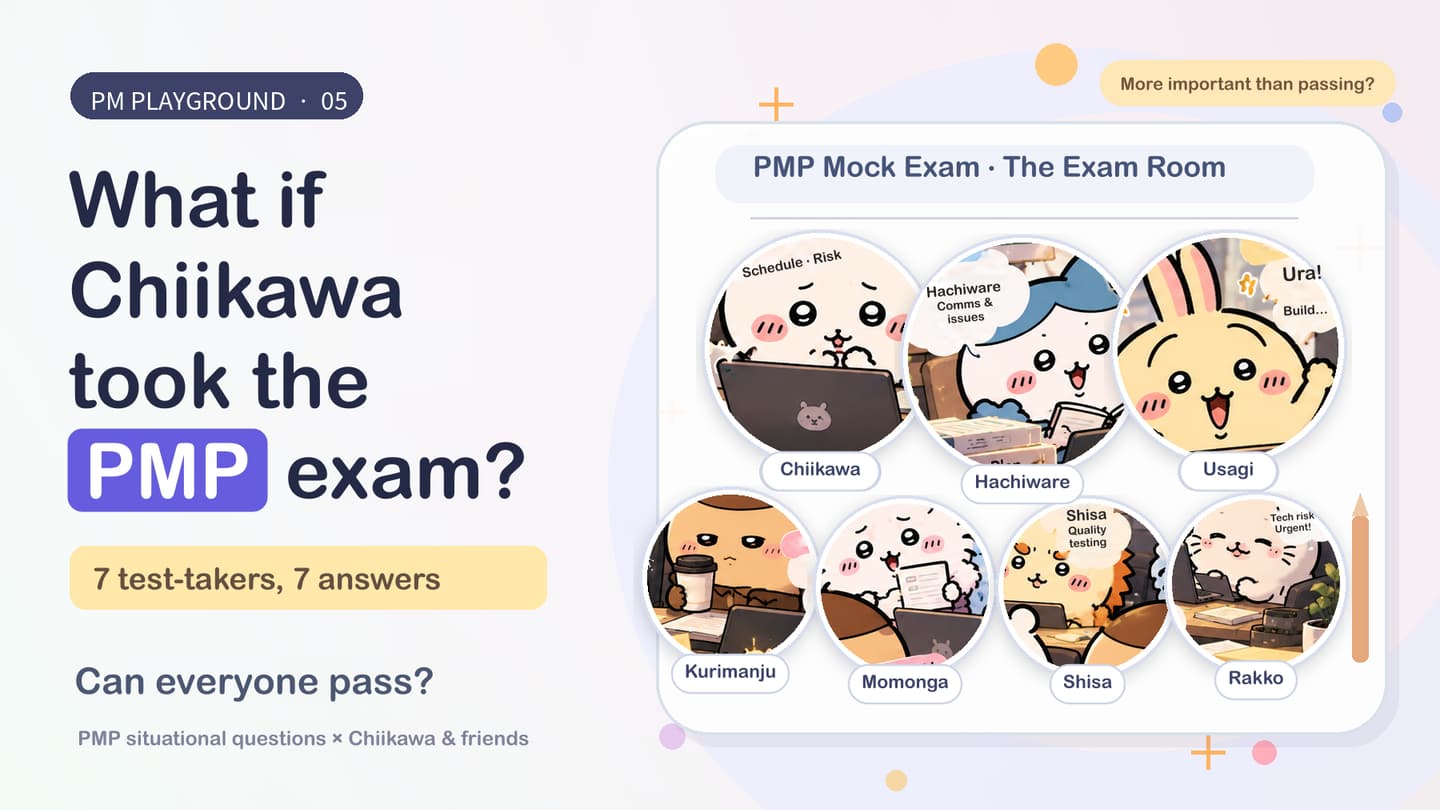
Anyone who manages projects knows this moment. Someone next to you is crying because the schedule slipped, someone in front of you has started building because "let's just try it," and someone else is smiling to reassure everyone.
Wait… isn't this exactly the Chiikawa world?
Then a thought struck me. If worried Chiikawa, upbeat Hachiware and Usagi, whose actions always outrun words, sat the PMP (Project Management Professional) exam, who would pass first?
They walk into the exam room with cute faces, but the questions are not cute at all. 😭
I earned my own PMP on July 3, 2026. Studying for it and then facing the exam, I came to feel that a PM's job is less about memorizing set answers and more about judging what to look at first in a situation, and who to make the decision with.
So today I've handed the PMP exam to Chiikawa and friends. Of course, the situational questions and answers below are hypothetical cases I wrote for this blog. They are not official PMI exam questions.
📋 Before Entering the Exam Room | What Is the PMP?
The PMP is a professional project management certification run by PMI (Project Management Institute). It assesses not only planning and execution skills but also the judgment that connects people, process and business value.
The exam was revised in July 2026. According to PMI's current information, it has 180 questions in 240 minutes, weighted People 33%, Process 41% and Business Environment 26%. Alongside predictive, agile and hybrid approaches, it puts more weight on situational judgment that includes AI, sustainability and value delivery.
※ I earned mine on July 3, 2026, just before the revised exam took effect, so please keep my experience separate from the current exam format. For exam details, the most accurate source is PMI's official notice, so check it again before you sit the exam.
Official PMI information: pmi.org/certifications/project-management-pmp/new-exam
🎒 1. How Chiikawa and Friends Prepare for the PMP
🐹 Chiikawa | Writes a Risk Register Before the Exam Even Starts
"Um… what if I run out of time…? What if I hit three questions I don't know in a row…? Waaah!"
Chiikawa's notebook is packed with error patterns, time allocation and confusing terms. Even during practice questions, Chiikawa worries about missing a single small clue. Yet that worry actually turns into risk identification and preparing in advance.
PM take: The risk manager. Strength: preparation. Weakness: analyzing so long that decisions get put off. In the exam room, while weighing every possibility, the time to move on to the next question can disappear.
🐱 Hachiware | "It's okay, let's solve it together!"
"Chiikawa, it's okay to get it wrong! Let's think together about why you picked that!"
Hachiware sets the mood in the study room, explaining the material and listening to everyone's different approaches all the way through. Those strengths would probably shine on situational questions about interpersonal conflict or team growth.
PM take: The servant leader. Strength: listening and removing impediments. Weakness: waiting for everyone to agree, so decisions come late.
🐰 Usagi | Already Picked Option 3 Before Reading the Question
"Uraaa!!!" (flipping past 30 questions within five minutes of the start)
When it comes to drive, Usagi is in a league of their own. When a plan stalls, Usagi moves without hesitation. But on PMP situational questions, skipping past what you should do "first" and jumping straight to building, escalating or taking immediate action will get you into trouble.
PM take: The doer. Strength: decisiveness and speed. Weakness: moving before checking the impact and the root cause. The study habit Usagi needs most is "read the question all the way to the end before clicking an option."
🪽 Momonga | Plans the Passing-Photo Angle Before Studying
"When I pass, which angle will look the coolest? I'll show you my study plan too!"
Momonga presents study progress more stylishly than anyone. Momonga may well have a knack for reporting, presenting and handling stakeholder reactions. But good-looking materials don't replace real understanding.
PM take: The stakeholder manager. Strength: communication. Weakness: caring more about impressions than results. The PMP isn't looking for the owner of a pretty report. It's looking for someone who uses that information to lead the right decision.
🍶 Kurimanju | "Haa… Let's look at the priorities first."
While the others spread out every textbook they own, Kurimanju sorts the wrong answers by type. "Is this a people conflict? A process issue? Is it tied to the business objective?"
PM take: The experience-based judge. Strength: prioritization and a sense of balance. Weakness: leaning too hard on the old ways. "I've done this before" and "Is this right for this situation now?" are different questions.
🦁 Shisa | The Error Log Is Leveling Up
"Today I'll review change control questions, and tomorrow I'll go over agile situational questions!"
Diligent Shisa, who learns one step at a time, sets a study goal every day. Instead of just marking a question wrong, Shisa writes down "why my judgment was different."
PM take: The growth seeker. Strength: continuous improvement and lessons learned. Weakness: putting off action until the studying feels perfect. Even when preparing for a certification, a fair amount of real practice is a must.
🦦 Rakko | Probably Has an Incident Response Plan Even for the Exam
"If something has gone wrong, start with the facts. Who's affected, and what needs to be decided?"
Rakko stays calm even in a crisis, and would probably be strong on questions about separating an issue's scope of impact and working with the right owners.
PM take: The crisis responder. Strength: judgment and composure. Weakness: taking everything on alone because of being so capable. A real leader also needs to know how to let the team solve the problem, rather than always swooping in like a hero.
🧠 2. The Exam Begins! Team Chiikawa Takes On Situational Questions
Question 1 | Three Days Before Launch, the Client Asks for a New Feature
[Hypothetical practice question] The client urgently requests a feature outside the already agreed scope. They say the launch date cannot move. What should the PM do first?
- A. Shout "Ura!" like Usagi and start building right away.
- B. Tell the client "Of course we can!" like Momonga.
- C. Check the purpose of the request and its impact on scope, schedule and quality, then follow the appropriate change process.
- D. Cry like Chiikawa and stop the project.
🐰 Usagi: "A!!!"
🪽 Momonga: "Wouldn't B be better for client satisfaction?"
🐹 Chiikawa: "It's not D… right…?"
🍶 Kurimanju: "Haa. Before you accept or refuse anything outright, you have to check the impact."
✅ Recommended answer for this hypothetical case: C — first understand the request and assess the impact of the change.
In real work too, what matters more than "can we do it?" is "what impact are we willing to accept, and who will approve it?" The PMP mindset isn't about mechanically shouting "no changes." It's closer to a judgment call that weighs value against risk.
Question 2 | Team Members Keep Clashing. What Should the PM Do First?
[Hypothetical practice question] The development team and the design team each blame the other for work delays. The client is anxious and team morale has dropped.
- A. Ignore the conflict and just push development faster.
- B. Understand both sides' positions and set up a session to discuss a joint solution.
- C. Immediately reprimand one side in public.
- D. Stop all work until it's decided who was at fault.
🐱 Hachiware: "Both sides have something to say. Let's listen first and solve it together!"
🦁 Shisa: "I'll also look at how we collaborated on the previous project."
🦦 Rakko: "Let's separate the facts of the problem from the blame game."
✅ Recommended answer for this hypothetical case: B — confirm the facts and resolve the conflict collaboratively.
A good PM thinks less about who won and more about how the problem gets solved and how the team can get moving again. Of course, this is different from situations that call for a formal response, such as harassment or a serious policy violation.
Question 3 | On Time and on Budget, but Users Say It's Hard to Use
[Hypothetical practice question] You launched a global brand website on schedule and on budget. But overseas visitors can't find product information and are leaving. How would you approach this?
- A. The project is over, so stop worrying about it.
- B. Put only "on schedule" in big letters in the report.
- C. Check customer and user feedback and the metrics, and discuss improvements with stakeholders.
- D. Add one more celebration banner to the home page.
🪽 Momonga: "First, the success report…"
🐹 Chiikawa: "Did what we built… not actually help the customers?"
🐱 Hachiware: "Then let's find out together why users are having trouble!"
🍶 Kurimanju: "Because finishing and creating value aren't the same thing."
✅ Recommended answer for this hypothetical case: C — look beyond the deliverables to value and outcomes.
In the revised 2026 PMP, too, the perspective on value, outcomes and the business environment has become more important. A project doesn't end at "did we build something?" We also have to ask "did we create a meaningful result?"
📈 3. Who Will Pass? My Own Prediction of the Exam Room
- Chiikawa: Thorough when reviewing wrong answers, but running out of time is a worry.
- Hachiware: Strong on people-centered questions, but needs decisiveness in urgent situations.
- Usagi: Will get through the questions fast, but must not miss the word "first."
- Momonga: May be strong at stakeholder management, but needs to look after actual execution and verification.
- Kurimanju: Good at judging priorities, but should stay open to learning new approaches.
- Shisa: Steady review and improvement are strengths, but time management under real exam conditions is the key.
- Rakko: Strong in crisis response, but should choose team collaboration over deciding alone.
So who comes first? I'm not going to pick a winner. Whether you pass the real PMP exam depends on your own ability and preparation, and these characters aren't official candidates anyway.
Instead, I picture a slightly different scene. When Chiikawa worries, Hachiware studies alongside. Kurimanju channels Usagi's drive. Rakko turns Shisa's error log into real-world cases.
Seven friends who each seemed to fall short on their own learn to make better judgments when they study together.
✍️ 4. Looking Back on Passing the PMP | What the Certification Taught Me
Earning the PMP didn't turn me into someone who can easily solve every problem on a project. Sudden client requests are still hard, and when development and design disagree, I still have to bring them together.
But studying for it gave me one important perspective. What a PM needs isn't a one-line answer to memorize for every situation. It's the attitude of making responsible choices while weighing people, process and business value together.
Chiikawa is scared but sees the risk first. Hachiware smiles but never just walks past someone in trouble. Usagi seems to do whatever Usagi likes, but gets stalled situations moving. Each friend's weaknesses are filled in, little by little, by another friend's strengths.
Borrowing Aristotle's idea of "practical wisdom," good judgment isn't complete just by memorizing rules. It takes practice in seeing what the good choice is in a given situation and then acting on it.
A certification can show what we have learned. But what kind of colleague we will be is proven by the choices we make every day.
If someday, at the end of a project, someone says "I'd like to work with this team again," wouldn't that be another kind of pass, one that no official scorecard shows?
And Chiikawa and friends, after the exam:
🐹 Chiikawa: "Ugh… that was so hard…!"
🐱 Hachiware: "But we really gave it our all!"
🐰 Usagi: "Uraaa!" (already searching for the next certification)
🍶 Kurimanju: "Haa… let's rest for now."
Cheers to every PM preparing for the PMP or leading projects in the field today. Which kind of Chiikawa PM are you? 🐹
Connected reading
Posts tied to this one by series, direct links, topic hub or tags.
Topic hub · PMP & Project Management
All 21 posts →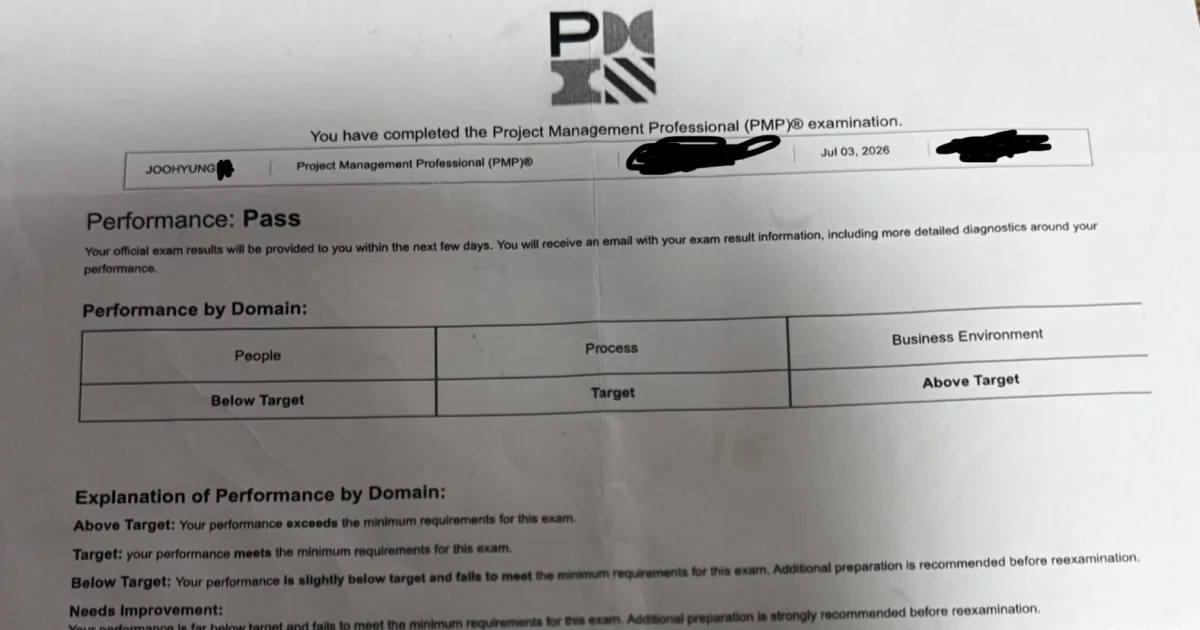
PMP Pass Review Part 1: 7 Weeks of Prep, Study Hall Scores in the 60s, and a PASS
The whole picture: seven weeks, the cost, Study Hall scores21 min
PMP Error Log: 6 Steps to Turn Wrong Answers into Judgment Rules (+ Free Word Template)
Six steps from a wrong answer to a decision rule, with a free Word template14 min
Ask DailySay
Continue Reading
Why Gamification Matters at Work: What Homo Ludens Teaches About Play and Work
Huizinga argued in Homo Ludens that culture arises in and as play. What play's features mean for work and onboarding, and gamification beyond points and badges.
Notes worth keeping.
Occasional updates about project management, AI, products, travel, and the things I’m building.
No spam — occasional notes only. See our Privacy.