GPT for Concepts, NotebookLM Audio for the Commute: My PMP AI Study Routine
How I used a ChatGPT project to re-check concepts and a 155-source NotebookLM notebook to make audio reviews for my commute, with prompts and setup steps.
Part 7 / 15
Say "I used AI to study for the PMP" and people tend to picture an AI answering the questions for you. Mine was close to the opposite. I asked GPT whether my understanding was right, not what the answer was, and I turned NotebookLM into audio lessons I listened to on my commute.
In three lines — I kept my ChatGPT chats in one project, "PMP 시험공부" (PMP exam study), and used them to diagnose my prep, clean up my error log and make sense of Study Hall results. In NotebookLM (now called Gemini Notebook) I collected 155 sources, generated 12- to 24-minute audio reviews in Korean and listened to them on my commute. AI can be wrong with total confidence, so my final reference was always the ECO, the PMBOKPMBOKProject Management Body of Knowledge: A collection of processes, best practices, terminologies, and guidelines compiled by the PMI.Read More → Guide and the Study Hall explanations.
My AI study loop at a glance
In Part 1 I briefly listed what I used GPT and NotebookLM for. This time I'll go a level deeper, with real screenshots. First, the whole loop:
Study Hall → wrong answers → GPT to explain and verify → error log → new sources in NotebookLM → audio on the commute
- Do questions in Study Hall and pull out the misses and the lucky guesses.
- Ask GPT to explain the concepts and options that tripped me up, and check whether my understanding holds.
- Write what I confirmed into my error log as a cause tag and an "If ___, first ___" rule. How to keep one is in Part 6.
- Add the cleaned-up notes and reference material to my NotebookLM notebook as sources.
- Generate an Audio Overview per topic and listen on the commute.
GPT was for checking my understanding. NotebookLM turned travel time into review time.
ChatGPT: one project for everything PMP
Instead of scattering PMP chats across my history, I kept them in one ChatGPT project called "PMP 시험공부." With a project, everything PMP sits in one place, so finding an old conversation is easy.
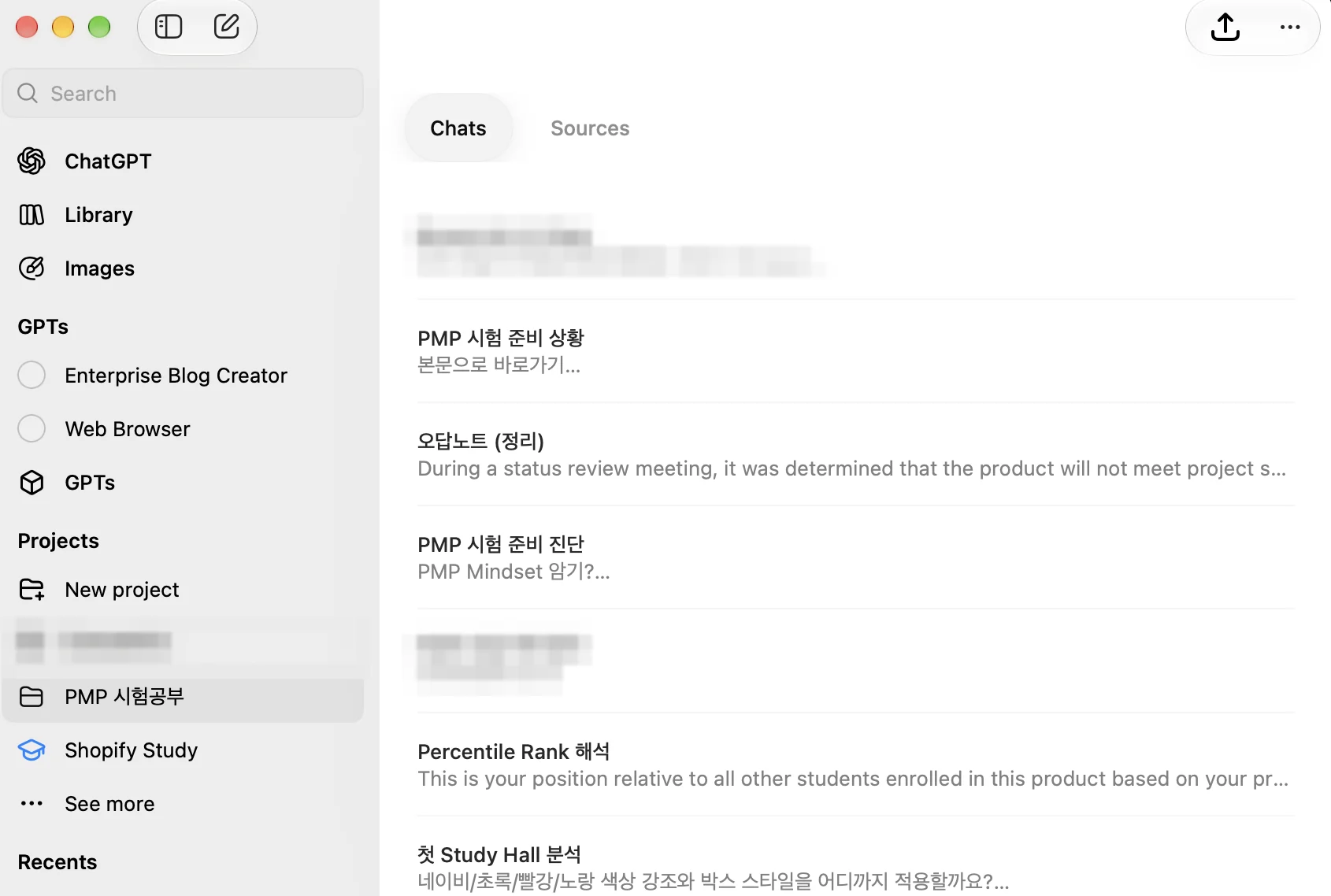
The chat list in my ChatGPT project "PMP 시험공부." Three private items (two chats and another project) are pixelated.
The chat titles alone show what I used it for:
| Chat (Korean title) | What it was for |
|---|---|
| PMP 시험 준비 상황 (where my prep stands) | Checking how far along I was |
| PMP 시험 준비 진단 (prep diagnosis) | Diagnosing my prep ("Do I memorize the PMP Mindset?") |
| 오답노트 (정리) (error log cleanup) | Sorting misses by cause and tidying up rules |
| 첫 Study Hall 분석 (first Study Hall analysis) | Going over my first Study Hall results |
| Percentile Rank 해석 (reading Percentile Rank) | Understanding Study Hall's Percentile Rank |
Study Hall's Percentile Rank is your position relative to everyone else using the same Study Hall product. My scores made me nervous every time I checked them, so I asked separately what that number actually meant.
The prep-diagnosis chat still shows me wondering whether I had to memorize the Mindset. My answer is the one I gave in Part 1: the Mindset isn't a formula you apply blindly. It's a judgment order you use while knowing the exceptions, like ethics, legal, safety and urgent risks.
How I used GPT is also what I described in Part 1: to check my understanding, not to pick answers for me. Pasting in a Study Hall question and just looking at the AI's pick is something I don't recommend, as I said in Part 1 and Part 2.
What to ask GPT
The promptsPrompt EngineeringThe practice of structuring, refining, and optimizing textual inputs to instruct generative AI models to produce desired outputs.Read More → below aren't copied from my chats. They're rewritten as what I'd recommend asking if you use GPT for the PMP, grouped into four uses that don't repeat the example in Part 1.
1. Explain a concept in your own words first, and ask only for the gaps
If you get a full explanation handed to you, you read it and that's it. If you explain first and only get your mistakes pointed out, those gaps become the C (Concept) tags in your error log.
Let me explain "Validate Scope" in my own words:
"The customer or sponsor formally accepting deliverables that have already been verified in Control Quality."
Point out only what's wrong or missing. Don't rewrite the explanation for me.
2. Ask it to compare the right answer with the runner-up
The hard part of the PMP is the gap between the right answer and a plausible second-best. Rather than pasting a whole question, sum up the situation in one line and ask about just the two options you were torn between. Writing the summary is half the review already.
Situation: two developers on an agile team keep clashing over a technical approach. What does the PM do first?
Option 1: Report it to the functional manager and ask for a decision.
Option 2: Bring both together and help them reach an agreement.
Both are things a PM might do. If the question asks what to do FIRST, which comes first from PMI's point of view,
and under what conditions would the other one be the right answer?
3. Ask for counter-examples that break your rule
A rule gets sturdy once you know its exceptions. Trust "conflict means talk first" too much and you'll pick a conversation even when the situation calls for immediate action.
My error-log rule: "If the team is in conflict, first help the people involved talk it through."
Give me three situations where applying this rule as-is would be wrong.
Include cases that need immediate action, like an ethics violation or a safety issue.
4. Ask it to quiz you on your own rules
Paste in the "Read the night before: my 10 rules" list from the Part 6 template. The point is to make yourself state your reasoning before you see the answer.
Below are my 10 error-log rules. Write one situational question for each.
Four options, all plausible. When I answer, don't grade it right away:
first ask me why I picked it, then grade it.
NotebookLM: a notebook filled to the source limit
First, the name. On July 16, 2026, NotebookLM was renamed Gemini Notebook. Same product. It was still NotebookLM when I was studying, so that's what I'll call it here. The disclaimer at the bottom of my screenshot already shows the new name.
2026.06.01
Joined PMI, bought Study Hall, applied for the PMP
2026.06.08
Created the NotebookLM notebook
Agile Mindset and Key Concepts for the PMP Exam
2026.07.03
Passed the PMP
2026.07.16
NotebookLM renamed Gemini Notebook
The notebook is called "Agile Mindset and Key Concepts for the PMP Exam." I created it on June 8, a week after joining PMI and buying Study Hall. I kept adding material, and today it holds 155 sources and shows a notice that it has reached the source limit.
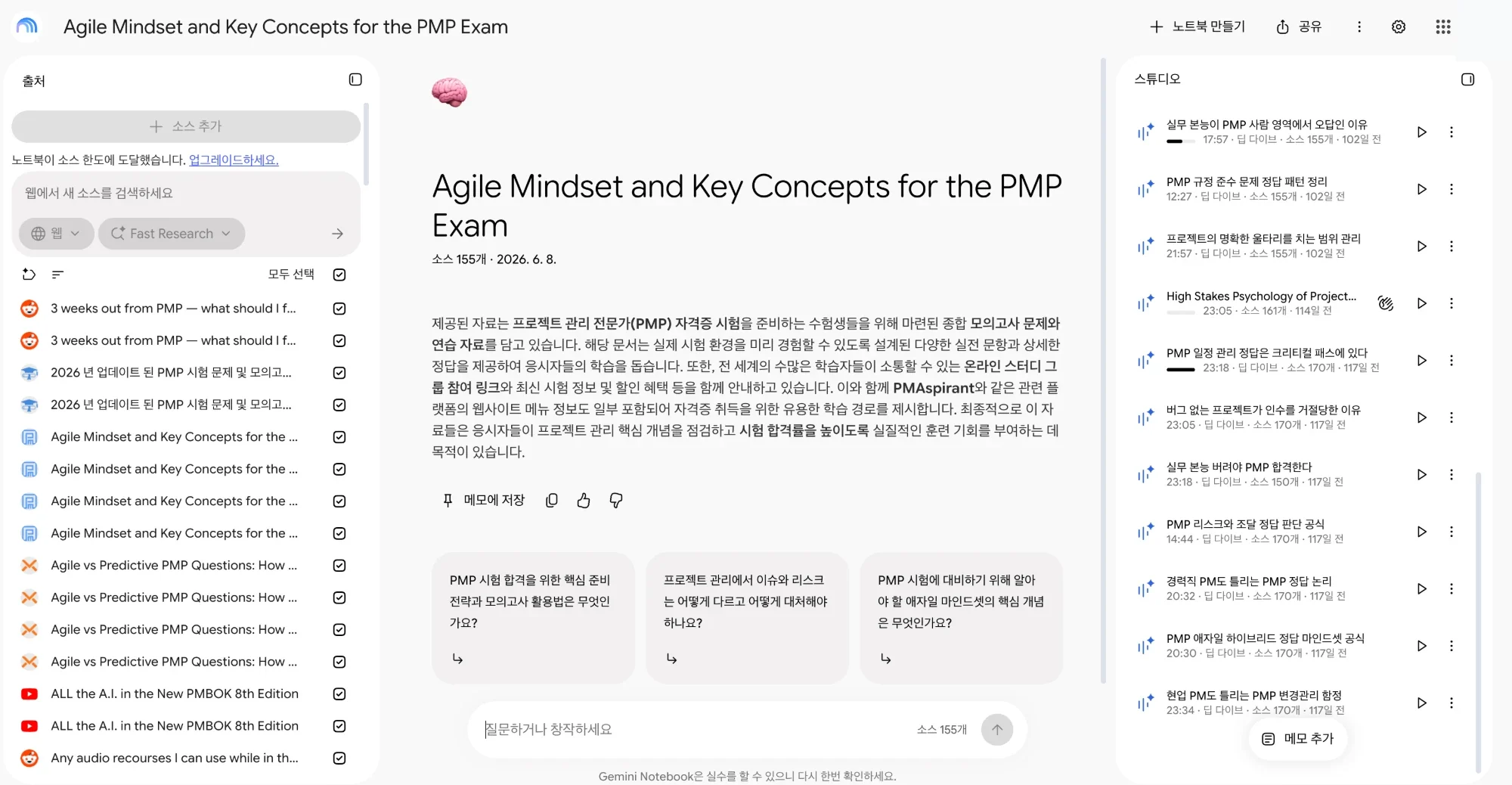
My NotebookLM notebook, created June 8, 2026. Top left: the notice that it has hit the source limit. Right: the Studio panel with my Korean audio overviews. The disclaimer at the bottom already says Gemini Notebook.
Alongside my own notes, the sources include:
- Exam-prep threads from Reddit's r/PMP
- The YouTube video "ALL the A.I. in the New PMBOKPMBOKProject Management Body of Knowledge: A collection of processes, best practices, terminologies, and guidelines compiled by the PMI.Read More → 8th Edition"
- Guides on telling agile questions from predictive ones
The more sources you add, the harder it is to tell what the AI is basing its answer on. Treat what comes from Reddit threads or YouTube videos as background, and keep official material and the Study Hall explanations as your yardstick.
The Korean deep dives I listened to on my commute
The heart of the notebook was the Audio Overview in the Studio panel. It turns your sources into a podcast-style episode; in the default Deep Dive format, two AI hosts talk it through. I made Korean Deep Dives by topic and listened to them on my commute.
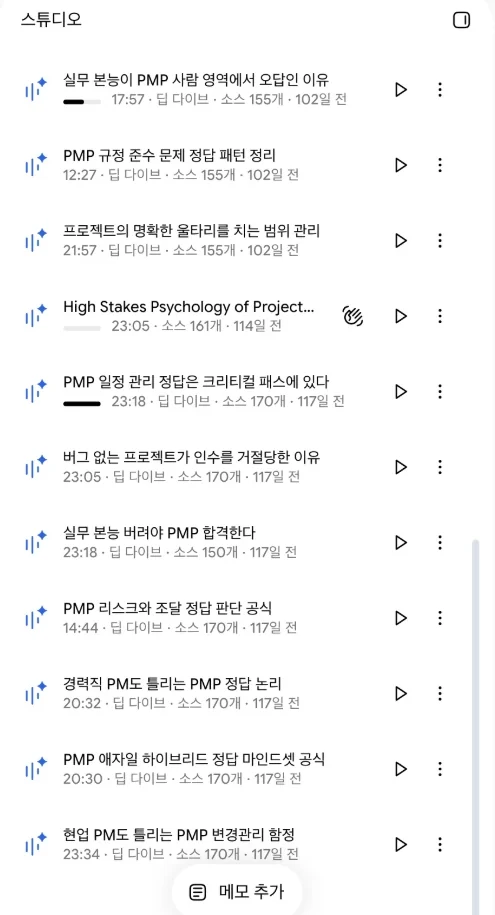
The audio list in the Studio panel. Almost all are Korean Deep Dives, running from 12:27 to 23:34.
| Episode title (Korean) | Roughly | Length |
|---|---|---|
| 실무 본능이 PMP 사람 영역에서 오답인 이유 | Why your on-the-job instincts are wrong answers in the People domain | 17:57 |
| PMP 규정 준수 문제 정답 패턴 정리 | Answer patterns for PMP compliance questions | 12:27 |
| 프로젝트의 명확한 울타리를 치는 범위 관리 | Scope management: putting a clear fence around the project | 21:57 |
| PMP 일정 관리 정답은 크리티컬 패스에 있다 | In PMP schedule questions, the answer is in the critical path | 23:18 |
| PMP 리스크와 조달 정답 판단 공식 | A formula for PMP risk and procurement answers | 14:44 |
| 경력직 PM도 틀리는 PMP 정답 논리 | The answer logic even experienced PMs get wrong | 20:32 |
| PMP 애자일 하이브리드 정답 마인드셋 공식 | The mindset formula for agile and hybrid answers | 20:30 |
| 현업 PM도 틀리는 PMP 변경관리 함정 | The change-management traps working PMs fall into | 23:34 |
| 버그 없는 프로젝트가 인수를 거절당한 이유 | Why a bug-free project was rejected at acceptance | 23:05 |
The titles have something in common. "Answer patterns," "formula," "traps": they all dig into places where what's right at work is wrong on the exam. Definitions are faster to read with your eyes, but judgment logic, the "why does this come first," works well as a story you listen to.
With People at Below Target on my result sheet, "Why your on-the-job instincts are wrong answers in the People domain" stings a little just from the title. And "Why a bug-free project was rejected at acceptance" brings to mind the difference between verify and validate. I break that pair down in Part 8.
How to set up an Audio Overview
Here's how it works according to Google's help page:
- Open a notebook and add your sources.
- In the Studio panel, choose Audio Overview.
- In the customization options, pick the format, language and length, and write a prompt for what to focus on.
| Setting | Options | Good to know |
|---|---|---|
| Format | Deep Dive (default), Brief, Critique, Debate | Deep Dive is two hosts in conversation; Brief is one speaker, under two minutes |
| Language | 80+ languages | Korean included |
| Length | Shorter, Default, Longer | Longer is English only |
| Focus prompt | Free text | Set the topics to cover or the level of expertise |
There's also an interactive mode where you can jump into the hosts' conversation and ask questions, but for now it only works in English.
Here's the kind of focus prompt I'd write. The key is one topic per episode; my own list splits into scope, schedule, risk and procurement, change management, and agile and hybrid.
This is for a candidate preparing for situational questions on the PMP exam.
Focus on change management: where everyday work habits and PMI's answer part ways.
Explain "in this situation, what do you do first?" with examples,
and compare how the first action differs in predictive and agile projects.
Wrapping up
AI didn't study for me. What it did was give me more time and more places to study. GPT checked my understanding, and audio let me hear the same topics again while I was on the move.
In the next post, I'll cover how I used that commute, and why terminology deserves its own attention, especially if you take the exam in a translated language. I'll also share the vocabulary list I put together.
Next: PMP Study on Your Commute: Short, Frequent Sessions (+ My PMP Vocabulary List)
Previous: PMP Error Log: 6 Steps to Turn Wrong Answers into Judgment Rules
Frequently asked questions
Are NotebookLM and Gemini Notebook different services?
No, it's the same product. NotebookLM was renamed Gemini Notebook on July 16, 2026. The notebook I made in June still opens as before, and the disclaimer at the bottom of the screen now shows the new name.
Can I make NotebookLM Audio Overviews in languages other than English?
Yes. Audio Overviews support more than 80 languages, Korean included, and almost all of mine are Korean Deep Dives. The Longer length option and the interactive mode, where you join the conversation, are English-only for now.
Can I paste Study Hall questions into ChatGPT?
Not to check answers, I'd say. The AI can misread the subtle differences between options and still explain its pick convincingly. Summarize the situation in one line, ask it to test your reasoning, and confirm the conclusion with the Study Hall explanation and official material.
If GPT and the Study Hall explanation disagree, which should I trust?
The Study Hall explanation and official material such as the ECO and the PMBOKPMBOKProject Management Body of Knowledge: A collection of processes, best practices, terminologies, and guidelines compiled by the PMI.Read More → Guide. Use the AI's explanation only as a study aid, and when they disagree, find the basis in the official material and write it into your error log.
Can I study for the PMP just by listening to audio?
Use audio for review. Doing questions and working out why you missed them comes first; audio is how you hear that material again while you travel. I kept Study Hall questions and my error log at the center and added audio on top.
Sources
PMP Study on Your Commute: Short, Frequent Sessions (+ My PMP Vocabulary List)
Part 8 / 15Revision History
ChatGPT and NotebookLM study routine with prompts and audio setup.
- •ChatGPT project chats, recommended prompts and verification caveats
- •NotebookLM notebook, Korean audio overviews and setup steps
Knowledge Relationships
- ContinuesPMP Error Log: 6 Steps to Turn Wrong Answers into Judgment Rules (+ Free Word Template)
- ContinuesPMP Study on Your Commute: Short, Frequent Sessions (+ My PMP Vocabulary List)
- ExpandsPMP Study on Your Commute: Short, Frequent Sessions (+ My PMP Vocabulary List)
- ExpandsPMP Error Log: 6 Steps to Turn Wrong Answers into Judgment Rules (+ Free Word Template)
Referenced By
These articles mention this article
- After the PMP: I Started Volunteering on the PMI Korea Chapter's Education Committee
- What Changed at Work After the PMP: Not My Title, but How I Talk
- How to Prepare for PMP Case-Study Questions: Reading and Solving the New 2026 Format
- PMP Study on Your Commute: Short, Frequent Sessions (+ My PMP Vocabulary List)
- PMP Error Log: 6 Steps to Turn Wrong Answers into Judgment Rules (+ Free Word Template)
- PMP Pass Review Part 2: Time Management on Exam Day and Final Tips for Passing
- PMP Pass Review Part 1: 7 Weeks of Prep, Study Hall Scores in the 60s, and a PASS
Idea Evolution
Ask DailySay
Related Posts
PMP Study on Your Commute: Short, Frequent Sessions (+ My PMP Vocabulary List)
After the PMP: I Started Volunteering on the PMI Korea Chapter's Education Committee
Is the PMP Worth It? An Honest Look at Work, Salary and Hiring

The PMP May Matter Most for Non-PMs: When Developers and Designers Think Like PMs
Continue Reading
PMP Study on Your Commute: Short, Frequent Sessions (+ My PMP Vocabulary List)
Short, frequent review beats rare marathons. How I used my commute for PMP review with audio and a word list, plus tricky term pairs and a 5-minute word loop.
Notes worth keeping.
Occasional updates about project management, AI, products, travel, and the things I’m building.
No spam — occasional notes only. See our Privacy.