
What Changed at Work After the PMP: Not My Title, but How I Talk
The work habits the PMP changed for a Global Tech PM: shared vocabulary, assessing before acting, change control, value over deliverables and tailoring.
Part 12 / 15
In the last post, I planned how to keep my PMP active for three years with 60 PDUs. Which raises the obvious question: is it worth keeping? This post covers half of the answer, the half about work.
In three lines — The PMP changed the order in which I do things more than how much I know. I now use the same words to mean the same things, assess before I act on an issue, take changes in writing, and ask about value rather than deliverables. That said, I passed less than three months ago, and a certificate doesn't do the work for you.
Where I work
I'm a Global Tech PM at Concentrix. I run ShopifyShopifyA global commerce platform hosting digital and physical storefronts, supporting localized translations, checkouts, and custom apps.Read More → and Magento implementations and enhancements for enterprise clients: setting priorities, managing risk, running UAT (user acceptance testing), shipping releases and stabilizing things after launch.
The people I work with sit in client HQ teams, local business units in different countries, global vendors and overseas technical teams. To give you a sense of scale: I took on the enhancement and global rollout of a PDP (product detail page) generator SaaS for a global beauty group, across 5 brands and 27 e-commerce sites. One decision ripples across several brands and countries at once.
Before that, I was a Software Development PM at Hyperhire, running web, app, SaaS and blockchain projects. The developers I worked with were in India, Pakistan, Indonesia, Nigeria and Ethiopia. Five countries, and time zones all over the map.
In setups like these, I think projects go sideways because of words more often than because of skills. So most of what the PMP changed for me is about words and order.
And for the record, I was doing all of this work before the PMP. The certificate didn't change my job. It slowly changed how I do it.
The first thing that changed: my vocabulary
I've used words like scope, change request and risk for as long as I've been a PM. Studying for the PMP drew much sharper lines around them. These are the five terms I now deliberately keep apart in global meetings and emails:
| Term | What I mean by it | Why I keep it precise |
|---|---|---|
| Scope | What we agreed to deliver, and what we agreed not to | Writing down the "not" part prevents crossed wires later |
| Change request | A formal request to change agreed scope, schedule or cost | Even a small change needs a decision owner if it has an impact |
| Risk | Something uncertain that hasn't happened yet but could | You can plan a response in advance |
| Issue | Something that has already happened and is affecting you now | It needs fixing and reporting, not a plan |
| Acceptance criteria | The conditions under which a deliverable counts as "done" | Separates "looks done" from "is done" in UAT |
The risk-versus-issue distinction has been the most useful one for me. "This is a risk" and "this is an issue" send completely different signals. The first says "let's prepare." The second says "let's act now." Mix them up, and people don't know how worried to be.
When people with different native languages work together in English, one precise word can replace a whole paragraph. And since the PMP is the same exam worldwide, these terms are about as close to a shared language as project work gets.
Issues and changes: assess first, write it down first
Honestly, my on-the-job instinct is "just fix it." It showed in my error log, too. The mistakes I kept repeating were picking a solution before finding the cause, and acting before analyzing the impact.
The Korean audio overviews I generated in NotebookLM while studying tell the same story. Two of the titles contain the phrase "실무 본능" (on-the-job instinct), and two more contain "PM도 틀리는" (that even PMs get wrong). What I listened to on my commute was, in the end, all about the gap between a practitioner's instinct and the PMP answer. I explain how I made and used those audio overviews in Part 7.
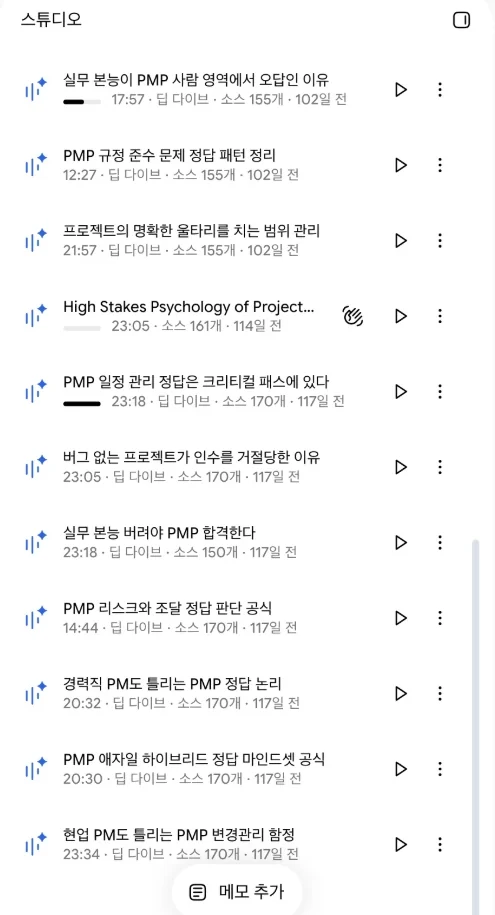
The Korean audio overviews I made in NotebookLM while studying for the PMP in June 2026. Two titles mention "on-the-job instinct," and two mention mistakes "even PMs" make.
When an issue hits
In e-commerce, issues show up unannounced. Say error reports start coming in from the checkout step right after a release. My instinct is to fire off "can you check this?" to the dev team.
These days, before I send that message, I write down three things:
- Impact: who's affected, where, and how badly. Every country, or one payment method?
- Nature: is this an issue that's already happening, or a risk that might?
- Who needs to know, and who decides: who should be informed, and who should make the call?
It takes a few minutes. Those minutes keep the developers from digging in the wrong place, and they put the client and me in front of the same picture.
There are exceptions, of course. If checkout is down everywhere, recovery comes before analysis. As I wrote in Part 1, the PMP mindset has its own exceptions, like urgent risks, that call for immediate action. But the more urgent things get, the harder I try to hold on to "how far, and why."
When a change request comes in
E-commerce enhancement work brings a steady stream of small requests: one button label, one filter, one more country. Each looks tiny, but quite a few of them touch QA, translations and per-country UAT.
Change management was also one of the areas I kept getting wrong while studying. The list above even includes an overview titled "현업 PM도 틀리는 PMP 변경관리 함정" (the PMP change-management trap that even working PMs fall into, 23:34). As the title says, it's an area where on-the-job instinct easily leads you to the wrong answer.
So now, the smaller the request, the less likely I am to just say "sure" out loud. At minimum, I try to capture these five lines:
[Change request] e.g., add a shipping-info banner to the product detail page
1. Request: who asked, and why
2. Impact: schedule / cost / scope / quality (QA and UAT reruns) / risk
3. Options: include in this release / move to the next release / don't do it
4. Decision owner: who approves
5. Decision: what was decided, and when
That's the same order the PMP exam rewards: analyze the impact, get approval through the formal process, then update the plan and tell people. It can feel a bit pedantic at first. But once there's a record, the client's own contact has a much easier time explaining the change inside their organization. A change request protects the PM, and it protects the person on the client side too.
Asking about value, not just deliverables
Another title in my audio list is "버그 없는 프로젝트가 인수를 거절당한 이유," which translates to "why a bug-free project was rejected at acceptance." The title is a question in itself. Here's the answer I read into it: the team built what it said it would, but didn't give the client what they actually wanted out of it.
In PM work, it's easy to blur outputs and outcomes. "We shipped the release" and "the feature is live" are outputs. The reason the client paid comes after that: operations get easier, customers buy more easily, sites across countries run on the same standard.
So when I take requirements now, I add one more question:
Once this goes live, who gets better at what? And how will we know?
Then I check whether the answer made it into the UAT acceptance criteria. A UAT that only checks whether a feature works is different from one that checks whether the intended outcome showed up.
PMI has been moving in the same direction. The 2026 PMP Exam Content Outline (ECO) uses the PMBOKPMBOKProject Management Body of Knowledge: A collection of processes, best practices, terminologies, and guidelines compiled by the PMI.Read More → Guide 8th edition's definition of a project: "a temporary initiative in a unique context undertaken to create value." It also adds a new Process task, "Help ensure value-based delivery," and Business Environment grew from 8% to 26% of the exam. I covered all the changes in Part 5.
Vendors and offshore teams: support over control
Confession: my People result on the exam was Below Target, the lowest of my three domains. Writing a section about how I now work with people feels a little awkward.
Still, the pattern behind my People mistakes was clear. I'd escalate before talking to the team, or try to replace someone before understanding the cause. PMI wanted the opposite. A PM isn't there to control the team but to support it and clear the way.
That lens matters even more with teams that sit in different organizations and time zones. The global vendors I work with now aren't my direct reports. They work for other companies, under other contracts. At Hyperhire, my developers were spread across five countries and very different time zones. Before asking "why is this late?", I think servant leadership starts with "what's blocking you?"
The blockers a PM can clear are surprisingly concrete:
- Vague requirements: answer questions before they sit for a full day, or connect the person who can.
- Pending decisions: get client-side approvals sorted before the other team's workday starts.
- Access and environments: permissions, test data, staging. Things a developer can't fix alone.
- Shifting priorities: boil "what comes first" down to one line and share it.
Supporting a team doesn't mean lowering the bar. If anything, clear acceptance criteria up front are the biggest support you can give a vendor. Few things are more draining than working without knowing what "done" looks like.
Choosing between predictive and agile
The enterprise e-commerce projects I've worked on are hybrid by nature. Launch dates and budgets are often approved and fixed in advance, and UAT and releases have to pass defined gates. Meanwhile, post-launch enhancement requests and the operational backlog keep reshuffling priorities.
What the PMP gave me is a way of seeing hybrid not as "a bit of both" but as a deliberate choice about what goes where. For an e-commerce project, the split might look like this:
| Manage predictively | Run with agile |
|---|---|
| Launch date, budget, contracted scope | Enhancement backlog and priorities |
| UAT schedule, acceptance criteria, release approval | Sprint-based development and demos |
| Country rollout sequence | Post-launch stabilization issues |
The 2026 PMP exam itself is now about 40% predictive and 60% adaptive or hybrid. In PMBOKPMBOKProject Management Body of Knowledge: A collection of processes, best practices, terminologies, and guidelines compiled by the PMI.Read More → 8, tailoring is no longer on the list of principles, but the tailoring guidance is still there. I read that as: tailoring isn't a slogan. It's a judgment call you make every day.
One line on my résumé changed
After the PMP, I changed the top line of my résumé to "PMP® | Global Project Manager."
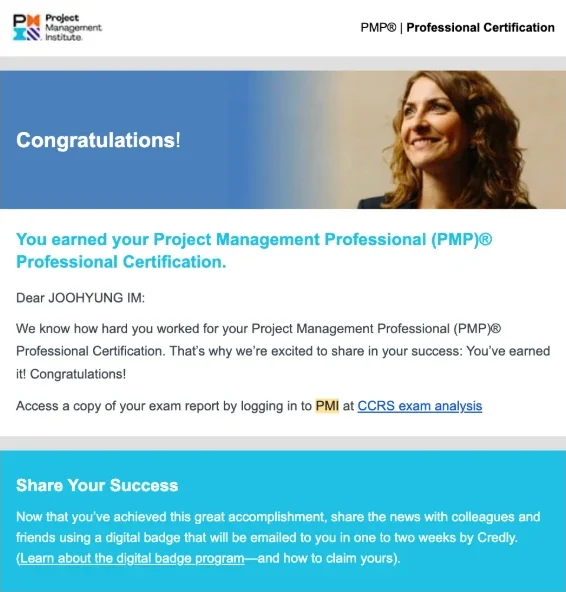
The "you earned your PMP" email from PMI, which landed in the early hours of July 4, 2026 (Korea time). It says a Credly digital badge follows by email within one to two weeks.
In global work, I think those three letters act as a short introduction. To an HQ contact or an overseas vendor meeting you for the first time, PMP can read as:
- You've led projects for a while (36 months with a bachelor's degree, and PMI randomly audits applications)
- You've studied the same vocabulary and decision framework PMI defines
- You keep learning, because the credential lapses without 60 PDUs every three years
But let me be honest: it's early. I passed in July, so as I write this, it hasn't even been three months. That's why there isn't a single "thanks to the certificate" story in this post. Three months is too short to tell one.
And a certificate doesn't do the work for you. The numbers on my résumé, like a global consumer-electronics client's operational backlog dropping from 104 to 48 items and issue-resolution lead time falling by 27%, weren't produced by three letters. They came from the work itself. The PMP just gave me more precise language for describing that kind of work.
The letters start the conversation. The work is what keeps it going.
Next, I want to make a slightly provocative case: that this way of thinking matters even more for people who aren't project managers, like developers, designers and marketers. And if you're curious about salaries and hiring, Part 14 covers that with numbers and real Korean job postings.
Next: The PMP May Matter Most for Non-PMs
Frequently asked questions
Does getting the PMP change your work right away?
Nothing changes the moment the certificate arrives. In my case, what changed was that the decision order I practiced for the exam turned into work habits: assessing impact before acting on an issue, taking change requests in writing, and asking about value rather than deliverables. Keep in mind that I passed less than three months ago.
Is it true that PMP answers differ from real-world instincts?
Partly. On-the-job instinct favors fixing and deciding fast, while PMP questions usually want you to understand the situation and analyze the impact first. That order turned out to be useful at work too. Some situations, like a full checkout outage, call for immediate action, so it is better to understand the reasoning than to memorize a formula.
Is the PMP useful if I work on an agile team?
The 2026 PMP exam is about 40% predictive and 60% adaptive or hybrid. If your project mixes a fixed launch date with backlog-driven enhancement work, the PMP helps you decide which parts to run predictively and which to run with agile.
How should I put the PMP on my résumé?
I changed the top line of my résumé to PMP® | Global Project Manager. Still, I think the project experience underneath matters more than the credential. The letters start the conversation, and the experience keeps it going.
Sources
The PMP May Matter Most for Non-PMs: When Developers and Designers Think Like PMs
Part 13 / 15Revision History
First version: the work habits that changed after passing the PMP
- •Six changes: shared terms, assessing before acting, change control, value, servant leadership, tailoring
- •What the letters on a résumé signal, and what they don't do
Knowledge Relationships
Referenced By
These articles mention this article
- After the PMP: I Started Volunteering on the PMI Korea Chapter's Education Committee
- Is the PMP Worth It? An Honest Look at Work, Salary and Hiring
- The PMP May Matter Most for Non-PMs: When Developers and Designers Think Like PMs
- My 3-Year, 60-PDU Plan to Keep the PMP, Starting with My First Approved PDU
- PMP Pass Review Part 1: 7 Weeks of Prep, Study Hall Scores in the 60s, and a PASS
Idea Evolution
Ask DailySay
Related Posts

The PMP May Matter Most for Non-PMs: When Developers and Designers Think Like PMs
After the PMP: I Started Volunteering on the PMI Korea Chapter's Education Committee
Is the PMP Worth It? An Honest Look at Work, Salary and Hiring
My 3-Year, 60-PDU Plan to Keep the PMP, Starting with My First Approved PDU
Continue Reading
The PMP May Matter Most for Non-PMs: When Developers and Designers Think Like PMs
Scope, stakeholders, risk, change control, value: why the PMP mindset helps developers, designers, marketers and ops even more than PMs, and a realistic way in.
Notes worth keeping.
Occasional updates about project management, AI, products, travel, and the things I’m building.
No spam — occasional notes only. See our Privacy.