Is the PMP Worth It? An Honest Look at Work, Salary and Hiring
What the PMP does at work, PMI's 17% median salary gap, the missing Korea data, real Korean job postings and the actual costs, three months after passing.
Part 14 / 15
If you're preparing for the PMP, sooner or later you hit this question: is it actually worth it? In this post, I'll split the answer into work, salary and hiring, and stick to my own experience and numbers I could verify.
In three lines — At work, the payoff in shared language and structure was clear, while on salary, PMI's survey shows PMP holders with a 17% higher median salary but no published figure for Korea. In Korean job postings, I found the PMP used as an application requirement, a scored certificate or a preferred qualification, mostly in IT roles at public institutions and in experienced IT hiring, while the claims about IBK and KT didn't hold up. If you already have years of project experience, it clearly pays off; if not, start with the CAPM.
My take first: it clearly helps experienced hires
I passed in July, so it hasn't even been three months. I can't prove anything with my own results yet, but I'm fairly confident about two things.
First, it clearly helps experienced hires. A recruiter has to size up a stranger's experience in very little time. The PMP is a summary that says: "This person has led projects for at least a few years, reported that experience to PMI's standard, and passed the exam." Three letters at the top of a résumé do that explaining for you.
Second, in Korea, project management is only now settling in as a profession of its own, at least as I see it. So in places that need an objective way to show PM capability, the PMP gets used as a preferred certificate or even an application requirement. The job postings below show exactly that.
At work: shared language, structure, credibility
I wrote about this in detail in Part 12 and Part 13, so here's the short version.
- Shared language: you start using scope, change request, risk versus issue and acceptance criteria to mean the same things. The more countries and companies you work across, the bigger the difference.
- Structure: you assess before acting on an issue, take changes in writing, and have a basis for choosing where predictive or agile fits.
- Credibility: with global clients and vendors, the PMP is a standard that needs no explanation. At a first meeting, it signals "this person works from the same framework."
- Even more for non-PMs: developers, designers and marketers start speaking the language decision-makers use.
These benefits are hard to prove with numbers, though. I call them "certain, but hard to measure." So let's move to the part we can measure: salary.
Salary: what the numbers say, and what they don't
PMI publishes a project management salary survey called Earning Power. The latest, the 14th edition, came out in November 2025, based on 14,628 respondents in 21 countries surveyed in March and April 2025.
| Item | PMI Earning Power, 14th edition |
|---|---|
| PMP holders vs non-certified | PMP holders report a 17% higher median salary |
| US: PMP holders / non-certified | $135,000 / $109,157 |
| US: certified 10+ years / under 5 years | $173,000 / $123,000 |
The numbers look attractive. But keep three things in mind when you read them.
- These are self-reported salaries. They're what survey respondents said, not a collection of payslips.
- PMP holders already have experience, by definition. You need at least 36 months of leading projects (with a bachelor's degree) just to sit the exam. So 17% doesn't mean "the PMP raises your salary by 17%." It means "the group of PMP holders has a 17% higher median salary."
- The same goes for 10+ years versus under 5. People who have held the certificate longer also have longer careers. You can't credit the gap to time-with-the-certificate alone.
By the way, the "PMP holders earn 33% more" figure that still circulates online comes from an older edition. The number to quote now is the 14th edition's 17%.
What about Korea? No published PMP premium
The 14th edition's detailed country data is for PMI members only. Among publicly available sources, the edition with Korea figures is the 13th, published in 2023.
| Item | PMI Earning Power, 13th edition (2023), South Korea |
|---|---|
| Korean respondents | 130 |
| Overall median salary | US$65,363 |
| PMP holders' median salary | US$66,857 |
| Non-PMP median salary | Too few respondents; not published |
Don't call the gap between the overall median and the PMP holders' median a "Korean PMP premium." The overall median includes PMP holders, and the figure you'd actually need to compare against, the non-PMP median, was never published.
In short, there's no published evidence yet that the PMP raises salaries in Korea by any particular percentage. If you see such a number, check the source first.
Hiring: how Korean job postings use the PMP
More practical than salary averages are actual job postings. In Korea, postings usually list required qualifications and "preferred" ones (우대 사항), and some public institutions also score certificates during document screening. When I checked Korean postings, the same "PMP preferred" carried very different weight. It falls into three tiers:
- Application requirement: without this certificate (or one from a list), you can't apply.
- Scored certificate: it counts directly toward your document-screening score.
- Preferred qualification: it appears on the list of nice-to-haves.
Here are the cases I could verify:
| Organization | Posting | How the PMP was used |
|---|---|---|
| Government Employees Pension Service (공무원연금공단) | 2025 new hires, IT track (전산직), Sept 1–15, 2025 | One of the certificates that qualify you to apply; worth 20 of 100 points under project management (사업관리) in the certificate score |
| Korea Asset Management Corporation (KAMCO, 한국자산관리공사) | 2024 entry-level grade 5, IT | Holding one IT certificate from a list that includes the PMP was required to apply |
| kt cloud (KT Group) | 2024 H2 experienced hires, Cloud proposal consulting | Preferred: holders of IT/cloud certificates (PMP/PMBOKPMBOKProject Management Body of Knowledge: A collection of processes, best practices, terminologies, and guidelines compiled by the PMI.Read More →/…) |
| kt cloud (KT Group) | 2024 H2 experienced hires, Cloud delivery management | Preferred: domestic or international CSP qualifications (PMP/PMBOKPMBOKProject Management Body of Knowledge: A collection of processes, best practices, terminologies, and guidelines compiled by the PMI.Read More →/…) |
| Academy of Korean Studies (한국학중앙연구원) | 2025 professional staff (IT), March 2025 | Preferred: PMP, IT-PMP, TOPCIT level 3 or higher, or Professional Engineer Information Management |
KOTRA's 2021 posting for an experienced software architect also listed "PMP·CISA" as preferred, but it's old, so take it as a footnote.
Notice the pattern? They're all roles that manage IT work: computing, IT, and cloud proposal or delivery management. And at public institutions, the PMP can go beyond "preferred" to become an application requirement or a scored item.
What about IBK and KT?
To be honest, I'd also heard that the Industrial Bank of Korea (IBK) and KT give the PMP preference. But when I checked the postings myself, I couldn't find any evidence.
- IBK (IBK기업은행): the certificate bonus list for its 2026 H2 new-graduate hiring (applications August 28 to September 14, 2026; 175 hires) doesn't include the PMP. Neither did the 2024 H2 list. There was a 2026 contract posting for an "IT project management (PMO) specialist," but I couldn't confirm its preferred qualifications.
- KT: I found no KT Corporation posting that mentions the PMP. The only ones I could confirm came from kt cloud, a KT Group company.
This is how "I heard company X prefers it" spreads. If you believed it too, open the original posting of the company you're applying to. Focus on experienced-hire, PMO, IT project management and public-institution IT postings. Even within the same group or company, it varies by role and by year. In Korea, public-institution postings can be searched on job portals such as ALIO (잡알리오).
Cost versus benefit: what I actually spent
To judge the payoff, you have to look at the cost too. Here's what I spent, going by my receipts. My seven weeks of studying are in Part 1.
| Item | Amount | Notes |
|---|---|---|
| PMI Study Hall Essentials (3-month subscription) | $53.90 | $49 + $4.90 tax, paid June 1, 2026 (now $59 per 3 months) |
| PMP exam fee (member price) | $445.50 | $405 + $40.50 tax, paid June 12, 2026 |
| Total | $499.40 | PMI membership and online course not included |
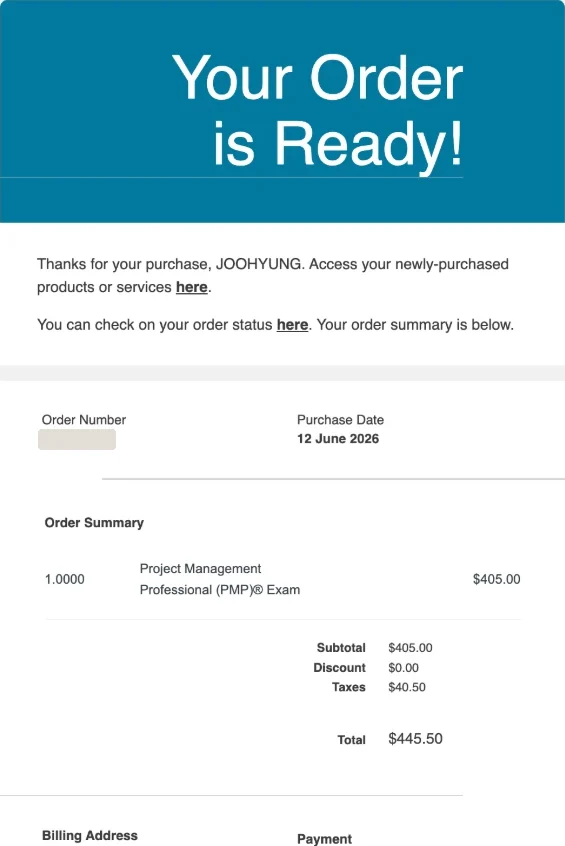
The order email for my PMP exam fee, received June 12, 2026. I covered the order number.
PMI membership costs extra: the current list price in the Korea store is $139. Joining still pays off for a simple reason. The exam costs $655 for non-members and $405 for members, a $250 gap that's bigger than the membership fee. Members also pay $100 less for a retake ($275 versus $375) and $90 less for renewal three years later.
Keeping it: $60 and 60 PDUs every three years
The PMP isn't one-and-done. Every three years, you need 60 PDUs and a renewal fee: $60 for members, $150 for non-members. Since free webinars, eLearning and chapter activities can cover PDUs, it's less about money and more about time and habit. My first PDU claim, 1.00 PDU, was approved on September 3.
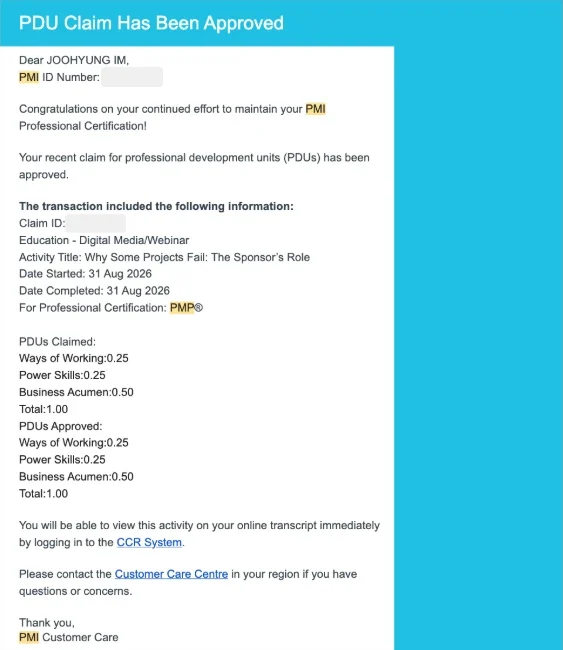
My first approved PDU claim, September 3, 2026: 1.00 PDU for a PMI webinar I watched on August 31. I covered my PMI ID and the claim ID.
My plan for earning PDUs over three years is in Part 11.
All in, getting to the exam cost me about $500 plus membership and a course, and seven weeks of evenings after work and weekends. For that to be worth it, I think at least one of two things has to be true: you're actually going after roles that ask for the PMP, or you use the mindset at work every day.
Verdict: who it clearly pays off for, and who should wait
It clearly pays off if you…
- have led projects for three years or more (with a bachelor's degree) and are preparing for an experienced-hire move or a PM or PMO role
- are targeting roles where postings actually mention the PMP, such as public-institution IT jobs, IT project management, or cloud proposal and delivery management
- work with global clients, vendors or overseas teams and need a shared language
- have plenty of experience but need a framework to explain it
It may not be the right time if you…
- don't have enough project-leading experience yet: you won't meet the eligibility rules. The CAPM route I compared in Part 10 comes first.
- only want a raise: there's no published evidence of how much the PMP raises salaries in Korea.
- never see the PMP in postings for your target companies and roles: that money and time may be better spent on core skills for the role.
- have no plans to earn 60 PDUs every three years: the credential only means something while it's active.
Wrapping up: I'll test it on the market and report back
Here's my conclusion. The PMP clearly changed how I work, and it's a certificate that public-institution IT postings and IT project management roles really use. What doesn't exist yet is Korean evidence that it raises salaries by any particular percentage. As for how well the PMP actually sells on the job market, I'll find out for myself and update this post.
The next post is the last in the series: volunteering on the education committee of the PMI Korea Chapter. Chapter volunteering also counts toward the Giving Back category of PDUs.
Next: After the PMP: I Started Volunteering on the PMI Korea Chapter's Education Committee
Frequently asked questions
Does the PMP increase your salary?
In PMI's Earning Power survey (14th edition), PMP holders reported a 17% higher median salary than non-certified peers. But you need at least 36 months of project-leading experience (with a bachelor's degree) just to sit the exam, so PMP holders tend to have longer careers to begin with. It does not mean the certificate raises your salary by 17%, and no Korea-specific PMP premium has been published.
Do Korean employers prefer the PMP?
Some do, mostly for IT roles. In the postings I checked, the Government Employees Pension Service used the PMP as an application qualifier and a scored certificate for its 2025 IT hires, and KAMCO required one certificate from a list including the PMP for its 2024 entry-level IT hires. kt cloud (2024 experienced hires) and the Academy of Korean Studies (2025 IT professional staff) listed it as preferred. Postings change every year, so always check the original.
Do IBK or KT give preference to the PMP?
I had heard that too, but I found no evidence in their postings. The certificate bonus list for IBK's 2026 H2 new-graduate hiring did not include the PMP, and I found no KT Corporation posting that mentions it. The only confirmed cases came from kt cloud, a KT Group company.
How much does it cost to get the PMP?
I spent $499.40: $53.90 for Study Hall Essentials and $445.50 for the exam at the member price, tax included. PMI membership and my online course were extra. Membership currently lists at $139 in the Korea store, and the non-member exam fee is $655, so taking the exam as a member comes out ahead.
How much does it cost to keep the PMP?
Every three years you need 60 PDUs and a renewal fee of $60 for PMI members or $150 for non-members. Free webinars, eLearning and chapter activities can cover the PDUs.
Sources
- PMI: Project Management Salary Survey (Earning Power)
- PMI: Project Management Professional (PMP)
- PMI Study Hall Essentials
- PMI CCR Handbook: certification renewal requirements (PDF)
- Korean job postings: Government Employees Pension Service 2025 new hires (IT track), KAMCO 2024 entry-level grade 5 (IT), kt cloud 2024 H2 experienced hires, Academy of Korean Studies 2025 professional staff (IT), and IBK's 2024 and 2026 H2 new-graduate hiring notices. Postings often come down after they close, so I list them by name instead of linking.
After the PMP: I Started Volunteering on the PMI Korea Chapter's Education Committee
Part 15 / 15Revision History
First version: what the PMP does for work, salary and hiring, and what it costs
- •PMI Earning Power 14th edition and the 13th edition's Korea data
- •Korean job postings that mention the PMP, and what checking IBK and KT turned up
- •Actual and ongoing costs, and who it pays off for
Knowledge Relationships
Referenced By
These articles mention this article
- After the PMP: I Started Volunteering on the PMI Korea Chapter's Education Committee
- The PMP May Matter Most for Non-PMs: When Developers and Designers Think Like PMs
- What Changed at Work After the PMP: Not My Title, but How I Talk
- PMP Pass Review Part 1: 7 Weeks of Prep, Study Hall Scores in the 60s, and a PASS
Idea Evolution
Ask DailySay
Related Posts
After the PMP: I Started Volunteering on the PMI Korea Chapter's Education Committee

The PMP May Matter Most for Non-PMs: When Developers and Designers Think Like PMs

What Changed at Work After the PMP: Not My Title, but How I Talk
My 3-Year, 60-PDU Plan to Keep the PMP, Starting with My First Approved PDU
Continue Reading
After the PMP: I Started Volunteering on the PMI Korea Chapter's Education Committee
Why I started volunteering on the PMI Korea Chapter's education committee after passing the PMP, what the chapter and committee do, and how you can join in.
Notes worth keeping.
Occasional updates about project management, AI, products, travel, and the things I’m building.
No spam — occasional notes only. See our Privacy.