PMP vs CAPM vs PMI-ACP: Which One Fits You? (2026 Comparison)
PMP, CAPM and PMI-ACP compared for 2026: eligibility, exam format, member and non-member fees, retakes, PDUs and recent changes, plus which one fits you.
Part 10 / 15
For nine posts, this series has been about one thing: getting the PMP. But spend any time on PMI's site and two other names keep showing up, the CAPM and the PMI-ACP. Here are all three side by side, and who each one is really for.
In three lines — If you've led projects for three years or more (with a bachelor's degree), go for the PMP; if you're just starting out or switching careers, start with the CAPM; if you're a product owner or scrum master on an agile team, look at the PMI-ACP. From Korea, the PMP costs $405 for PMI members and $655 for everyone else, and keeping it takes 60 PDUs every three years. An active CAPM waives the PMP's 35 training hours, and an active PMP covers the PMI-ACP's experience requirement.
The comparison table (2026)
| PMP | CAPM | PMI-ACP | |
|---|---|---|---|
| Who it's for | Experienced project leads | Entry level, no experience needed | Agile practitioners |
| Eligibility | 24–60 months of experience (depending on education) + 35 hours of training | Secondary school diploma + 23 hours of PM education; age 18+ | Secondary school diploma + 21 hours of agile training + 2 years of agile work in the last 5 (alternatives exist) |
| Exam | 180 questions (170 scored + 10 unscored), 240 minutes, 2 breaks | 150 questions (135 scored + 15 unscored), 3 hours, 1 break | 120 questions (100 scored + 20 unscored), 3 hours, 1 break |
| Fee (member / non-member) | Korea $405 / $655; US $425 / $675 | $225 / $300 | $435 / $495 |
| Retake (member / non-member) | $275 / $375 | $150 / $200 | $335 / $395 |
| To keep it (every 3 years) | 60 PDUs | 15 PDUs | 30 PDUs |
| Latest update | New exam since 9 July 2026 | Exam content outline from 2023 | New exam since 8 November 2024 |
On paper the numbers look similar, but the three are aimed at quite different people. The PMP is for people who have led projects, the CAPM for people just getting started, and the PMI-ACP for people who work in agile teams. Let's take them one at a time.
PMP: for people who have led projects
This is the one I hold, so it's the one I can say the most about. As I wrote in Part 1, it isn't tied to a single industry or methodology. It tests whether you can lead a project while juggling people, process and business priorities.
Eligibility depends on your education
| Highest education | Project leadership experience needed |
|---|---|
| Secondary school | 60 months |
| Associate degree or vocational qualification (EQF level 5, new in 2026) | 48 months |
| Bachelor's degree | 36 months |
| PMI GAC-accredited degree | 24 months |
The experience has to fall within the last 10 years, and you also need 35 hours of project management training. An active CAPM waives those 35 hours.
The training rules get a little stricter soon. From 1 December 2026, live classes only count if they come from a PMI Authorized Training Partner (ATP), a China REP or an accredited higher-education program. Self-paced courses from any provider still count. Books and practice exams on their own never do.
How to write up your experience, and what happens if you're audited, is covered in Part 4.
The exam: new since 9 July 2026
The new PMP exam is 180 questions (170 scored, 10 unscored) in 240 minutes, with two 10-minute breaks. The domains are People 33%, Process 41% and Business Environment 26%. Roughly 40% of the questions are predictive and 60% are agile or hybrid. Part 5 goes through everything that changed.
For the record, I took the old version (180 questions, 230 minutes) on 3 July, just before the switch.
Fees: $405 / $655 from Korea
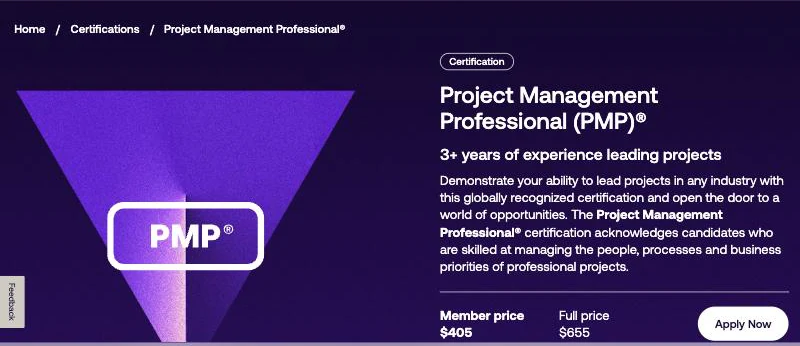
PMI's PMP page as seen from Korea: member price $405, full price $655.
PMI's store prices vary by region. The same exam costs $425 for members and $675 for non-members in the US store. I paid the $405 member price on 12 June 2026, plus $40.50 tax, so $445.50 in total. The whole process from payment to booking at Pearson VUE is in Part 3.
A retake costs $275 for members and $375 for non-members. And once you pass, you need 60 PDUs every three years. I'll show you my actual plan for that in the next post.
CAPM: the entry-level option
The CAPM (Certified Associate in Project Management) is the one you can take with no experience at all. You need a secondary school diploma, 23 hours of project management education, and to be at least 18.
The exam is 150 questions (135 scored, 15 unscored) in three hours, with one break, and it's based on a 2023 exam content outline. It costs $225 for members and $300 for non-members, retakes are $150 and $200, and you keep it with 15 PDUs every three years.
To me, the CAPM's real value is as a bridge to the PMP. An active CAPM waives the PMP's 35 hours of training. If you don't have the experience yet but want the PMP someday, getting the CAPM first and building experience along the way is a perfectly good route.
It's a good fit if you are:
- A student or a new graduate starting out
- Moving into project management from another role
- Already working on projects, but not yet at the PMP's experience bar (36 months with a bachelor's degree, for example)
PMI-ACP: for people on agile teams
The PMI-ACP (PMI Agile Certified Practitioner) is for agile practitioners. Think scrum masters, product owners and agile team members.
To apply, you need a secondary school diploma, 21 hours of agile training, and two years of agile work experience within the last five years. The experience part can be replaced by one of these:
- One year of agile experience plus a PMI GAC-accredited degree
- One year of agile experience plus an agile certification from another body
- An active PMP
The exam changed on 8 November 2024. It's 120 questions (100 scored, 20 unscored) in three hours, with one break. The domains are Mindset 28%, Leadership 25%, Product 19% and Delivery 28%, so mindset and leadership together make up more than half. It costs $435 for members and $495 for non-members, retakes are $335 and $395, and it takes 30 PDUs every three years to keep.
The detail worth noticing is the last line of that list. An active PMP covers the PMI-ACP's experience requirement. If you want to go deeper into agile after the PMP, it's a natural next step.
Which one should you pick?
No need to overthink it. Start from where you are right now.
| Where you are now | Pick | Why |
|---|---|---|
| You've led projects for 3+ years (with a bachelor's degree) | PMP | Covers predictive, agile and hybrid work, and it's widely recognized |
| You're a student, a new graduate or changing careers | CAPM | No experience needed; waives the PMP's 35 training hours later |
| You have some experience, but not enough for the PMP | CAPM | Build the basics while your experience catches up |
| You're a product owner, scrum master or agile team member | PMI-ACP | Focused on agile mindset, leadership, product and delivery |
| You already hold the PMP and want to go deeper into agile | PMI-ACP | An active PMP covers the experience requirement |
One thing to remember: the three-year figure assumes a bachelor's degree. With a secondary school diploma, the PMP asks for 60 months, or five years.
If you're in between
If you work on an agile team and have also led projects for more than three years, either one works. Choose the PMP if you want the broad, widely recognized credential, or the PMI-ACP if you want to show agile expertise specifically. And since the PMP takes care of the PMI-ACP's experience requirement, doing the PMP first isn't a bad order.
The three can also line up like this:
CAPM (while you build experience) → PMP (35 training hours waived) → PMI-ACP (experience requirement covered)
Why I chose the PMP
My reasons were simple. I had been leading projects in e-commerce and global software delivery for more than five years, so the experience requirement wasn't an issue. And I wanted something broad, not tied to one methodology, that people recognize anywhere in the world. That was the PMP.
If you lead projects without a "project manager" title, I'll cover why the PMP can matter even more for you in Part 13.
Up next: the three years after you pass
It took me seven weeks to get the PMP, but keeping it runs in three-year cycles. The PMP needs 60 PDUs every three years, the PMI-ACP 30 and the CAPM 15. In the next post, I'll share my first PDU approval email and my plan for earning 60 PDUs over three years.
Next: My 3-Year, 60-PDU Plan to Keep the PMP
Frequently asked questions
Do I need the CAPM before I can take the PMP?
No. The CAPM is not a prerequisite for the PMP. If you meet the experience requirement for your education level (36 months with a bachelor's degree, for example) and have 35 hours of training, you can apply for the PMP directly. An active CAPM does waive those 35 hours, though.
Does an active PMP count toward the PMI-ACP?
Yes. An active PMP satisfies the PMI-ACP agile experience requirement (two years within the last five). You still need a secondary school diploma and 21 hours of agile training.
How much does the PMP exam cost?
As of 2026, it is $405 for PMI members and $655 for non-members from Korea, and $425 and $675 in the US store. In June 2026 I paid the $405 member price plus $40.50 tax, $445.50 in total.
What does it take to keep each certification?
PDUs every three years: 60 for the PMP, 30 for the PMI-ACP and 15 for the CAPM. The PMP renewal fee is $60 for members and $150 for non-members.
Is PMI membership worth it?
For the PMP, yes. From Korea, the member discount on the exam is $250 and membership costs $139, so the discount alone covers it. For the CAPM and PMI-ACP the discounts are $75 and $60, so the other member benefits need to make up the difference.
Sources
My 3-Year, 60-PDU Plan to Keep the PMP, Starting with My First Approved PDU
Part 11 / 15Revision History
Compared PMP, CAPM and PMI-ACP for 2026 with a decision guide.
- •Added a full comparison table, a decision guide and why I chose the PMP
Knowledge Relationships
- ContinuesHow to Prepare for PMP Case-Study Questions: Reading and Solving the New 2026 Format
- ContinuesMy 3-Year, 60-PDU Plan to Keep the PMP, Starting with My First Approved PDU
- ExpandsThe PMP May Matter Most for Non-PMs: When Developers and Designers Think Like PMs
- ExpandsWriting Up Your PMP Experience and Handling an Audit: Applied June 1, Approved June 9
Referenced By
These articles mention this article
- After the PMP: I Started Volunteering on the PMI Korea Chapter's Education Committee
- Is the PMP Worth It? An Honest Look at Work, Salary and Hiring
- The PMP May Matter Most for Non-PMs: When Developers and Designers Think Like PMs
- My 3-Year, 60-PDU Plan to Keep the PMP, Starting with My First Approved PDU
- How to Prepare for PMP Case-Study Questions: Reading and Solving the New 2026 Format
- PMP Pass Review Part 1: 7 Weeks of Prep, Study Hall Scores in the 60s, and a PASS
Idea Evolution
Ask DailySay
Related Posts
My 3-Year, 60-PDU Plan to Keep the PMP, Starting with My First Approved PDU
After the PMP: I Started Volunteering on the PMI Korea Chapter's Education Committee
Is the PMP Worth It? An Honest Look at Work, Salary and Hiring

The PMP May Matter Most for Non-PMs: When Developers and Designers Think Like PMs
Continue Reading
My 3-Year, 60-PDU Plan to Keep the PMP, Starting with My First Approved PDU
How PMP renewal works (60 PDUs in three years, 35+ Education, Giving Back capped at 25), my first approved PDU, and my year-by-year plan by Talent Triangle.
Notes worth keeping.
Occasional updates about project management, AI, products, travel, and the things I’m building.
No spam — occasional notes only. See our Privacy.