
The PMP May Matter Most for Non-PMs: When Developers and Designers Think Like PMs
Scope, stakeholders, risk, change control, value: why the PMP mindset helps developers, designers, marketers and ops even more than PMs, and a realistic way in.
Part 13 / 15
I'll open this one with a slightly provocative claim: the way of thinking the PMP teaches is even more powerful for people who aren't project managers.
In three lines — The real value of the PMP is less the certificate and more the habit of seeing the whole project. When developers, designers, marketers and ops people pick up that habit, they start speaking the language decision-makers use, and that makes them stand out. If you don't meet the experience requirement yet, start with the CAPM; if you have no plans to take an exam, start with the six principles in the PMBOKPMBOKProject Management Body of Knowledge: A collection of processes, best practices, terminologies, and guidelines compiled by the PMI.Read More → Guide 8th edition.
In the last post, I wrote about how the PMP changed the way I work as a PM. This time, let's turn the lens around. What happens when someone who isn't a PM uses it?
What "thinking like a PM" means
What I call "the PM's lens" is nothing grand. It's the habit of placing your own work inside the whole project. Here are the five lenses I took away from studying for the PMP:
| Lens | The question you ask yourself |
|---|---|
| Scope | Where does this piece of work end, and what did we agree not to do? |
| Stakeholders | Who is affected by this, and who decides? |
| Risk | What could go wrong, and what would we do then? |
| Change control | If this changes, what else moves, and who approves it? |
| Value | When this is done, who is better off, and how? |
Two of the six principles in the PMBOKPMBOKProject Management Body of Knowledge: A collection of processes, best practices, terminologies, and guidelines compiled by the PMI.Read More → Guide 8th edition are "holistic view" and "focus on value." It's the same idea. Don't just look at your own task; look at what it connects to and what it ultimately produces.
Why it's even more powerful for non-PMs
I see three reasons.
First, it's table stakes for PMs but rare everywhere else. When a PM talks about scope and risk, nobody notices; that's the job. When a developer says the same thing, it lands differently. Rarity is what makes it a differentiator.
Second, the people doing the work see problems first. The person writing the code is the first to notice scope quietly growing. The person designing the screens is the first to sense a timeline in trouble. When that person speaks the PM's language, problems reach the table much earlier.
Third, decision-makers listen in scope, schedule, cost, risk and value. Even a technically correct point rarely turns into a decision unless it's translated into that language. "This library isn't maintained anymore" is a fact. "If we keep it, the security risk stays; if we replace it now, we add two weeks. Which way do we go?" gets a decision.
A non-PM who speaks the PM's language isn't playing PM. They become a practitioner who sees the whole picture, and I think that's the most valuable kind of person on any team.
What it looks like, role by role
Developers: don't silently absorb it; raise it as a change request
Mid-sprint, someone asks: "Can you just add this one field?" The nice developer quietly takes it on. They cover it with late nights, testing gets squeezed, and the schedule risk piles up where nobody can see it.
A developer with a PM's lens answers the same request like this:
Before we add the "delivery note" field, here's the impact:
- Scope: changes the checkout form, the admin screen and how order data is stored
- Schedule: if it goes into this sprint, payment testing slips
- Risk: it touches the payment flow, so we need regression testing
- Options: (A) include in this release (B) move to the next sprint (C) reduce scope
Which way should we go?
The moment they send that message, the developer stops being "the person pushing back on work" and becomes "the person helping us decide." It's a change request with an impact analysis attached, which is exactly the order the PMP exam rewards.
Designers: explain options by value and risk, not taste
"Option A looks nicer" is taste, not persuasion. The same mockups land very differently when explained like this:
Option A cuts the number of steps a new customer goes through before their first purchase. It needs a new component, though, so the development scope grows. Option B reuses existing components, so the schedule risk is lower. If this quarter's goal is converting new customers, I'd go with A; if the launch date comes first, B.
Put the options side by side in terms of value and risk, and propose the decision criteria too. When designers talk like this, a design review shifts from "whose taste wins" to "what do we gain, and what do we accept."
Marketers: treat a campaign as a project
PMBOKPMBOKProject Management Body of Knowledge: A collection of processes, best practices, terminologies, and guidelines compiled by the PMI.Read More → 8 defines a project as "a temporary initiative in a unique context undertaken to create value." It has a start and an end, the conditions are different every time, and it leaves something behind. That's a campaign, exactly.
See a campaign as a project, and your questions change. If the landing page depends on a dev release, what happens to the ad budget already spent when the release slips? If orders spike, are customer service and logistics ready? What does "done" mean for the landing page? And is success for this campaign measured in impressions, revenue or repeat purchases?
A marketer who asks these questions before launch becomes the colleague that dev, customer service and logistics all want to work with.
Ops people: write a one-page risk register first
Ops people remember "this happened last year, too" better than anyone. Take that memory out of your head and put it into a single table, and you have a risk register.
| Risk | Likelihood | Impact | Response | Owner |
|---|---|---|---|---|
| Orders spike right before a major holiday and shipping slips | Medium | High | Announce shipping cutoffs early, line up extra staff | Logistics |
| The payment provider's scheduled maintenance overlaps a promotion | Low | High | Check the maintenance calendar early, move the promotion window | Operations |
| Inventory sync lags and sold-out items keep selling | Medium | Medium | Monitor the sync, agree on how to handle sold-out items | Systems |
With that table on the screen, a meeting moves from "worrying" to "deciding." And a risk register written by the person closest to the work is likely to be more accurate than one a PM writes at a desk.
My own path made the case
I'm confident about this mostly because of my own path. I didn't start out as a PM.
- University: a dual major in business administration and software engineering at Sungkonghoe University in Seoul (2014–2021). One side taught me the language of money and customers; the other, the language of systems.
- Founder: in October 2020, I started FeelBetter, a small e-commerce business of my own. It did about KRW 50 million in sales within four months.
- Online business manager: in January 2021, I joined iCOOP (Natural Dream) as a PM and online business manager, launching on the Naver and Coupang marketplaces, two of the biggest online shopping channels in Korea. I coordinated sales, customer service, SCM, WMS, design and IT, and ran SEO, campaigns and ESG campaigns such as No Plastic.
- PM: from April 2023, I was a Software Development PM at Hyperhire, working with developers in five countries. Since March 2025, I've been a Global Tech PM at Concentrix.
My titles kept changing, but what helped in every role wasn't the title. It was the PM's lens. When you run a small business, deciding what to sell and what not to sell is your scope. A marketplace launch was a project with six strands of work, from sales to IT, tangled together. Looking back, I was always doing projects, whatever my title said.
The PMP gave that lens a name and an order. That's why I see it less as "the certificate for becoming a PM" and more as "a textbook for thinking like one."
A realistic path for non-PMs
To turn this into more than an idea, start from where you are now.
1. Check your PMP eligibility first
The PMP requires experience before you can sit the exam. Under the 2026 Exam Content Outline (ECO), the requirements look like this:
| Highest education | Project-leading experience required |
|---|---|
| Secondary school diploma | 60 months |
| Associate or vocational degree (EQF level 5, new in 2026) | 48 months |
| Bachelor's degree | 36 months |
| Degree from a PMI GAC-accredited program | 24 months |
In every case, the experience must fall within the last 10 years, and you need 35 hours of project management training. When I applied, the window was still 8 years, and I went through the bachelor's route with 36 months.
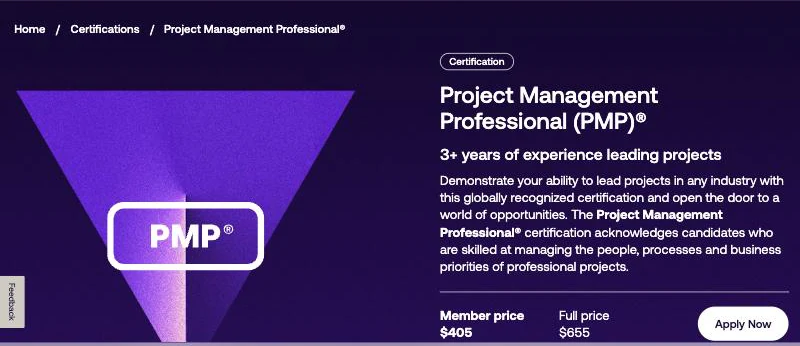
PMI's PMP page viewed from Korea. Right under the title: "3+ years of experience leading projects."
If you're not a PM, the word to notice is "leading." What PMI looks for in your experience entries is how you led the project. For each project, you describe its aim, the dates, how you led, whom you worked with, which activities you directed, and the outcome. Routine operational work and administrative tasks don't count, and overlapping months count only once.
So even if your title isn't PM, it's worth looking into if you can clearly explain what you led on a project. I go into how to write your experience in Part 4.
2. Not enough experience yet? Look at the CAPM
You don't have to just wait until you have enough experience. The CAPM, PMI's entry-level certification, requires no work experience at all. You need a secondary school diploma, 23 hours of project management education, and to be at least 18. The exam has 150 questions (135 scored, 15 unscored), takes 3 hours with one break, and costs $225 for members or $300 for non-members.
The CAPM's real advantage shows up in the next step. If your CAPM is active when you later apply for the PMP, the 35-hour training requirement is waived. What you study now becomes the next rung of the ladder. I compare the PMP, CAPM and PMI-ACP side by side in Part 10.
3. No exam plans? Start with PMBOKPMBOKProject Management Body of Knowledge: A collection of processes, best practices, terminologies, and guidelines compiled by the PMI.Read More → 8's principles
Even if you have no intention of taking an exam, there's something worth reading: the six principles of the PMBOKPMBOKProject Management Body of Knowledge: A collection of processes, best practices, terminologies, and guidelines compiled by the PMI.Read More → Guide 8th edition, published in November 2025.
- Holistic view
- Focus on value
- Embed quality
- Accountable leadership
- Integrate sustainability
- Empowered culture
They're just six lines, but a developer or a designer can map each one onto their own work right away. PMI members can download the 8th edition PDF for free. I covered how it differs from the 7th edition in Part 5.
There's also something you can try today. Before your next meeting, write the five questions from the top of this post at the top of your notes: scope, stakeholders, risk, change, value. Bring up just one of them in the meeting, and the conversation will start to feel different.
Wrapping up
The PMP is a certification for project managers, but the PM's lens can belong to anyone. In fact, the difference is bigger when someone who isn't a PM picks it up. I felt that every time my title changed.
Next up is the most practical question of all: does the PMP actually help with salary and hiring? I went through PMI's salary survey and real Korean job postings to find out.
Next: Is the PMP Worth It? An Honest Look at Work, Salary and Hiring
Frequently asked questions
Can you get the PMP if you are not a project manager?
The requirements are set in months of experience by education level plus training hours, and what matters is experience leading projects. Under the 2026 rules, with a bachelor's degree you need at least 36 months of project-leading experience within the last 10 years, plus 35 hours of project management training. Routine operational work and administrative tasks do not count as experience.
Is the PMP really useful for developers?
I think it can make an even bigger difference for developers than for PMs. A developer who raises a scope change as a change request, with the impact and the options attached, instead of silently absorbing it, is speaking the language decision-makers use. You can use that mindset right away, with or without the certificate.
Should I start with the CAPM if I lack experience?
If you do not have enough project-leading experience yet, it is a good choice. The CAPM requires no work experience: a secondary school diploma, 23 hours of project management education, and being at least 18. If your CAPM is active when you later apply for the PMP, the 35-hour training requirement is waived.
Where can I read the PMBOKPMBOKProject Management Body of Knowledge: A collection of processes, best practices, terminologies, and guidelines compiled by the PMI.Read More → Guide 8th edition?
The PMBOKPMBOKProject Management Body of Knowledge: A collection of processes, best practices, terminologies, and guidelines compiled by the PMI.Read More → Guide 8th edition came out in November 2025, and PMI members can download the PDF for free. It has six principles (holistic view, focus on value, embed quality, accountable leadership, integrate sustainability and empowered culture) and seven performance domains.
Sources
Is the PMP Worth It? An Honest Look at Work, Salary and Hiring
Part 14 / 15Revision History
First version: why the PMP mindset matters even more for non-PMs
- •Role-by-role examples for developers, designers, marketers and ops
- •2026 eligibility, the CAPM route and PMBOK 8 principles
Knowledge Relationships
- ContinuesWhat Changed at Work After the PMP: Not My Title, but How I Talk
- ContinuesIs the PMP Worth It? An Honest Look at Work, Salary and Hiring
- ExpandsWhat Changed at Work After the PMP: Not My Title, but How I Talk
- ExpandsPMP vs CAPM vs PMI-ACP: Which One Fits You? (2026 Comparison)
- ExpandsWriting Up Your PMP Experience and Handling an Audit: Applied June 1, Approved June 9
Referenced By
These articles mention this article
- After the PMP: I Started Volunteering on the PMI Korea Chapter's Education Committee
- Is the PMP Worth It? An Honest Look at Work, Salary and Hiring
- What Changed at Work After the PMP: Not My Title, but How I Talk
- PMP vs CAPM vs PMI-ACP: Which One Fits You? (2026 Comparison)
- PMP Pass Review Part 1: 7 Weeks of Prep, Study Hall Scores in the 60s, and a PASS
Idea Evolution
Ask DailySay
Related Posts

Continue Reading
Is the PMP Worth It? An Honest Look at Work, Salary and Hiring
What the PMP does at work, PMI's 17% median salary gap, the missing Korea data, real Korean job postings and the actual costs, three months after passing.
Notes worth keeping.
Occasional updates about project management, AI, products, travel, and the things I’m building.
No spam — occasional notes only. See our Privacy.